Sequence of Returns Risk Explained: How to Survive a Market Crash
Getting sequence of returns risk explained is the single most important financial step you can take before leaving your job. When planning for retirement, financial calculators often lull you into a false sense of security. You plug in a 7% or 8% “average annual return,” the chart goes up in a beautiful, smooth line, and it tells you that you will have millions of dollars by the time you are 60.
But the stock market does not deliver smooth, average returns. It delivers chaotic swings—up 20% one year, down 15% the next.
While you are working and saving, this volatility doesn’t matter. But the absolute second you stop working and start withdrawing money to pay your bills, volatility becomes the greatest threat to your financial survival.
If the market crashes during the first few years of your retirement, pulling cash out of a shrinking portfolio can trigger a mathematical “death spiral” that you can never recover from. To ensure you never outlive your money, you must build a defense against bad timing. Here is sequence of returns risk explained in plain English, along with the exact strategies to bulletproof your portfolio.
Phase 1: The Math Behind the Risk
To truly understand having sequence of returns risk explained, you have to recognize how “average returns” lie to you.
Imagine two investors, Investor A and Investor B. Both retire with $1,000,000. Both withdraw $50,000 a year. Over a 10-year period, both experience the exact same average market return of 5%.
However, they experience the returns in a completely different sequence.
The Sequence Matrix
How timing dictates your financial survival.
Investor A: The Lucky Start
- The Sequence: Gets high returns (+15%, +10%) in the first few years of retirement, and negative returns much later.
- The Math: When they withdraw $50,000 in Year 1, the market growth easily replaces the withdrawn cash. The principal balance actually grows.
- The Result: After 10 years, their portfolio is worth more than what they started with, despite withdrawing $500,000.
Investor B: The Danger Zone
- The Sequence: Gets negative returns (-15%, -10%) in the first few years, and high returns later.
- The Math: The market drops their balance to $850,000. They then withdraw $50,000, bringing it down to $800,000. They sold shares at rock-bottom prices.
- The Result: When the bull market finally arrives in Year 5, they have drastically fewer shares left to capture the growth. Their portfolio is permanently crippled.
Your Ecosystem Tool: Want to see if your current savings rate can survive a bad market sequence? Run your numbers through the Retirement Readiness Planner & Retirement Income Analyzer to stress-test your portfolio.
Phase 2: The “Fragile Decade”
This mathematical danger does not last forever. This is why having sequence of returns risk explained focuses heavily on what financial planners call the “Fragile Decade”—the five years immediately before you retire, and the first five years after.
If you make it through the first five to seven years of retirement without a major stock market crash, your portfolio has likely compounded enough that you are mathematically safe for the rest of your life.
However, if a recession hits on your retirement date, you are in the maximum danger zone. You no longer have a salary to rely on, you can no longer buy stocks while they are cheap, and every dollar you withdraw acts as a permanent drain on your wealth.
Real-World Scenario: The Freelancer’s Transition
When you get sequence of returns risk explained, you realize that traditional corporate employees aren’t the only ones who need a defense plan. Business owners face this exact same threat when they decide to step away.
Consider a freelance video editor who has spent years scaling their social media content business. They’ve built a substantial investment portfolio to support their eventual transition away from heavy client work. If they decide to permanently turn down editing contracts and live entirely off their investments, they enter the Fragile Decade.
If a severe global recession hits the very next month, their stock portfolio could instantly drop by 20%. If they proceed to sell their depressed index funds just to pay for groceries and apartment maintenance fees, they are locking in those losses permanently.
To survive this, a smart freelancer utilizes a “cash buffer.” Because they knew they were stepping back from the business, they kept two years’ worth of living expenses in a High-Yield Savings Account. When the recession hits, they completely stop selling their stocks. They pay for their lifestyle using their cash reserves, giving the stock market 24 months to bounce back before they touch their investments again.
(To map out exactly how much cash you need to bridge this gap, read Emergency Fund Size After You Retire).
Phase 3: 3 Strategies to Eliminate the Risk
You cannot control the stock market, but you can control where your monthly paycheck comes from. Here are three proven methods to neutralize the threat now that you have had sequence of returns risk explained:
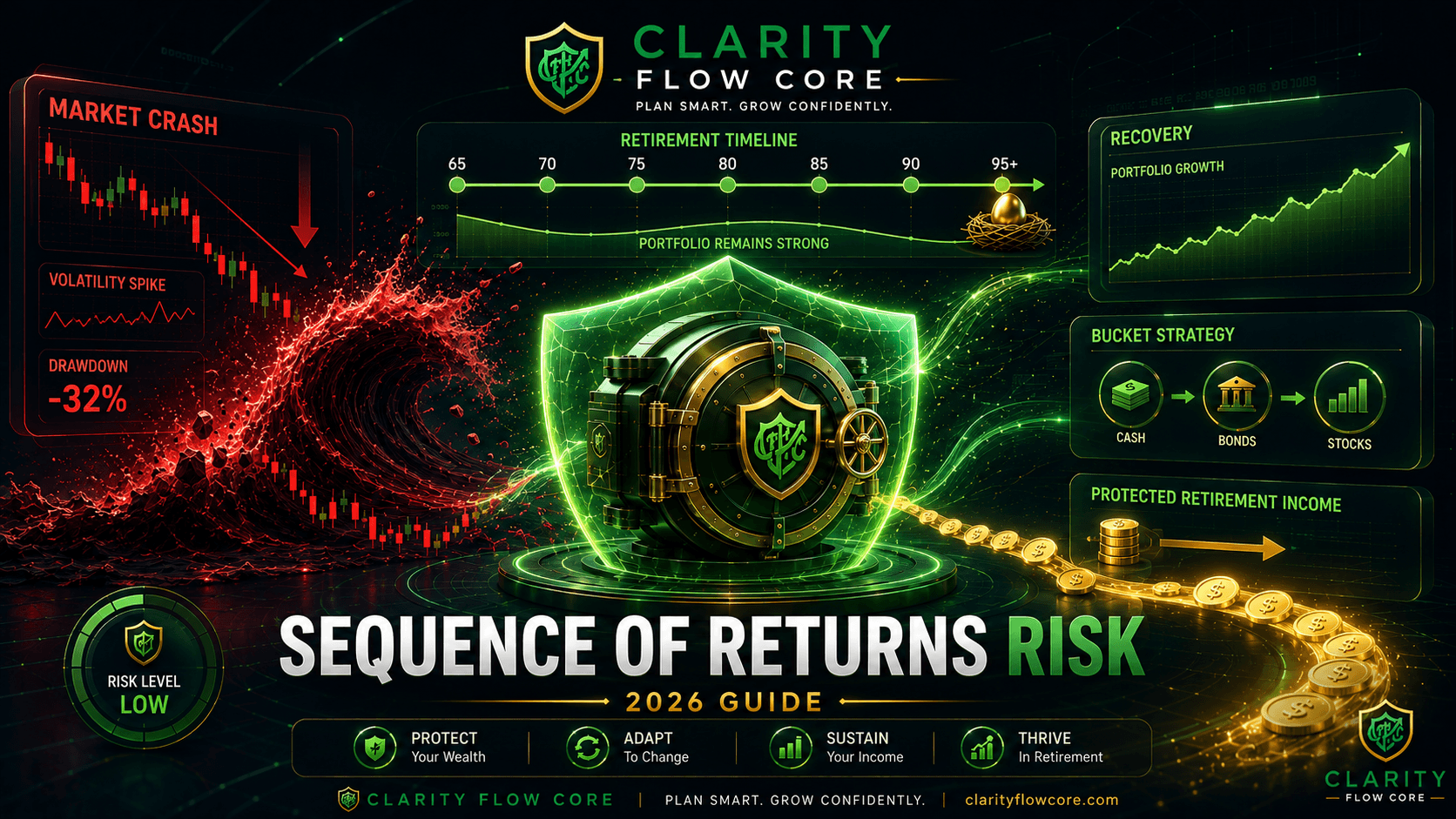
- The Bucket Strategy: Divide your money into three buckets. Bucket 1 holds cash and CDs for the next 1–3 years of expenses. Bucket 2 holds stable bonds for years 4–10. Bucket 3 holds growth stocks for years 11+. When stocks crash, you live exclusively out of the cash and bond buckets, giving Bucket 3 time to recover without being touched.
- Dynamic Guardrails: Instead of rigidly withdrawing a set dollar amount every year, you remain flexible. If the market drops 15%, you agree to cut your spending by 5% and skip your annual inflation raise. This slight reduction takes immense pressure off a shrinking portfolio. You can model this using the Retirement Withdrawal Planner & Safe Withdrawal Strategy Analyzer.
- The Bond Tent: Five years before you retire, you gradually sell some stocks and buy bonds, building a protective “tent” of stable assets. On the day you retire, your portfolio might be 60% stocks and 40% bonds. As you move safely through the Fragile Decade, you slowly spend down the bonds, allowing your portfolio to gradually drift back to a more aggressive stock allocation once the risk period has passed. (Review your current balance with Asset Allocation Strategies for Beginners: The 2026 Guide).
4 Deadliest Mistakes to Avoid
Now that you have had sequence of returns risk explained, avoid these four wealth-destroying traps:
- ❌ Staying 100% in stocks on retirement day: Equities are required for long-term growth, but holding 100% stocks on the day you stop working leaves you with zero shock absorbers. You must have cash and fixed income to draw from.
- ❌ Panic selling at the bottom: Selling your investments after the market drops 20% to “prevent further losses” is financial suicide. You are converting temporary paper losses into permanent, unrecoverable cash losses.
- ❌ Having inflexible fixed expenses: If 90% of your retirement budget is locked into massive mortgage payments and expensive car loans, you cannot use Dynamic Guardrails. Keep your fixed overhead low so you have the freedom to cut back during a recession. (Check your cash flow with the Smart Budget Planner & Cash Flow Analyzer).
- ❌ Relying solely on “Average Return” calculators: Never assume the market will deliver a smooth 7% every year. Always plan for the worst-case scenario occurring in Year 1.
Frequently Asked Questions
Once you have sequence of returns risk explained, does it matter while I am still working? No. While you are in the “accumulation phase” and actively adding money to your accounts from your salary, a market crash is actually beneficial. It allows you to buy shares at a steep discount. The risk only begins when you start withdrawing.
What happens if I experience a massive bull market right after I retire? You experience the opposite effect: Sequence of Returns Reward. If the market surges 20% in your first year, your portfolio grows so fast that it practically guarantees you will never run out of money, even if severe crashes happen a decade later.
How much cash should I hold to protect myself? Most financial planners recommend keeping a minimum of 12 to 24 months of required living expenses in liquid cash or short-term equivalents (like Treasury Bills or a HYSA) to safely ride out an average bear market.
Your Action Plan
Do not let the fear of bad timing force you to work longer than necessary. Now that you have sequence of returns risk explained, execute these three steps today:
- Calculate Your Fragile Decade: Determine the exact year you plan to stop working. The five years before and after that date are your maximum risk zone. Mark this window on your long-term calendar.
- Audit Your Asset Allocation: Log into your investment accounts. If you are within 5 years of retirement, ensure you are slowly shifting a percentage of your highly volatile stocks into stabilizing bonds and cash.
- Build Your Cash Buffer: Start funneling money into a dedicated High-Yield Savings Account until you have 1 to 3 years of baseline living expenses saved. This is the exact bucket of money you will use if the market crashes on your first day of freedom.
Sources & Further Reading
Official U.S. Guidelines & Consumer Resources
- Securities and Exchange Commission (SEC): Planning for Retirement
- Financial Industry Regulatory Authority (FINRA): Managing Retirement Income
Further Reading from Clarity Flow Core
- Retirement Readiness Planner & Retirement Income Analyzer
- Retirement Withdrawal Planner & Safe Withdrawal Strategy Analyzer
- Emergency Fund Size After You Retire
- Asset Allocation Strategies for Beginners: The 2026 Guide
- Smart Budget Planner & Cash Flow Analyzer
Disclaimer: The information provided in this article is for educational and informational purposes only and does not constitute financial, legal, or tax advice. Sequence of returns risk is a complex financial concept, and mitigating strategies do not guarantee that a portfolio will not suffer losses. Investing involves risk, including the possible loss of principal. Always consult with a certified financial planner or registered investment advisor before executing a withdrawal strategy or adjusting your asset allocation.
About Author

Rishabh Nigam
Rishabh Nigam founded Clarity Flow Core to make personal finance easier to understand for everyday readers. He covers credit scores, debt repayment, credit utilization, loan readiness, taxes, and financial planning through practical guides, calculators, and educational resources. His content focuses on turning complex financial concepts into clear, actionable steps that readers can apply in real life.