
How Much Money Should You Keep in Your Emergency Fund After You Retire?
For your entire working life, the golden rule of personal finance has been simple: keep 3 to 6 months of living expenses in cash. But the day you officially stop working, the financial rules completely rewrite themselves.
Transitioning from the “accumulation phase” (building wealth) to the “decumulation phase” (spending wealth) is psychologically terrifying. You no longer have a bi-weekly paycheck to bail you out of a financial disaster. Because of this, one of the most critical questions you will ever answer is: how much money should you keep in your emergency fund after you retire?
If you keep too little, a stock market crash could force you to sell your investments at a massive loss just to buy groceries. If you keep too much, inflation will silently eat away at your purchasing power, leaving you broke in your eighties.
To find the perfect balance, you must abandon the standard 3-to-6-month rule. If you are asking how much money should you keep in your emergency fund after you retire, here is the definitive, step-by-step mathematical framework to protect your nest egg.
Phase 1: The “Sequence of Returns” Threat
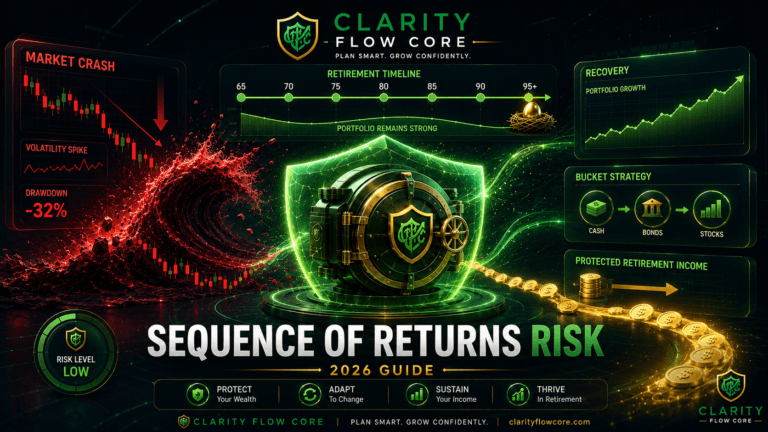
To understand exactly how much money should you keep in your emergency fund after you retire, you first have to understand your biggest enemy: Sequence of Returns Risk.
When you are 30 years old, a 20% stock market crash is actually a good thing—it allows you to buy stocks on sale. But when you are 65 and relying on your portfolio to pay your mortgage, a 20% crash is devastating. If the market crashes and you are forced to sell your stocks at the absolute bottom just to pay for your daily living expenses, those shares can never recover. Your portfolio will bleed out, and you risk outliving your money.
The entire purpose of a retirement emergency fund is to act as a “Cash Buffer.”
When the market crashes, you stop selling your stocks and live off your cash buffer instead. You wait 12 to 24 months for the stock market to recover, and then you resume selling stocks.
Phase 2: The Retirement Bucket Strategy
Because of this market risk, financial planners generally agree that the answer to how much money should you keep in your emergency fund after you retire is 1 to 3 years of living expenses.
However, you don’t just dump three years of cash into a checking account. You organize it using the “Bucket Strategy.”
The Retirement Bucket Strategy
How to organize your assets to survive a stock market crash.
Bucket 1: Liquid Cash
- Timeline: Year 1 to Year 2.
- Where it lives: High-Yield Savings Accounts (HYSA) or Money Market Funds.
- The Goal: Immediate liquidity. This is your true “emergency fund” that you draw from to pay daily bills if the market drops.
Bucket 2: Fixed Income
- Timeline: Year 3 to Year 7.
- Where it lives: Treasury Bills, CDs, and High-Quality Bonds.
- The Goal: Outpace basic inflation with minimal risk. If Bucket 1 runs out, you sell these assets to refill it.
Bucket 3: Growth
- Timeline: Year 8+.
- Where it lives: S&P 500 Index Funds, Real Estate, Equities.
- The Goal: Long-term wealth growth to ensure you don’t run out of money in your 90s. Highly volatile, but you don’t need this money today.
Your Ecosystem Tool: Not sure what your baseline living expenses will actually be without a commute? Run your projected post-work numbers through the Smart Budget Planner & Cash Flow Analyzer to find your monthly burn rate.
Real-World Scenario: The Retiring Freelancer
When calculating how much money should you keep in your emergency fund after you retire, you must subtract your guaranteed income streams.
Consider an independent freelance video editor who decides to semi-retire at age 65. For years, they operated a highly volatile business, keeping a massive 9-month cash emergency fund. Now, they are scaling back to only take on a few passion projects a year.
They calculate their total baseline living expenses at $4,000 a month. However, they are now receiving $2,500 a month in guaranteed Social Security benefits. This means their portfolio only has to cover the remaining $1,500 a month gap.
If they want a 2-year cash buffer, they do not need to save $96,000 in cash ($4,000 x 24 months). They only need to save $36,000 in cash ($1,500 x 24 months).
By factoring in their Social Security, they avoid hoarding too much liquid cash. They can keep the rest of their money invested in broad-market ETFs, allowing their wealth to continue compounding.
(If you are self-employed and approaching your transition years, ensuring your retirement accounts are properly funded is vital. Review our Freelance Video Editor Tax Guide to maximize your SEP IRA or Solo 401(k) contributions before stepping away).
4 Deadliest Retirement Cash Mistakes
Even if you know exactly how much money should you keep in your emergency fund after you retire, many retirees fall into these psychological traps:
❌ Hoarding 100% in Cash: Out of fear of the stock market, some retirees pull their entire $500,000 nest egg into a checking account. This is incredibly dangerous. The Securities and Exchange Commission (SEC) warns that inflation will silently destroy the purchasing power of that cash over a 20-year retirement.
❌ Ignoring Healthcare Shocks: Medicare does not cover everything. A sudden need for long-term care or an extended hospital stay can vaporize a standard emergency fund. Your cash buffer must account for potential medical deductibles.
❌ Failing to Refill the Bucket: When the stock market is hitting all-time highs, you must sell off some of your winning stocks to replenish your cash Bucket 1. Do not get greedy and leave all your money in stocks right before a crash.
❌ Using the Fund for Family “Emergencies”: In retirement, your emergency fund is for your survival, not for bailing out an adult child’s credit card debt or funding a grandchild’s wedding. Once you stop working, you cannot easily replace that money.
Frequently Asked Questions
Does the amount of how much money should you keep in your emergency fund after you retire change over time? Yes. As you progress into your late 70s and 80s, you may shift to a more conservative stance, keeping closer to 3 years of living expenses in liquid cash or bonds, as your ability to wait out a 10-year stock market recovery diminishes.
Should I keep my emergency fund in the same account as my daily spending? No. Your 1-to-3 year cash buffer should be kept in a separate, dedicated High-Yield Savings Account (HYSA) or a low-risk Money Market Fund. It needs to earn interest while remaining easily accessible, but it should not be mixed with the checking account you use to buy groceries.
What if I receive a pension? If you are lucky enough to have a guaranteed pension that covers 100% of your living expenses, your need for a massive cash buffer drops significantly. In that scenario, a standard 3-to-6 month fund for unexpected home repairs or medical deductibles is completely sufficient.
Your Action Plan
Do not let a sudden market downturn ruin the retirement you spent 40 years building. Answer the question of how much money should you keep in your emergency fund after you retire today by taking these three steps:
- Calculate the “Gap”: Add up your absolute necessary monthly expenses (housing, food, utilities, medical). Subtract your guaranteed fixed income (Social Security, pensions, annuities). The remaining number is your “Gap.”
- Multiply by 24: Multiply your monthly Gap by 24. This is the exact dollar amount you need to establish a 2-year cash safety net in Bucket 1.
- Optimize the Yield: Ensure that 2-year cash pile is not sitting in a traditional bank earning 0.01%. Move it to a secure, FDIC-insured High-Yield Savings Account or an easily liquid Treasury Bill ladder. (Check the FDIC website to ensure your bank is fully insured).
Retirement should be a time of peace, not financial anxiety. By building a strategic cash buffer, you guarantee that no matter what the stock market does tomorrow, your bills are already paid for the next two years.
Sources & Further Reading
Official U.S. Guidelines & Consumer Resources
- Securities and Exchange Commission (SEC): Investor.gov – Asset Allocation & Risk
- Consumer Financial Protection Bureau (CFPB): Planning for Retirement
- Social Security Administration (SSA): Retirement Estimator
Further Reading from Clarity Flow Core
- Smart Budget Planner & Cash Flow Analyzer
- ETF vs Mutual Fund vs Index Fund: Which to Choose?
- How to Audit Your Budget for Lifestyle Creep
- Traditional IRA vs Roth IRA: Which Is Better for Beginners?
Disclaimer: The information provided in this article is for educational and informational purposes only and does not constitute financial, investment, or tax advice. Retirement planning, sequence of returns risk, and asset allocation vary significantly based on individual circumstances. Always consult with a certified financial planner (CFP®) or fiduciary advisor before making major changes to your retirement portfolio.
About Author

Rishabh Nigam
Rishabh Nigam founded Clarity Flow Core to make personal finance easier to understand for everyday readers. He covers credit scores, debt repayment, credit utilization, loan readiness, taxes, and financial planning through practical guides, calculators, and educational resources. His content focuses on turning complex financial concepts into clear, actionable steps that readers can apply in real life.