
Credit Utilization Calculator: How to Lower High Credit Utilization
Use the calculator below to calculate your current credit utilization, compare different balance and credit-limit scenarios, and plan how you could lower high utilization over time.
What Is Credit Utilization?
Credit utilization generally describes how much of your available revolving credit you are using.
The basic calculation is:
Credit Utilization = Revolving Credit Balance ÷ Revolving Credit Limit × 100
For example, if your credit-card balance is $400 and your credit limit is $1,000:
$400 ÷ $1,000 × 100 = 40% utilization
You can calculate utilization for an individual credit card as well as across multiple revolving accounts.
FICO identifies revolving utilization as an important factor within its Amounts Owed category. FICO also considers other information within that category, including total balances, the number of accounts with balances, and amounts owed on individual accounts.
What This Credit Utilization Calculator Helps You Understand
This credit utilization calculator can help you:
- calculate your overall revolving utilization
- calculate utilization for individual cards
- compare your current balances with lower-balance scenarios
- see how a change in your credit limit could affect the utilization percentage
- identify which card has the highest utilization
- estimate how much you would need to pay down to reach a selected utilization target
- build a practical balance-reduction strategy
The calculator focuses on the math of utilization.
It does not predict the exact number of FICO points you will gain or determine how a particular lender will evaluate your application.
Why High Credit Utilization Can Affect Your Credit Score
A high revolving utilization ratio can indicate that you are using a large portion of your available credit.
FICO states that using a high percentage of available revolving credit can negatively affect FICO Scores, while lower utilization can generally be more favorable.
That doesn’t mean that having a balance automatically makes you a high-risk borrower.
Credit scores consider the information on your overall credit profile, including payment history, amounts owed, length of credit history, new credit, and credit mix. The relative importance of those categories can also vary by individual.
So high utilization is one factor, not a complete explanation for every credit-score change.
Overall Utilization vs. Individual Card Utilization
It’s useful to understand both.
Overall Utilization
This compares all of your revolving balances with all of your available revolving limits.
For example:
- Card 1: $1,000 balance / $5,000 limit
- Card 2: $500 balance / $5,000 limit
Total balances:
$1,500
Total limits:
$10,000
Overall utilization:
15%
Individual Card Utilization
Card 1 has:
$1,000 ÷ $5,000 = 20%
Card 2 has:
$500 ÷ $5,000 = 10%
Credit-scoring models can consider utilization at both the overall and individual-account level. FICO specifically notes that the highest utilization rates on individual revolving accounts can be relevant to scoring.
For that reason, simply looking at your total utilization may not tell the entire story.
Does 30% Credit Utilization Mean You Have Good Credit?
Not necessarily.
The 30% rule is a common guideline, but it isn’t a hard scoring cutoff.
FICO’s own educational material says that there is no universal utilization percentage that produces the maximum score, although lower utilization is generally better.
So don’t think of credit utilization like this:
29% = good
30% = bad
31% = bad
Credit scoring does not work according to a simple universal threshold.
Instead, treat 30% as a planning benchmark, not a magic number.
For a deeper explanation, read The 30% Credit Utilization Myth: What Actually Matters?
Is Lower Credit Utilization Always Better?
Generally, lower revolving utilization can be favorable for FICO Scores, but that doesn’t mean you need to keep every card at exactly 0%.
FICO’s educational materials note that a low utilization ratio can sometimes be more favorable than having no revolving utilization information at all.
More importantly, you do not need to carry a balance and pay interest simply to build credit.
You can use a credit card, have a small reported balance, and pay the statement balance in full when your card’s grace-period terms allow you to avoid purchase interest.
For more information, read How to Build a Strong Credit Profile Without Paying a Dime in Interest.
Why Your Credit Score Can Drop Even When You Pay in Full
This is one of the most confusing parts of credit utilization.
Suppose:
- Credit limit: $2,000
- Current card balance during the month: $1,500
- Payment made before the due date: $1,500
You may still see a balance reported to a credit bureau before your payment is made.
FICO explains that the balance appearing on a credit report may reflect the balance reported by the lender, often based on the latest monthly statement, rather than the current real-time balance shown in your banking app.
That means someone can:
use a large portion of their credit → receive a high reported balance → pay the card in full → avoid interest
and still temporarily have a higher reported utilization ratio.
Paying in full is still an important financial habit.
The issue is simply that credit reporting and payment due dates are not necessarily the same event.
When Do Credit Card Balances Get Reported?
There is no universal reporting date that applies to every credit-card issuer.
Creditors can report information to the credit bureaus on their own schedules.
FICO notes that the balance appearing on your credit report can differ from your current account balance and may commonly reflect a recently reported statement balance.
Because reporting practices vary, don’t assume:
“The credit card company always reports exactly on my statement date.”
Instead, check your own account and credit-report information to understand how your issuer reports.
How to Lower High Credit Utilization
If your utilization is high, there are several possible approaches.
1. Pay Down Your Revolving Balances
The most direct way to reduce utilization is to reduce your reported revolving balances.
For example:
$4,000 balance ÷ $8,000 limit = 50% utilization
Reducing the balance to $2,000 would result in:
$2,000 ÷ $8,000 = 25% utilization
The exact amount you should pay depends on your financial situation.
Do not drain your emergency savings or miss other required payments simply to pursue a particular utilization percentage.
Use the calculator above to model different payoff amounts.
2. Consider Paying Before a Balance Is Reported
If you regularly make large purchases and then pay the full statement balance later, an earlier payment may reduce the balance that gets reported.
The exact timing depends on your issuer’s reporting practices.
Instead of assuming there is a universal “two days before statement closing” rule, check how your card reports balances and use the information shown in your account and credit reports.
The goal is not to pay early because early payment is automatically better.
The goal is simply to understand which balance may be reported.
3. Consider a Credit-Limit Increase Carefully
A higher credit limit can reduce utilization if your balance stays the same.
For example:
$2,000 balance ÷ $4,000 limit = 50%
If the limit increases to $8,000 while the balance remains $2,000:
$2,000 ÷ $8,000 = 25%
The utilization percentage has fallen without the balance changing.
However, requesting a higher limit can involve a credit inquiry depending on the issuer’s policies, and a higher limit can create additional temptation to spend.
Before requesting an increase, check the issuer’s terms.
For a detailed guide, read How to Increase Your Credit Limit Without Hurting Your Credit Score.
4. Avoid Closing a Credit Card Solely to Get Rid of It
Closing a credit card can reduce the amount of available revolving credit associated with your active accounts.
For example, if you have:
$2,000 balance / $10,000 total limits = 20%
and close a card that removes $5,000 of available credit:
$2,000 ÷ $5,000 = 40%
Your overall utilization could rise even though your spending did not change.
However, this doesn’t mean that every credit card should remain open indefinitely.
An annual fee, security concern, poor product fit, or other legitimate reason may make closing an account appropriate.
Make the decision based on your complete financial situation.
Should You Keep Every Credit Card Open?
No universal rule says that you should keep every credit card open.
An old account with no annual fee can provide available credit and may contribute useful account history.
But keeping an account open can also be inconvenient or undesirable in some circumstances.
Consider:
- annual fees
- account security
- whether you actually use the card
- available credit
- impact on your utilization
- whether the issuer offers an alternative product
- your broader financial goals
Don’t keep an expensive or unsuitable card open simply because you’re worried about a small potential score change.
What If One Credit Card Is Maxed Out?
A single heavily utilized card can matter even if your overall utilization is relatively low.
For example:
Card A: $2,500 balance / $10,000 limit
Card B: $0 / $10,000
Overall utilization:
12.5%
But Card A individually has:
25% utilization
Now imagine Card A has a $2,900 balance on its $3,000 limit.
Overall utilization could still be relatively modest across all your cards, while the individual account would be close to maxed out.
FICO states that scoring can consider the highest utilization rates on individual revolving accounts as well as overall utilization.
If one account is carrying a particularly high balance, the individual account calculation may therefore deserve attention.
Should I Pay Down the Card With the Highest Utilization or Highest Interest Rate?
Those goals can point to different cards.
Suppose you have:
Card A: 80% utilization, 15% APR
Card B: 40% utilization, 29% APR
If your immediate goal is lowering utilization, Card A may have the larger percentage problem.
If your goal is minimizing interest costs, Card B may deserve priority because it carries the higher APR.
There’s no universal answer.
Consider both:
credit-score impact
and
borrowing cost
before choosing your repayment strategy.
For a broader debt-payoff comparison, use our Debt Payoff Calculator & Strategy Planner.
You can also read Debt Avalanche vs. Debt Snowball: Which Debt Payoff Method Works Better?.
Can a New Credit Card Lower My Utilization?
Mathematically, adding available revolving credit can lower your overall utilization if your existing balances remain unchanged.
For example:
$5,000 total balances ÷ $10,000 total limits = 50%
Adding a new card with a $5,000 limit would change the calculation to:
$5,000 ÷ $15,000 = 33.3%
However, opening a new credit account can also create a hard inquiry, change your average account age, and add another account to manage.
FICO considers new credit as one category in its scoring framework, and multiple new accounts in a short period can represent greater risk, particularly for people with limited credit histories.
So don’t open a new card solely because the additional credit limit looks attractive on paper.
Should You Use a Balance Transfer to Lower Utilization?
A balance transfer can change where your debt sits and potentially reduce the interest cost during a promotional period.
However, it does not automatically eliminate your debt.
Before using a balance transfer, compare:
- promotional APR
- length of promotional period
- balance-transfer fee
- regular APR after the promotion
- credit-limit impact
- minimum payment
- your ability to repay the balance before the promotion ends
The effect on utilization will also depend on the limits and balances involved.
For more information, read 0% APR Balance Transfers: How They Actually Work.
Can I Build Credit While Paying Off High Utilization?
Yes.
You don’t need to wait until your balances reach a particular percentage before you can establish better credit habits.
Focus on:
- making required payments on time
- reducing revolving balances when financially possible
- avoiding unnecessary new applications
- monitoring your credit reports
- maintaining a sustainable budget
Credit utilization can change relatively quickly as reported balances change, while other aspects of your credit history take much longer to develop.
For beginners, read How to Build Credit From Scratch in 2026.
Credit Utilization and Your Emergency Fund
One common mistake is using every available dollar of cash to reduce a credit-card balance simply to improve utilization.
Reducing revolving debt can be financially beneficial, particularly when the balance carries a high interest rate.
But completely eliminating your cash reserves can leave you vulnerable to an unexpected expense.
Before making an aggressive payment, consider whether you have enough accessible emergency savings.
Use the Emergency Fund Calculator to estimate an emergency-savings target.
The best decision can involve balancing:
debt reduction
with
cash reserves
rather than maximizing one metric at the expense of the other.
How Credit Utilization Fits Into Your Overall Credit Score
Credit utilization is important, but it isn’t the entire scoring system.
FICO’s commonly published framework groups information into five broad categories:
| Category | Commonly Published Weight |
|---|---|
| Payment History | 35% |
| Amounts Owed | 30% |
| Length of Credit History | 15% |
| New Credit | 10% |
| Credit Mix | 10% |
FICO explains that these percentages represent the relative importance of the categories in typical base FICO scores, and their importance can vary by individual profile.
Credit utilization is an important component of the Amounts Owed category; it is not a standalone 30% category.
That distinction matters.
For another perspective, read Credit Utilization vs Payment History: Which Matters More?.
Credit Utilization vs. Payment History
If you have to choose between:
making the required payment on time
and
optimizing your utilization percentage
the required payment should not be sacrificed.
Payment history is the largest category in the commonly published FICO framework, accounting for 35% of a typical FICO score.
A high utilization ratio may hurt your score, but missing required payments can create a much more serious credit problem.
Your priority should therefore be maintaining required payments while working on utilization and other areas of your profile.
What Is the Fastest Way to Lower Credit Utilization?
There isn’t one universally fastest strategy.
The mathematical options are:
reduce balances
or
increase available credit
The practical decision depends on your circumstances.
If you have cash available without compromising emergency savings, paying down a revolving balance can directly reduce utilization.
If your issuer offers a credit-limit increase without a hard inquiry, that may lower the ratio without requiring an immediate payment.
However, a higher credit limit is only useful for utilization if your spending doesn’t rise with it.
Use the credit utilization calculator above to compare the scenarios before deciding.
How to Use This Credit Utilization Calculator
For the most useful result:
Enter Current Balances and Limits
Use the most recent information available from your credit-card statements or credit accounts.
Calculate Both Individual and Overall Utilization
A single highly utilized card can tell a different story from your overall utilization.
Test One Change at a Time
For example:
Current balance → $3,000
Scenario → $2,000
Then compare the resulting utilization.
Compare Multiple Strategies
You can model:
- paying down a balance
- paying down one specific card
- increasing a credit limit
- changing how balances are distributed
- reducing total revolving debt
Keep the Credit-Score Goal in Context
A lower utilization percentage can be useful, but don’t sacrifice emergency savings or take on unnecessary fees just to achieve a particular number.
What If My Credit Utilization Is 0%?
Zero reported revolving utilization isn’t automatically a problem.
FICO has noted that a low utilization ratio can sometimes be more favorable than having no revolving utilization information at all.
However, there is no reason to carry debt and pay interest simply to avoid reporting a zero balance.
Use your credit cards for purchases you can afford and manage them according to the card’s terms.
The goal is responsible credit management, not creating unnecessary interest charges.
What If My Utilization Is High Because of One Large Purchase?
A temporary increase in utilization doesn’t necessarily mean that your credit profile is permanently damaged.
Once updated balance information is reported, the utilization component can change again.
FICO notes that scores respond to changes in credit-report information, so high utilization doesn’t necessarily create a permanent penalty.
If the balance is temporary and you can repay it without creating other financial problems, focus on managing the balance rather than assuming your long-term credit profile is ruined.
Improve Your Credit Profile
Credit utilization is only one part of building and maintaining good credit.
Build Better Credit Habits
Read:
- How to Build Credit From Scratch in 2026
- How to Build a Strong Credit Profile Without Paying a Dime in Interest
- 10 Credit Score Mistakes That Can Cost You 100+ Points
- How Many Credit Cards Should You Have for the Best Credit Score?
Understand Credit Reports
Read:
- How to Read and Fix Errors on Your Credit Report
- How Long Do Late Payments Stay on Your Credit Report?
Manage Related Debt
Read:
- What Happens If You Only Pay the Minimum on a Credit Card?
- I Can Only Afford the Minimum Payments — Now What?
- Debt Avalanche vs. Debt Snowball: Which Debt Payoff Method Works Better?
- Debt Consolidation vs Debt Settlement: Which Actually Saves More Money?
Related Financial Tools
Credit Score Simulator & Improvement Planner
Explore hypothetical credit scenarios and compare how different actions may affect your credit profile.
Open the Credit Score Simulator
Debt-to-Income Ratio Calculator
See how your monthly debt obligations compare with your gross monthly income.
Debt Payoff Calculator & Strategy Planner
Compare debt-repayment strategies and see how different payments can affect your balances.
Open the Debt Payoff Calculator
Emergency Fund Calculator
Estimate how much emergency savings you may want to maintain based on your circumstances.
Open the Emergency Fund Calculator
Financial Health Score & Annual Checkup Planner
Review your broader financial position beyond credit utilization.
Open the Financial Health Planner
These tool URLs match the Clarity Flow Core Pages inventory you supplied.
Frequently Asked Questions
Does high credit utilization permanently damage your credit?
Not necessarily.
Credit utilization can change as the balance and available credit reported on your credit accounts change. A high reported utilization ratio can negatively affect a score, but a later lower reported ratio may change the score again.
FICO describes credit scores as responsive to changes in credit-report information.
What is the best credit utilization ratio?
There is no universal percentage that guarantees the highest score.
FICO says lower utilization is generally better, while also explaining that the impact varies by credit profile.
The commonly cited 30% figure is a guideline, not a scoring cutoff.
Is 30% credit utilization bad?
No.
Crossing 30% does not automatically cause a particular score penalty.
FICO specifically says the data does not support treating 30% as a hard threshold. Generally, lower utilization can be better.
Is 10% credit utilization better than 30%?
A lower utilization ratio can generally be more favorable, but there is no universal score increase associated with moving from 30% to 10%.
The effect depends on your full credit profile and scoring model.
Should I pay my credit card before the statement closes?
You can, particularly if you regularly have high balances during the billing cycle and want to reduce the balance that may be reported.
But there is no universal rule requiring you to pay exactly one or two days before the statement closes.
Reporting practices vary by issuer.
Does paying my credit card in full eliminate utilization?
Not necessarily.
You can pay your full statement balance by the due date and still have a balance reported to a credit bureau from an earlier reporting point.
FICO notes that the balance on the credit report may reflect the lender-reported balance rather than the current real-time account balance.
Can a credit-limit increase lower my utilization?
Yes, mathematically.
If your balance stays the same while your available credit increases, your utilization percentage decreases.
However, the credit-limit request may involve a hard inquiry depending on the issuer, and a larger limit can encourage additional spending.
Will opening a new credit card lower my utilization?
It can lower your overall utilization if the new account adds available credit and your existing balances remain unchanged.
However, a new application can also result in a hard inquiry and change other parts of your credit profile.
Don’t open an account solely to manipulate utilization without considering the other effects.
Should I carry a balance to build credit?
No.
You do not need to pay interest to build credit.
Use the card responsibly, make required payments on time, and pay the statement balance in full when financially possible and when your card’s grace-period terms allow you to avoid purchase interest.
How quickly can high credit utilization improve?
There is no guaranteed timeline.
Once updated balance information is reported to the credit bureaus, your utilization ratio can change, and your score may respond.
The timing depends on when your creditor reports updated information and when that information is incorporated into the scoring model.
Does closing a credit card increase utilization?
It can.
Closing an account can reduce the amount of available revolving credit in your profile, which may increase overall utilization if your balances remain unchanged.
However, the effect of a closed account on your credit profile is more complicated than utilization alone.
Does credit utilization affect all three credit bureaus?
Credit utilization can be reflected in the information reported to the three major credit bureaus, but the information on your individual credit reports may not always be identical or updated at exactly the same time.
Your score can therefore vary depending on which credit report and scoring model are being used.
How This Credit Utilization Calculator Works
This credit utilization calculator uses the balances and credit limits you enter to calculate utilization mathematically.
For overall utilization:
Total Revolving Balances ÷ Total Revolving Credit Limits × 100
For individual-account utilization:
Card Balance ÷ Card Credit Limit × 100
The tool may also allow you to model potential balance reductions or credit-limit changes.
The calculations describe the mathematical change in utilization.
They do not determine exactly how many points your credit score will change.
Actual credit scores depend on the scoring model and the complete information contained in the credit report. FICO specifically notes that utilization is only one component of the Amounts Owed category and that its effect can vary by individual profile.
Important Limitations
This calculator provides educational estimates based on the information you enter.
It does not:
- predict your exact future credit score
- guarantee a specific score increase
- determine how a lender will evaluate your application
- access your credit reports
- submit credit applications
- guarantee that a specific utilization percentage will produce a particular score
Your actual score can differ depending on:
- scoring model
- scoring version
- credit report
- reported balances
- payment history
- account age
- new credit
- credit mix
- other information in your credit profile
Sources & Verification
Our credit-utilization guidance draws primarily from FICO’s consumer-education resources.
FICO — What’s in My FICO Scores?
FICO explains the five broad categories used in its scoring framework and notes that their relative importance can vary by individual profile.
FICO — What’s in My FICO Scores?
FICO — How Owing Money Can Impact Your Credit Score
FICO explains the Amounts Owed category, including revolving utilization, total balances, and balances on individual accounts.
FICO — How Owing Money Can Impact Your Credit Score
FICO — What Should My Credit Utilization Ratio Be?
FICO explains that there is no universal optimal utilization percentage and that lower utilization is generally better.
FICO — What Should My Credit Utilization Ratio Be?
FICO — How Credit Limit Information Affects Your Score
FICO explains how credit limits and utilization are used within the scoring process.
FICO — How FICO Scores Look at Credit Card Limits
We review material credit-scoring guidance and calculator assumptions when updating this page.
Credit-scoring models and creditor reporting practices can change, so readers should review their current credit information and the terms provided by their card issuer.
Continue Your Credit-Building Plan
Credit utilization is only one part of a healthy credit profile.
A practical credit-building plan usually combines:
on-time payments
manageable revolving balances
careful use of new credit
accurate credit reports
sustainable debt levels
Use the Credit Score Simulator & Improvement Planner to explore potential scenarios, the Debt-to-Income Ratio Calculator to review your monthly debt obligations, and the Emergency Fund Calculator to consider your available cash reserve.
Disclaimer
The information provided by Clarity Flow Core and this Credit Utilization Calculator is for educational and informational purposes only and does not constitute financial, investment, credit, lending, tax, or legal advice. Calculator results are mathematical estimates based on user-provided information and assumptions and do not guarantee a particular credit score, credit-score increase, lender decision, loan approval, interest rate, or other financial outcome. Individual credit profiles and scoring models vary. Consider your own financial circumstances and consult a qualified professional when appropriate.
About Author

Rishabh Nigam
Rishabh Nigam founded Clarity Flow Core to make personal finance easier to understand for everyday readers. He covers credit scores, debt repayment, credit utilization, loan readiness, taxes, and financial planning through practical guides, calculators, and educational resources. His content focuses on turning complex financial concepts into clear, actionable steps that readers can apply in real life.
Credit Utilization Calculator: Lower Your Utilization
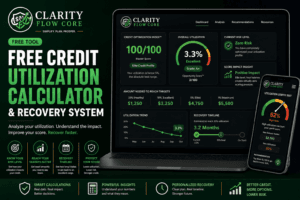
Use our credit utilization calculator to calculate your ratio, compare payoff scenarios, and plan how to lower high credit utilization.
Price Currency: USD
Operating System: Web Browser
Application Category: WebApplication