Quarterly Estimated Taxes Explained for Freelancers and Side Hustlers
When you get your first major payout from a freelance gig or side hustle, the feeling is incredible. But that excitement usually fades the moment you realize something crucial: the IRS hasn’t taken their cut yet.
If you are transitioning from a traditional W-2 job to freelance work, you are used to your employer automatically withholding income taxes and Medicare/Social Security contributions from every paycheck. As a freelancer, independent contractor, or side hustler, that responsibility falls entirely on you. You are now both the employee and the employer.
Understanding quarterly estimated taxes for freelancers is one of the most critical skills you need to build a sustainable independent income. Falling behind can lead to massive tax bills and harsh penalties come April.
In this guide, we will break down exactly how quarterly taxes work, who actually needs to pay them, how to calculate what you owe, and how to stay out of trouble with the IRS. Let’s get started.
What Are Quarterly Estimated Taxes For Freelancers?
The US tax system operates on a “pay-as-you-go” basis. This means the IRS expects to receive tax payments as you earn the income throughout the year, rather than in one giant lump sum at the end of the year.
For traditional employees, this is handled through payroll withholding. For freelancers, gig workers, and business owners, it is handled through quarterly estimated tax payments.
These payments cover two main things:
- Income Tax: Your standard federal and state income taxes based on your tax bracket.
- Self-Employment Tax: This covers your Medicare and Social Security contributions. W-2 employees split this cost with their employer, but self-employed individuals must pay the full 15.3% themselves.
Who Actually Has to Pay Them?
Not every side hustler needs to worry about quarterly payments right away. The IRS has a specific threshold.
You generally must pay estimated taxes if you expect to owe $1,000 or more in taxes for the year after subtracting your withholding and refundable credits.
If you have a W-2 day job and run a side hustle on the weekends, you might not need to pay quarterly taxes if your W-2 job withholds enough extra tax to cover your side hustle earnings. However, if your freelance work is your sole source of income, you almost certainly need to make these payments.
Example:
💡 Quick Rule of Thumb
If freelancing or self-employment is your primary income source and you expect to owe at least $1,000 in federal taxes this year, you should generally plan for quarterly estimated tax payments.
How to Calculate Your Estimated Taxes (Step-by-Step)
Figuring out exactly what you owe can feel overwhelming, especially if your income changes every month. Here is a practical way to approach it.
Step 1: Estimate Your Expected Taxable Income
Look at what you made last year or project your current earnings for the year. Remember, you are taxed on your net profit, not your gross revenue.
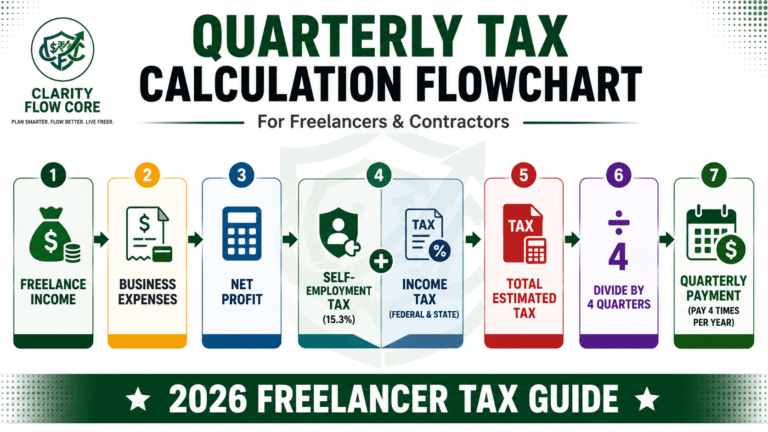
- Gross Revenue – Business Deductions = Net Profit
Step 2: Calculate Your Self-Employment Tax
Take your projected net profit and multiply it by 92.35%. Then, multiply that number by 15.3% to find your estimated self-employment tax.
Step 3: Calculate Your Income Tax
Add your net business income to any other income you have (like a spouse’s W-2 income if filing jointly). Subtract your standard or itemized deductions, and use the IRS tax brackets to estimate your income tax.
Step 4: Divide by Four
Add your expected self-employment tax and income tax together. Divide that total by four to get your quarterly payment amount.
Real-Life Example: > Meet David. He is a freelance video editor. He estimates his net profit for the year will be $40,000.
- His estimated self-employment tax is roughly $5,650.
- His estimated federal income tax (after the standard deduction) is roughly $2,800.
- Total estimated tax: $8,450.
- David’s quarterly payment to the IRS: $2,112.50.
Want a bigger-picture view of how taxes affect your financial goals?
Use our Financial Freedom Planner to estimate how much of your freelance income you can save, invest, and keep after taxes.
Financial Freedom Planner →The Safe Harbor Rule (Crucial for Beginners)
If your income is highly unpredictable, predicting your exact tax bill is nearly impossible. To avoid underpayment penalties, use the Safe Harbor Rule.
The IRS won’t penalize you if your estimated payments equal at least:
- 100% of the tax shown on your previous year’s tax return (110% if your income was over $150,000).
- 90% of the tax you will owe for the current year.
If you just pay 100% of whatever your tax bill was last year (divided into four payments), you are protected from underpayment penalties, even if you earn way more this year. You will still owe the difference in April, but you won’t be hit with fines.
Important IRS Deadlines You Can’t Miss
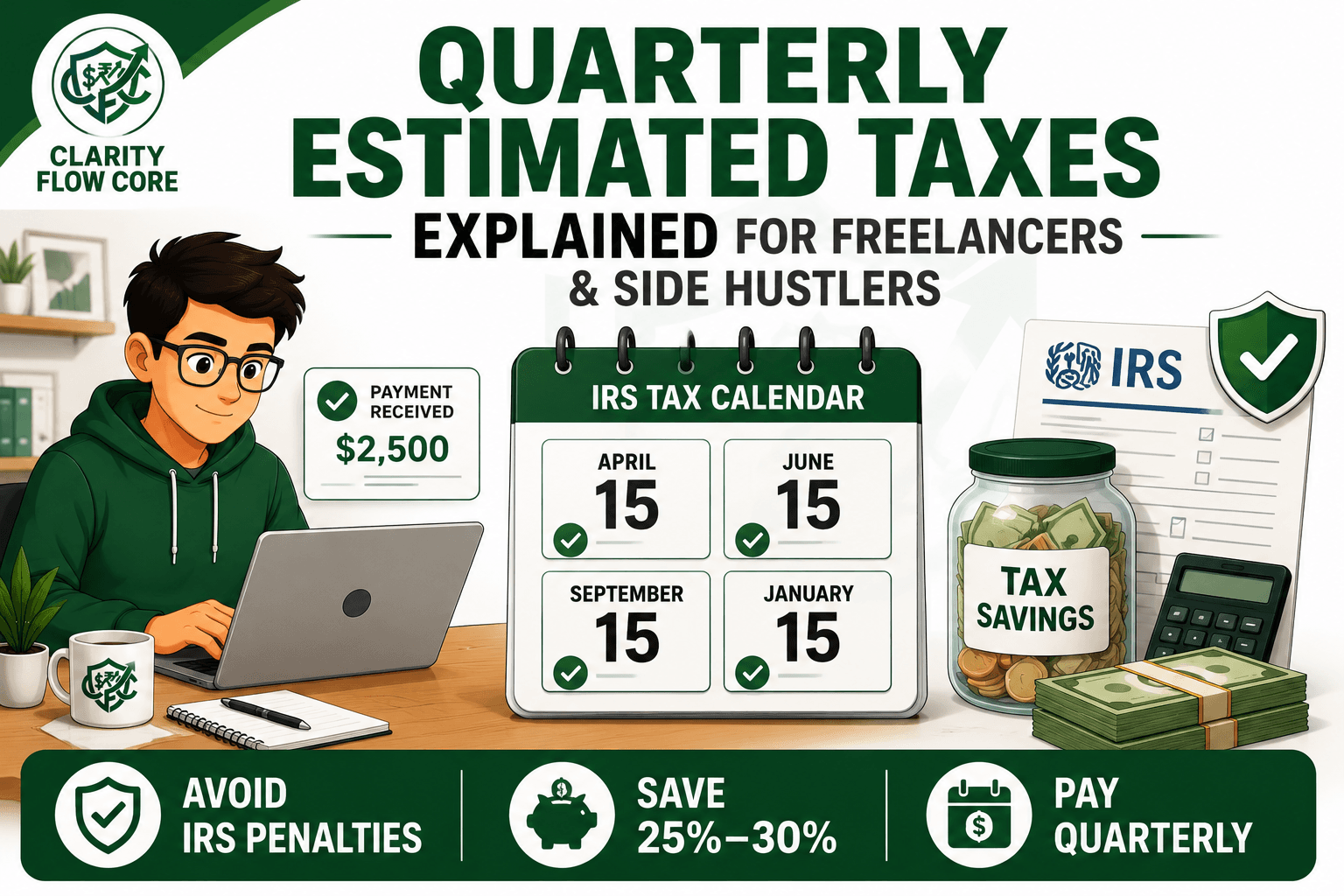
Quarterly taxes are split into four payment periods. Surprisingly, they don’t land exactly three months apart. The typical IRS deadlines are:
- 1st Quarter (Jan 1 – March 31): April 15
- 2nd Quarter (April 1 – May 31): June 15
- 3rd Quarter (June 1 – Aug 31): September 15
- 4th Quarter (Sept 1 – Dec 31): January 15 (of the following year)
If a deadline falls on a weekend or a federal holiday, the payment is due on the next business day.
⚠️ Disclaimer: State estimated tax requirements vary by state. If you live in a state that imposes income tax, you may need to make separate quarterly payments to your state tax authority in addition to your federal estimated tax payments.
How to Actually Pay the IRS
Paying the IRS is surprisingly simple. You don’t need to mail physical checks unless you really want to.
- IRS Direct Pay: This is the easiest method. You can pay directly from your checking or savings account for free on the IRS website.
- EFTPS (Electronic Federal Tax Payment System): Great for regular freelancers. It requires a brief setup and a PIN mailed to you, but makes tracking payments very easy.
- Credit/Debit Card: You can use approved third-party payment processors on the IRS site, but they will charge a processing fee (usually around 1.8% to 2%). Avoid this unless absolutely necessary.
⚠️ Don’t forget your state! If you live in a state with income tax, you will need to make separate quarterly payments to your state’s department of revenue.
Common Mistakes Freelancers Make with Taxes
Even experienced side hustlers slip up when managing their tax obligations. Here is what to avoid:
- Treating Gross Income as Net Profit: Don’t pay taxes on your top-line revenue. Always deduct your legitimate business expenses (software, home office, internet) first.
- Forgetting State Taxes: The IRS only handles federal taxes. Forgetting to pay your state’s quarterly estimates will result in a nasty surprise in April.
- Failing to Separate Funds: Never leave your tax money in your main checking account. Open a dedicated high-yield savings account just for taxes and transfer 25-30% of every client payment there immediately.
- Ignoring Long-Term Planning: Taxes are just one part of your financial picture. To map out your overall wealth-building strategy, you can use the Financial Freedom Planner on Clarity Flow Core.
Your Action Plan for This Quarter
Ready to get your tax life organized? Follow these specific next steps:
- Open a Tax Savings Account: Open a separate, free high-yield savings account today.
- Automate Your Withholdings: Every time you receive a 1099 payment, immediately transfer 25% to 30% into your tax account.
- Review Last Year’s Return: Find your total tax liability from last year to see if you can use the Safe Harbor Rule. If you’re trying to estimate how much income you can realistically keep after taxes, budgeting, and debt obligations, our Financial Freedom Planner can help you map the bigger picture.
- Mark Your Calendar: Set phone reminders for April 15, June 15, September 15, and January 15.
- Assess Your Emergency Savings: Taxes can sometimes fluctuate unexpectedly. Ensure your personal safety net is strong by running your numbers through our Advanced Emergency Fund Analyzer.
Frequently Asked Questions (FAQ)
1. What happens if I miss a quarterly tax payment? If you miss a payment or underpay, the IRS will charge you an underpayment penalty. The penalty amount depends on how much you owe and how late the payment is. It is best to make the payment as soon as you realize you missed it to minimize fees.
2. Do I need to send a form with my online payment? No. If you pay electronically using IRS Direct Pay or EFTPS, you do not need to mail Form 1040-ES. The digital transaction acts as your record.
3. What if my side hustle doesn’t make any money in a quarter?
You only pay taxes on the income you actually earn. Estimated taxes are based on your expected annual income. If your income fluctuates, you may be able to reduce or skip a quarterly payment when earnings are lower, but you should recalculate your projected annual tax liability before doing so. If you underpay overall, you may still owe taxes or penalties at filing time.
4. Can I just increase my W-2 withholding instead? Yes! If you have a day job, you can submit a new Form W-4 to your employer and request additional withholding from each paycheck. This can cover your side hustle tax liability and save you from making manual quarterly payments.
Skip Quarterly Taxes with Your W-4
Have a day job alongside your freelance gig? Avoid the hassle of quarterly estimated payments. Use our optimizer to figure out exactly how much extra to withhold from your W-2 paycheck to automatically cover your side hustle taxes.
Optimize My W-45. How much should I set aside for taxes?
A safe benchmark for most beginners is 25% to 30% of your gross freelance income. This generally covers both federal self-employment tax and standard income tax.
6. Are quarterly payments exact?
No, they are estimates. When you file your official tax return in April, you will reconcile what you paid versus what you actually owed. If you overpaid, you get a refund. If you underpaid, you pay the remaining balance.
Conclusion
Quarterly estimated taxes may feel intimidating at first, but they quickly become part of running a successful freelance business. The sooner you build the habit of setting aside money from every payment and tracking your income throughout the year, the easier tax season becomes. By understanding estimated payments, using the Safe Harbor Rule when appropriate, and staying ahead of IRS deadlines, you can avoid penalties and keep more control over your finances.
References & Trusted Resources
- IRS Form 1040-ES (Estimated Taxes for Individuals) Official IRS guide for calculating and paying estimated taxes.
- IRS Self-Employment Tax (Schedule SE) Official IRS resource explaining self-employment tax requirements and calculations.
- IRS Direct Pay Free IRS payment system that allows taxpayers to pay directly from a bank account.
- Electronic Federal Tax Payment System (EFTPS) Government-operated payment platform for managing recurring federal tax payments.
- IRS Estimated Taxes Overview Comprehensive IRS overview covering who must pay estimated taxes, deadlines, and payment methods.
Disclaimer: The information provided in this guide is for educational purposes only and does not constitute financial, investment, or tax advice. All financial products and offers are subject to individual credit approval and specific lender terms. Please consult with a qualified financial professional to determine if the strategies or products discussed in this guide are the right fit for your personal financial situation.
About Author

Rishabh Nigam
Rishabh Nigam founded Clarity Flow Core to make personal finance easier to understand for everyday readers. He covers credit scores, debt repayment, credit utilization, loan readiness, taxes, and financial planning through practical guides, calculators, and educational resources. His content focuses on turning complex financial concepts into clear, actionable steps that readers can apply in real life.