Renters Insurance: Is It Worth It? The Cost vs. Coverage Guide
There is a dangerous myth in the housing market that keeps millions of tenants financially exposed: “I don’t own the building, and I don’t own that much expensive stuff, so I don’t need insurance.”
This mindset stems from a fundamental misunderstanding of what renters insurance actually does. It is not just about replacing a stolen television; it is a comprehensive financial shield that protects your cash flow, your temporary housing, and your future wages from lawsuits.
If you are trying to balance your budget and asking renters insurance: is it worth it?, the answer is mathematically absolute. For the price of two cups of coffee a month, you are buying a multi-thousand-dollar safety net.
If you are living without a policy, you are one burst pipe or electrical fire away from draining your entire savings account. Here is the exact breakdown of how renters insurance works and why skipping it is the most expensive mistake a tenant can make.
Phase 1: The Landlord Liability Myth
The single biggest reason people ask renters insurance: is it worth it? is because they assume their landlord’s insurance policy covers them. It does not.
Your landlord’s policy strictly covers the physical structure of the building. It offers zero protection for you or your personal assets.
Coverage at a Glance
| Incident | Landlord’s Insurance Covers | Renters Insurance Covers |
| Kitchen Fire | Rebuilding the cabinets and drywall | Replacing your burnt furniture, clothes, and laptop |
| Burst Pipe | Replacing the damaged flooring | Replacing your ruined rugs and electronics |
| Apartment Uninhabitable | The landlord’s lost rental income | Your hotel bills and food while displaced |
| Guest Slips and Falls | Landlord’s liability (if negligent) | Your legal defense and medical bills for the guest |
If you live in a larger residential block dealing with ongoing construction, maintenance disputes, or unresolved issues like lift repairs, your risk of a freak accident or water damage is exponentially higher. When the building fails, the landlord fixes the building. You are entirely on your own to replace everything inside your unit.
Phase 2: The Three Pillars of Protection
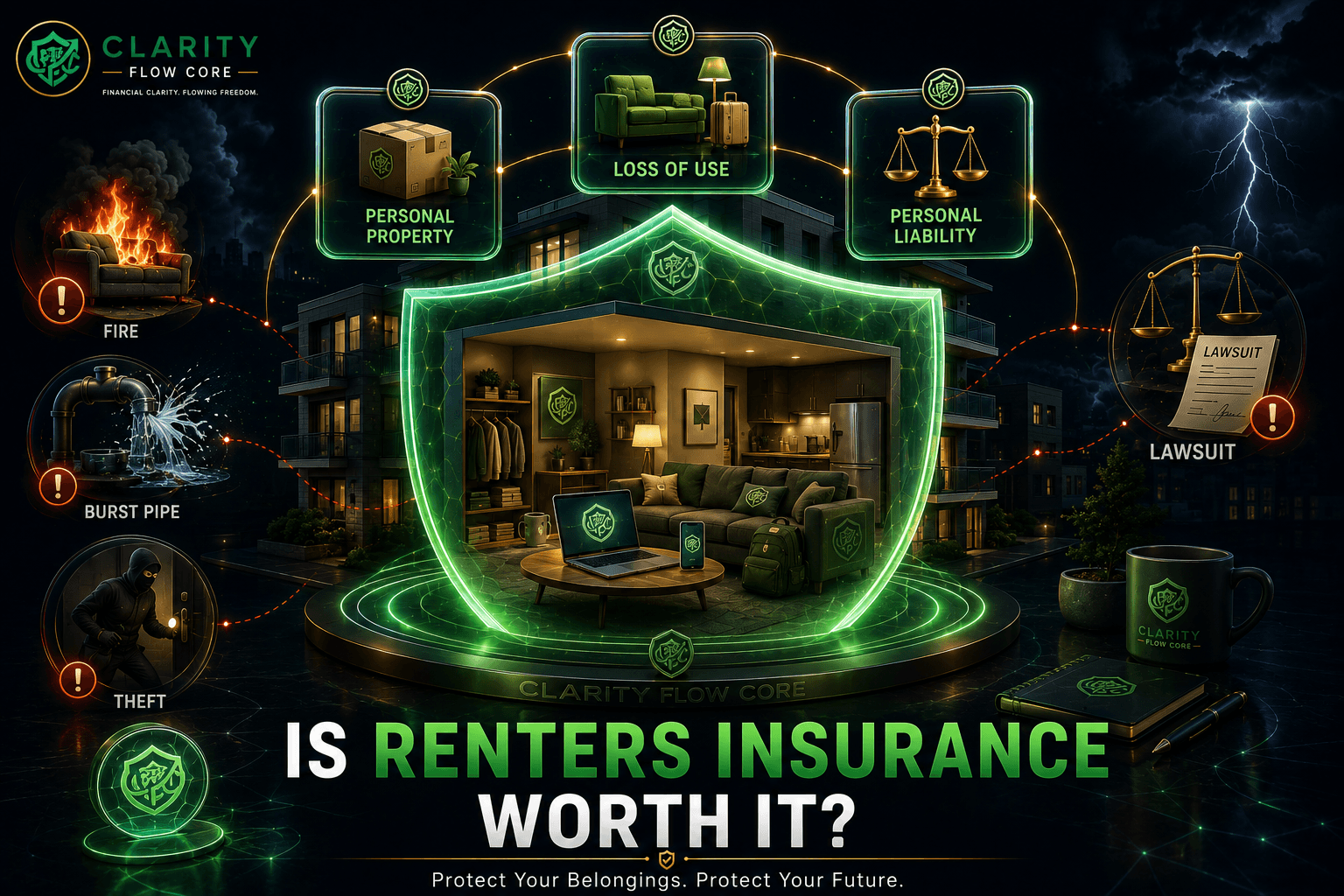
To truly understand the answer to renters insurance: is it worth it?, you have to look at the three distinct buckets of financial protection a standard policy provides.
The Renters Coverage Matrix
How the policy actively protects your net worth.
1. Personal Property
- What it is: Covers the cost to replace your furniture, clothing, and electronics.
- The Reality: It protects your items even when they aren’t in your apartment. If your laptop is stolen out of your car while traveling, renters insurance covers it.
2. Loss of Use
- What it is: Covers additional living expenses if your unit is destroyed or uninhabitable.
- The Reality: If a fire guts your building, this pays for your hotel, extra commuting costs, and restaurant meals while you find a new place to live.
3. Personal Liability
- What it is: Pays legal defense and settlement costs if you accidentally injure someone or damage their property.
- The Reality: If you leave the bathtub running and flood the apartment below you, this prevents your neighbor from suing you into bankruptcy.
Your Ecosystem Tool: Not sure if you can squeeze the premium into your monthly expenses? Input your rent and utility costs into the Smart Budget Planner & Cash Flow Analyzer to see exactly where a policy fits into your 50/30/20 breakdown.
Real-World Scenario: The Freelancer’s Hardware Trap
When weighing the debate of renters insurance: is it worth it?, you have to accurately assess the value of what you own. People wildly underestimate the cost of their belongings.
Consider an independent freelance video editor working from a rented apartment. They don’t own expensive jewelry or fancy furniture, so they assume they don’t need insurance. However, their desk holds a custom-built PC, dual 4K monitors, external SSD drives, and specialized camera equipment for creating high-quality social media assets.
While they are out, a burglar breaks in and steals their entire editing rig. The hardware alone costs $6,000 to replace. Without renters insurance, this freelancer’s business grinds to an absolute halt. They have to drain their entire emergency fund just to buy a new computer and resume work.
If they had been paying $15 a month for renters insurance, they would simply file a claim, pay a small $500 deductible, and receive a check for the remaining $5,500 to replace their gear.
(If you are running a business out of your rental, ensure your policy limits cover your commercial equipment. Check your gaps using the Insurance Coverage Analyzer & Protection Planner).
4 Deadliest Mistakes When Buying Renters Insurance
If you have finally concluded the answer to renters insurance: is it worth it? is a resounding “yes,” avoid these four critical traps when purchasing your policy:
❌ Buying “Actual Cash Value” (ACV) instead of “Replacement Cost”: If your 5-year-old laptop is destroyed, an ACV policy only pays you what a 5-year-old laptop is worth today (maybe $200). A Replacement Cost policy pays you the amount required to go buy a brand-new laptop of similar quality. Always pay a few dollars extra for Replacement Cost.
❌ Failing to document your belongings: If your apartment burns to the ground, you must prove to the insurance company what you owned. Take 10 minutes today to film a continuous video walkthrough of your apartment, open all your drawers, and save the video to the cloud.
❌ Ignoring roommate rules: Renters insurance typically only covers the person named on the policy and immediate family. Your roommate’s belongings are not covered by your policy. They must purchase their own.
❌ Assuming floods are covered: Just like homeowners insurance, standard renters insurance explicitly excludes damage from natural flooding. If you live on the first floor in a flood zone, you need a separate flood policy.
Frequently Asked Questions
How much does renters insurance actually cost? It is arguably the cheapest insurance product in existence. The national average is roughly $15 to $20 per month (about $180 to $240 a year) for $30,000 in personal property coverage and $100,000 in liability coverage.
Is renters insurance legally required? It is not required by state or federal law, but an overwhelming majority of modern landlords and property management companies require proof of a renters insurance policy before they will hand over the keys. They do this to protect themselves from liability disputes.
Does it cover my dog biting someone? Usually, yes. The personal liability portion of your policy generally covers dog bites, both inside your apartment and at the local park. However, many insurers explicitly exclude certain “high-risk” breeds (like Pitbulls or Rottweilers). Always check your specific policy terms.
Your Action Plan
Stop leaving your financial security up to chance. If you are still asking renters insurance: is it worth it?, take these three steps today to lock down your perimeter:
- Estimate Your Value: Walk through your apartment and mentally add up the cost to replace your clothes, furniture, TV, and electronics. The number is almost always higher than you think.
- Check Your Emergency Fund: Do you have the liquid cash to replace everything if a fire strikes? Run your numbers through the Financial Safety & Emergency Fund Planner. If you don’t have the cash, you need the policy.
- Bundle and Save: Call the company that provides your auto insurance. Ask them to add a renters policy to your account. Insurers offer massive “bundling” discounts, which sometimes makes the renters policy practically free.
Sources & Further Reading
Official U.S. Guidelines & Consumer Resources
- Insurance Information Institute (III): What Does Renters Insurance Cover?
- National Association of Insurance Commissioners (NAIC): Renters Insurance Guide
Further Reading from Clarity Flow Core
- Insurance Coverage Analyzer & Protection Planner
- Smart Budget Planner & Cash Flow Analyzer
- How to Save on Insurance Without Cutting Your Coverage
- Financial Safety & Emergency Fund Planner
- The Ultimate Financial Health Checkup (Annual Personal Finance Checklist)
Disclaimer: The information provided in this article is for educational and informational purposes only and does not constitute financial, legal, or insurance advice. Policy limits, exclusions, and premium costs vary significantly by provider, location, and the value of your personal property. Always consult with a licensed insurance broker to evaluate your specific risk profile and coverage needs before purchasing a policy.
About Author

Rishabh Nigam
Rishabh Nigam founded Clarity Flow Core to make personal finance easier to understand for everyday readers. He covers credit scores, debt repayment, credit utilization, loan readiness, taxes, and financial planning through practical guides, calculators, and educational resources. His content focuses on turning complex financial concepts into clear, actionable steps that readers can apply in real life.