
How to Save on Insurance Without Cutting Your Coverage
If you are just blindly paying your auto and renters policies every six months without aggressively questioning the price, you are actively bleeding cash.
Insurance premiums are the silent wealth killer hiding in your monthly budget. Over the last few years, the cost to insure your car, your house, and your life has absolutely skyrocketed due to inflation and rising repair costs. Most people complain about the bill, but then they simply accept the auto-renewal letter because they assume the price is fixed. It isn’t.
If you want to keep your hard-earned money in your pocket, you need a ruthless, operational strategy for how to save on insurance.
Lowering your premiums does not mean stripping your policy down to state minimums and leaving yourself financially vulnerable. It means restructuring the math, shifting the risk, and eliminating the bloated coverage you do not actually need. It takes a little bit of legwork up front, but spending an hour optimizing your policies yields one of the highest hourly returns on your time.
Here is the exact operational math, the hidden industry algorithms, and the definitive guide on how to save on insurance without sacrificing your peace of mind.
⚡ Quick Answer
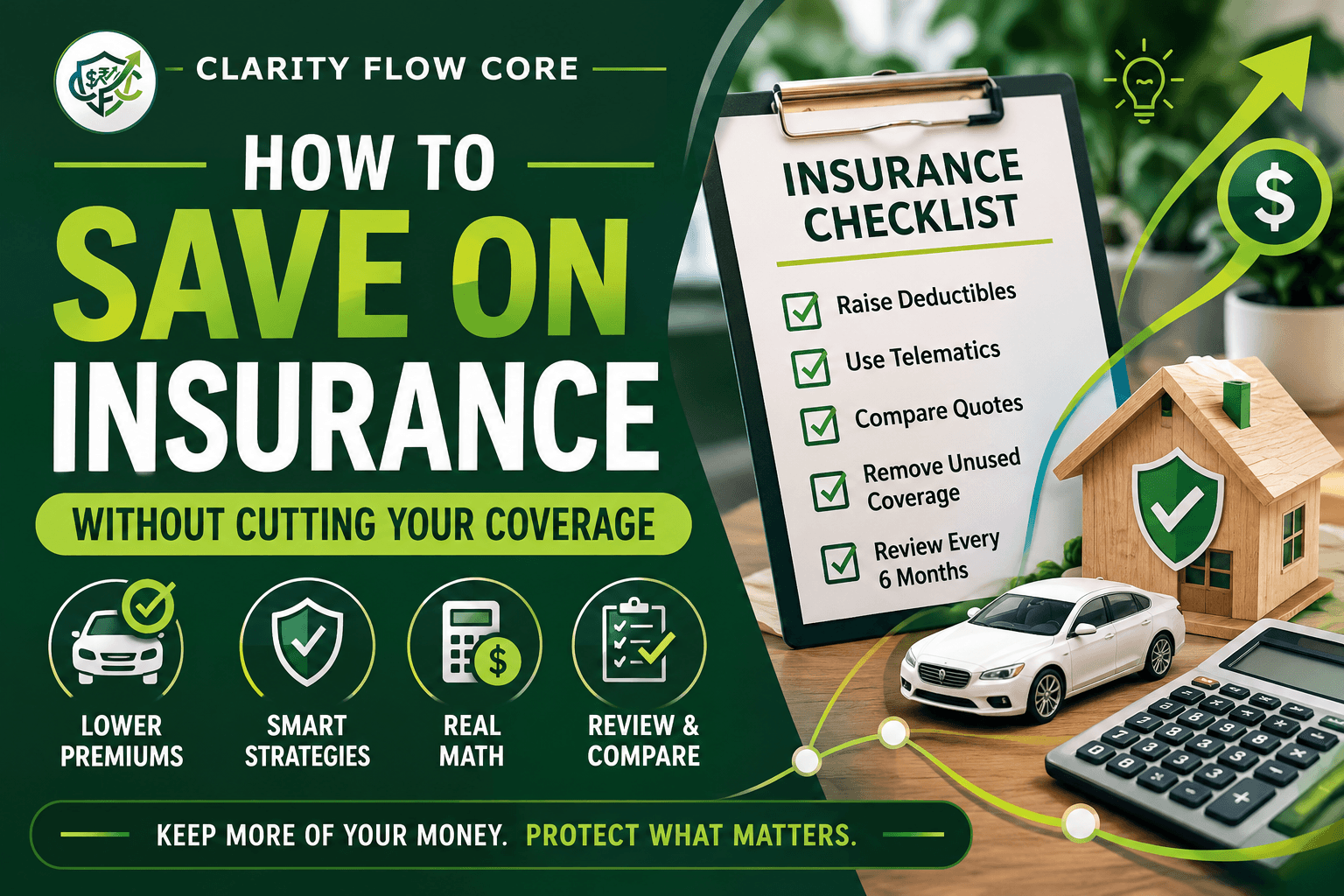
The fastest ways to save on insurance without reducing your actual protection include raising your deductibles to lower your monthly premium, enrolling in telematics (usage-based) programs if you are a safe driver, bundling your policies, and aggressively shopping for new quotes from competitors every 12 months to combat incremental rate hikes.
Hack 1: The Deductible Flip
The fastest, most direct method for how to save on insurance is to adjust your deductibles. Your deductible is the amount of money you must pay out of your own pocket before the insurance company steps in to cover the rest of a claim.
Most people instinctively choose a low $500 deductible for their collision and comprehensive coverage because they are terrified of a sudden, unpayable repair bill. The insurance companies love this because they charge you a massive premium for that low deductible.
If you have been following standard financial advice and have already built a fully loaded Emergency Fund Basics: How Much Cash Should You Keep?, you can afford to take on slightly more risk to lower your monthly bills. Bumping your auto or home deductible from $500 to $1,000 (or even $1,500) shifts a small amount of risk back to you, which forces the insurance company to slash your premium.
(To maximize this strategy, keep your dedicated deductible fund parked securely in a high-yield savings vehicle. Review HYSA vs. Money Market Account: What’s the Difference? to find the best rate).
The Break-Even Math
If you are researching how to save on insurance, you must look at the break-even timeline. Raising your deductible from $500 to $1,000 typically reduces the collision and comprehensive portion of your premium by 15% to 20%.
Let’s assume the collision/comp portion of your auto policy costs $800 a year:
| Deductible Option | Annual Premium | Yearly Savings | Out-of-Pocket in an Accident |
| $500 Deductible | $800 | $0 | $500 |
| $1,000 Deductible | $660 | $140 | $1,000 |
You save $140 a year by taking the higher deductible. If you get into an accident, you have to pay $500 more out of pocket than you would have with the lower deductible.
The Math: $500 (extra risk) ÷ $140 (yearly savings) = 3.5 Years.
If you go just three and a half years without causing an accident or filing a claim, you mathematically break even. Every single month after that, the higher deductible is generating pure profit in your budget. Let your cash buffer do the heavy lifting.
Hack 2: Embrace Telematics (Usage-Based Insurance)
Traditional car insurance prices are based on broad demographic buckets. If you are a 25-year-old male living in a busy city, you pay a high rate because the average 25-year-old male in a city crashes frequently.
If you work from home or only drive three miles a day to run local errands, you are financially subsidizing the insurance costs of people who commute 50 miles a day in heavy traffic. That stops today.
A massive breakthrough in how to save on insurance is the adoption of telematics, also known as usage-based insurance (UBI).
How Telematics Works
Almost every major insurer now offers a telematics program (like Progressive’s Snapshot, Allstate’s DriveWise, or State Farm’s Drive Safe & Save). You either plug a small diagnostic tracker into your car’s OBD-II port, or you download their app to your phone.
The software tracks your actual driving behavior in real-time. If you want to know how to save on insurance using your actual driving data, here is exactly what the algorithm monitors:
- Hard Braking: Indicates tailgating, aggressive driving, or not paying attention.
- Rapid Acceleration: Indicates aggressive driving or speeding off the line.
- Time of Day: Driving between 12:00 AM and 4:00 AM statistically carries the highest risk of fatal accidents.
- Total Mileage: The less you are on the road, the lower your statistical chance of hitting something.
- Phone Usage: Some apps track if you are physically handling your phone while the car is in motion.
If you are a safe, low-mileage driver, switching to a usage-based plan can yield massive savings. Most companies offer an immediate 10% discount just for signing up, and after your first six months of data is analyzed, you can earn up to 30% or 40% off your total premium.
Hack 3: Stop Paying the “Loyalty Tax”
There is a deeply ingrained myth that if you stay with the same insurance company for ten years, they will reward you with the best possible rate. This is entirely false.
In the modern financial world, learning how to save on insurance requires understanding a concept called “Price Optimization.” Insurance companies regularly re-evaluate pricing based on complex risk models, inflation, geographic claims trends, and customer retention behavior. As a result, long-term customers may find that their premiums steadily rise over time even without ever filing a claim. Over five years, you might suddenly be paying 40% more for the exact same coverage. This is often referred to in the industry as the Loyalty Tax.
The Operational Fix:
You must actively shop your rates every single year. Use independent comparison tools to pull quotes from five different competitors. If you find a cheaper rate for the exact same coverage limits, call your current provider.
Tell them nicely: “I have a quote for $300 less a year. I want to stay with you, but you need to match this.” Often, they will magically find a “new discount” to apply to your account. If they say no, switch immediately. Integrate this annual rate audit directly into your routine by learning 7 Everyday Saving Habits That Can Make a Real Difference.
The Side Hustle Trap: Don’t Get Dropped!
If you are currently making money outside of a traditional W-2 job, you need to pay close attention. A critical part of learning how to save on insurance is making sure your savings don’t accidentally void your coverage entirely.
A massive mistake side-hustlers make is assuming their standard, personal insurance covers their commercial gig work.
If you start driving your personal car for Uber, DoorDash, or Amazon Flex to make extra cash, your standard auto policy will absolutely refuse to pay out if you get into an accident while “on the clock.” The moment you open the delivery app, your personal coverage drops. To fix this, you must call your provider and add a Rideshare Endorsement. It costs a few extra dollars a month, but it prevents financial ruin.
The Freelancer Equipment Trap:
The same rule applies to your home or apartment. If you are running a heavy-duty freelance video editing business out of your spare bedroom with $10,000 worth of specialized computer gear, massive NAS storage drives, and ultra-wide monitors, your standard renters or homeowners policy will not protect you.
Standard policies typically cap electronics and “business property” payouts at a maximum of $1,500. If your apartment floods or gets robbed, the insurance company will hand you $1,500 and tell you good luck replacing your $10,000 editing bay.
The smartest move for how to save on insurance while protecting your livelihood is to get a specialized Business Equipment Rider added to your policy. It generally costs less than $10 a month, but it will save your entire freelance operation if a disaster strikes. (If you are currently organizing your side-hustle finances, make sure you cross-reference your gear with our Freelance Video Editor Tax Guide: Deductions & Write-Offs).
When These Hacks Backfire
Optimizing your policies is powerful, but pushing the math too far is a recipe for disaster. If you do not understand the risks of how to save on insurance, your cost-cutting measures will backfire aggressively. Here is exactly when these strategies fail:
1. The Deductible Cash Flow Crunch
We established that raising your deductible from $500 to $1,000 saves you money. However, this completely backfires if you do not have $1,000 in liquid cash. If you get into a wreck and cannot afford to pay the $1,000 deductible to the auto body shop, they will not release your car. If you have to put that $1,000 on a credit card at 24% interest, the interest charges will instantly wipe out years of premium savings. Only raise your deductible if you have the cash on hand.
2. The Telematics Penalty
Telematics programs are fantastic for safe drivers, but they are brutal for aggressive ones. Some insurers explicitly state in their fine print that your rates can increase if the tracking device records dangerous driving. If you have a lead foot, slam on your brakes at every red light, or regularly drive at 2:00 AM, do not sign up for a tracking program. The algorithm will flag you as high-risk, and your bill will skyrocket.
3. Slashing Liability Limits
The absolute worst mistake you can make when figuring out how to save on insurance is cutting your liability coverage. Liability is what pays for the other person’s medical bills and property if you cause a crash.
State minimums are dangerously low (often capping at $25,000). If you cause a multi-car pileup and cause $100,000 in medical damage, but your insurance only covers $25,000, you are personally on the hook for the remaining $75,000. They can garnish your wages and seize your assets. Never lower your liability limits just to save $15 a month.
Frequently Asked Questions (FAQs)
How much can raising my deductible save?
Raising a deductible from $500 to $1,000 can reduce premiums by roughly 10%–20%, depending heavily on the insurer and your specific vehicle.
Is usage-based insurance worth it?
For low-mileage and historically safe drivers, telematics programs may reduce premiums significantly. Drivers with aggressive habits or long, heavy-traffic commutes may see little benefit.
Should I switch insurance companies every year?
Not necessarily, but comparing quotes annually helps ensure you are continuously receiving competitive pricing and not falling victim to incremental price optimization.
Does bundling insurance save money?
Yes. Many insurers offer significant multi-policy discounts when you combine home, renters, auto, or life insurance under the same corporate umbrella.
What coverage should never be reduced?
Liability coverage is generally the last area consumers should cut because it is the only thing protecting your personal assets against major lawsuits and catastrophic property damage claims.
The Bottom Line
Insurance is not a fun topic, but optimizing it is a non-negotiable part of wealth building. If you are trying to free up cash flow to attack toxic credit cards using the Debt Avalanche vs. Debt Snowball methods, your insurance policies are the very first place you should look for hidden money.
Stop accepting auto-renewals. Take one hour this weekend to review your coverages, raise your deductibles if you have the cash buffer, sign up for a telematics discount, and ruthlessly shop your rates.
Mastering how to save on insurance is entirely in your control. Treat your policies like a business expense, cut the bloat, and force the massive insurance companies to actually compete for your money.
References & Trusted Sources
To better understand industry practices, coverage requirements, and your rights as a policyholder, consult these official regulatory and educational organizations:
- Consumer Financial Protection Bureau (CFPB)
- National Association of Insurance Commissioners (NAIC)
- Federal Trade Commission (FTC) – Insurance
- Insurance Information Institute (III)
Disclaimer: The information provided in this guide is for educational purposes only and does not constitute financial, investment, or tax advice. All financial products and offers are subject to individual credit approval and specific lender terms. Please consult with a qualified financial professional to determine if the strategies or products discussed in this guide are the right fit for your personal financial situation.
About Author

Rishabh Nigam
Rishabh Nigam founded Clarity Flow Core to make personal finance easier to understand for everyday readers. He covers credit scores, debt repayment, credit utilization, loan readiness, taxes, and financial planning through practical guides, calculators, and educational resources. His content focuses on turning complex financial concepts into clear, actionable steps that readers can apply in real life.






One Comment
Comments are closed.