
The Annual Financial Health Checkup (2026 Audit)
If you want to take control of your money this year, an annual financial health checkup is the most important appointment you can make with yourself.
One pattern appears across many personal finance guides and budgeting systems:
Most people spend 80% of their effort optimizing tiny expenses (like skipping a $5 coffee) while completely ignoring the three numbers that actually dictate wealth:
- Savings Rate
- Debt-to-Income (DTI) Ratio
- Net Worth Growth
If these three metrics improve year after year, most financial decisions become effortless.
Many people earn a good income but still don’t know whether they’re financially improving or simply staying afloat. This isn’t just another article to read and forget. This is a complete Financial Operating System. By the time you reach the bottom of this page, you will know exactly what you own, what you owe, and the precise next step you need to take.
This annual financial health checkup is especially useful if:
- You received a raise this year
- You’re aggressively paying off debt
- You’re saving for a home
- You recently started investing
- You changed jobs or experienced an income shift
- You’re planning for retirement
The Financial Health Pyramid
Before diving into the checklist, it helps to visualize how a stable financial life is built. Think of your finances as a pyramid. You cannot build the top layers without a solid foundation.
- Level 5 (Top): Investments & Financial Freedom (Wealth building, early retirement)
- Level 4: Taxes & Optimization (Keeping more of what you earn)
- Level 3: Debt Management (Eliminating high-interest liabilities)
- Level 2: Emergency Fund & Insurance (Protecting yourself from disasters)
- Level 1 (Base): Income & Cash Flow (Earning and budgeting effectively)
If you try to invest (Level 5) while ignoring high-interest credit card debt (Level 3), the pyramid collapses. This system will walk you up the pyramid, step-by-step.
Your Annual Financial Health Checkup Checklist
Use this checklist to audit your progress. We will break down exactly how to complete each step below.
- ☐ Calculate Net Worth
- ☐ Review Cash Flow
- ☐ Check Emergency Fund
- ☐ Review Insurance
- ☐ Check Credit Score
- ☐ Calculate DTI (Debt-to-Income)
- ☐ Review Investments
- ☐ Check Taxes
- ☐ Update Beneficiaries
- ☐ Set Next Year’s Goals
☐ 1. Calculate Net Worth & Review Cash Flow
You cannot improve what you do not measure. Your net worth is your financial scorecard. It is everything you own (assets) minus everything you owe (liabilities). Track this number on the same day every year to see if you are actually moving forward.
Next, look at your daily cash flow. You need to know the exact dollar amount left over after your mandatory bills are paid.
When reviewing your expenses, clearly separate business from personal. A freelance video editor’s cash flow, for example, looks drastically different from a salaried employee’s. Necessary business subscriptions—like premium video editing software or a premium writing enhancement tool like Quillbot—are vital, tax-deductible tools. If you fall into this category, review the Freelance Video Editor Tax Guide: Deductions, Write-Offs & Basics to ensure you aren’t leaving money on the table. However, a forgotten personal streaming service or an unused gym membership is just a cash leak.
Your Ecosystem Tool: Input your current income and expenses into the Smart Budget Planner & Cash Flow Analyzer. This will instantly highlight where you can cut back and how much extra cash you have to deploy.
☐ 2. Check Emergency Fund & Review Insurance
Your emergency fund size should match your lifestyle risk. Compare your current numbers against this stress test matrix to instantly see where you stand:
| Financial Area | 🟢 Healthy | 🟡 Warning | 🔴 Critical |
| Emergency Fund | 6+ months of expenses | 3-5 months of expenses | < 1 month of expenses |
| Credit Utilization | < 10% | 10% – 30% | > 30% |
| Savings Rate | 20%+ of gross income | 10% – 19% | < 10% |
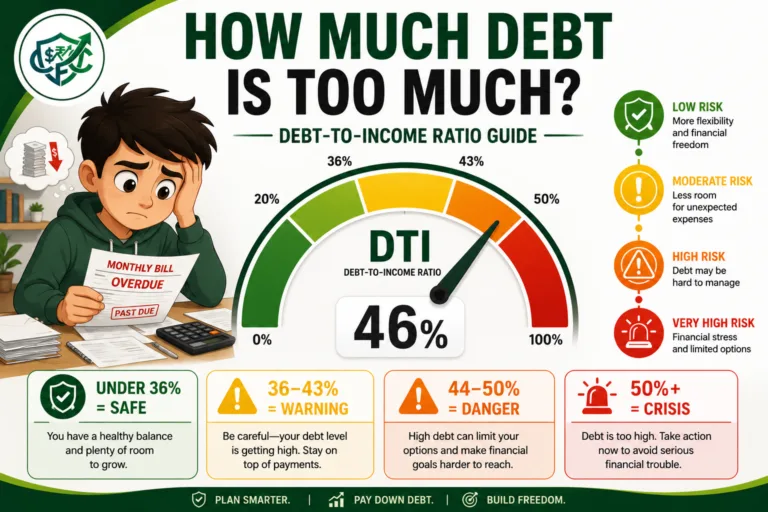
| Debt-to-Income (DTI) | < 36% | 36% – 43% | > 43% |
If you have any metrics in the “🔴 Critical” zone, that is your single financial priority for the year. Ignore everything else until it is fixed. Ensure this safety net is held in a High-Yield Savings Account (HYSA) backed by the FDIC.
Your Ecosystem Tool: Run your required monthly expenses through the Financial Safety & Emergency Fund Planner to calculate your exact target based on your job stability.
☐ 3. Check Credit Score & Calculate DTI
Pull your free annual credit report from AnnualCreditReport.com to check for errors. Next, evaluate your Debt-to-Income (DTI) ratio. This is the percentage of your gross monthly income that goes toward debt payments.
If your DTI exceeds the CFPB’s recommended 36% threshold, you need an aggressive payoff strategy.
Should I focus my extra cash on debt or investing?
↓
Is the debt APR above 10%? (e.g., Credit Cards, Personal Loans)
↓
YES ➔ Pay the debt first. (Paying off a 24% APR credit card is a guaranteed 24% return on your money. The stock market cannot guarantee that).
↓
NO ➔ Invest more. (If you have a 3% mortgage or a 4% auto loan, historical market returns will generally outpace the cost of that debt).
Your Ecosystem Tool: Use the Debt-to-Income (DTI) Analyzer & Loan Readiness Planner to see where you stand, and the Credit Utilization Planner & Recovery System to map out a credit score improvement strategy.
☐ 4. Review Investments & Check Taxes
Review your 401(k) or IRA. Are you contributing enough to get your full employer match? Are your assets allocated correctly for your timeline? Check the expense ratios on your mutual funds or ETFs. If you are paying over 0.75% in fees, you are actively giving away hundreds of thousands of dollars over your investing lifetime.
At the same time, audit your tax withholdings. Taxes are likely your largest single expense. An annual checkup ensures you aren’t paying the IRS more than legally required. If you got a massive refund last year, you overpaid the government and gave them an interest-free loan.
Your Ecosystem Tools: Map your timeline with the Retirement Readiness Planner & Retirement Income Analyzer. Then, adjust your paycheck using the Tax Withholding & Paycheck Optimizer.
☐ 5. Update Beneficiaries & Set Next Year’s Goals
This is the most overlooked step in personal finance. If you got married, divorced, had a child, or experienced the loss of a loved one this year, you must update the beneficiaries on your 401(k), IRA, and life insurance policies. Beneficiary designations override your will. If you forget to remove an ex-spouse from your 401(k), they legally get that money.
Finally, pick 1–3 specific financial goals for the upcoming year (e.g., “Max out my Roth IRA” or “Pay off my auto loan”).
Your Personal Financial Health Score
Take two minutes to grade yourself. Where are you succeeding, and where is the system breaking down?
| Financial Area | Target Goal | Status (✅ / ⚠ / ❌) | Next Action Step |
| Cash Flow | Spending less than I earn every month. | Run the Smart Budget Planner. | |
| Emergency Fund | 3-6 months of expenses in a liquid HYSA. | Automate 10% of paycheck to savings. | |
| Credit Score | Score above 740; zero errors on report. | Pay down balances to lower utilization. | |
| Debt (DTI) | Total monthly debt payments under 36% of income. | Choose a debt payoff strategy (Snowball/Avalanche). | |
| Retirement | Contributing at least 15% of gross income. | Increase 401(k) contribution to get full match. | |
| Taxes | Breaking even at tax time (no massive refund/bill). | Adjust W-4 withholdings at HR. |
The 5 Biggest Financial Checkup Mistakes
When conducting an annual review, avoid these common traps:
- ❌ Only checking your bank balance: Cash in a checking account loses purchasing power to inflation every day. Your net worth matters; your checking balance is just a tool for paying monthly bills.
- ❌ Never reviewing beneficiaries: Leaving ex-spouses or deceased relatives on your accounts can force your estate into years of legal limbo.
- ❌ Ignoring inflation: Leaving your emergency fund in a legacy bank paying 0.01% instead of an FDIC-insured High-Yield Savings Account.
- ❌ Forgetting ghost subscriptions: Experiencing “death by a thousand cuts” by failing to audit $10/month recurring charges for apps you no longer use.
- ❌ Never updating your W-4: Failing to adjust your tax withholdings after a major life event, resulting in either a massive tax bill or a delayed refund.
Frequently Asked Questions
Should I do this monthly or annually?
Do a light check-in monthly just to review your budget and pay your bills. However, the deep dive—checking credit reports, calculating net worth, rebalancing investments, and analyzing your DTI—should only be done annually. Doing it monthly leads to financial burnout and emotional reactions to normal market volatility.
What if my net worth is negative?
This is incredibly common for recent graduates with student loans or young professionals who recently bought a home. Do not panic. The goal of an annual financial health checkup is simply to ensure that negative number is moving in the right direction every year.
Can I skip retirement investing if I’m paying off debt?
You should temporarily pause extra retirement contributions if you have toxic, high-interest consumer debt (like 25% APR credit cards). However, you should always contribute exactly enough to get your employer’s 401(k) match. That match is a guaranteed 100% return on your money; you will never beat that by paying down debt.
What financial documents should I review during this annual financial health checkup?
Gather your most recent bank statements, credit card statements, investment account summaries, last year’s tax return, pay stubs, and a fresh copy of your credit report from AnnualCreditReport.com.
Should couples do this together?
Absolutely. Financial friction is a leading cause of divorce. Doing this checkup together ensures you are working toward the same goals, fully transparent about your individual debts, and operating from the exact same baseline.
What should I track year over year?
You only need to track three core metrics:
- Total Net Worth
- Debt-to-Income Ratio
- Savings Rate (the percentage of your gross income you save or invest).If those three numbers are improving, you are financially succeeding.
Your Action Plan
One year from today…
You’ll either wonder where your money went…
or
You’ll look back at this annual financial health checkup and realize it was the moment your finances finally became intentional.
That decision starts right now. Do not bookmark this page for later. Choose the most pressing issue in your financial life from the list below, click the planner, and start building your system today:
- To fix your cash flow: Smart Budget Planner & Cash Flow Analyzer
- To eliminate debt: Debt-to-Income (DTI) Analyzer & Loan Readiness Planner
- To build security: Financial Safety & Emergency Fund Planner
- To plan your exit: Retirement Readiness Planner & Retirement Income Analyzer
Sources & Further Reading
Official U.S. Guidelines & Tools
- Consumer Financial Protection Bureau (CFPB): Debt-to-Income Ratio Limits
- Federal Deposit Insurance Corporation (FDIC): Understanding Deposit Insurance
- Internal Revenue Service (IRS): Tax Withholding Estimator
- AnnualCreditReport.com: The federally authorized source for legally mandated free credit reports.
Further Reading from Clarity Flow Core
- Freelance Video Editor Tax Guide: Deductions, Write-Offs & Basics
- Emergency Fund Basics: How Much Cash Should You Keep?
- Index Funds vs. Mutual Funds: What Beginners Should Know
- Traditional IRA vs Roth IRA: Which Is Better for Beginners?
- 1099 Taxes Explained for Freelancers and Side Hustlers
Disclaimer: The information provided in this article is for educational and informational purposes only and does not constitute financial, legal, or tax advice. Always consult with a certified financial planner, CPA, or registered investment advisor regarding your specific financial situation before making any major financial decisions.
About Author

Rishabh Nigam
Rishabh Nigam founded Clarity Flow Core to make personal finance easier to understand for everyday readers. He covers credit scores, debt repayment, credit utilization, loan readiness, taxes, and financial planning through practical guides, calculators, and educational resources. His content focuses on turning complex financial concepts into clear, actionable steps that readers can apply in real life.