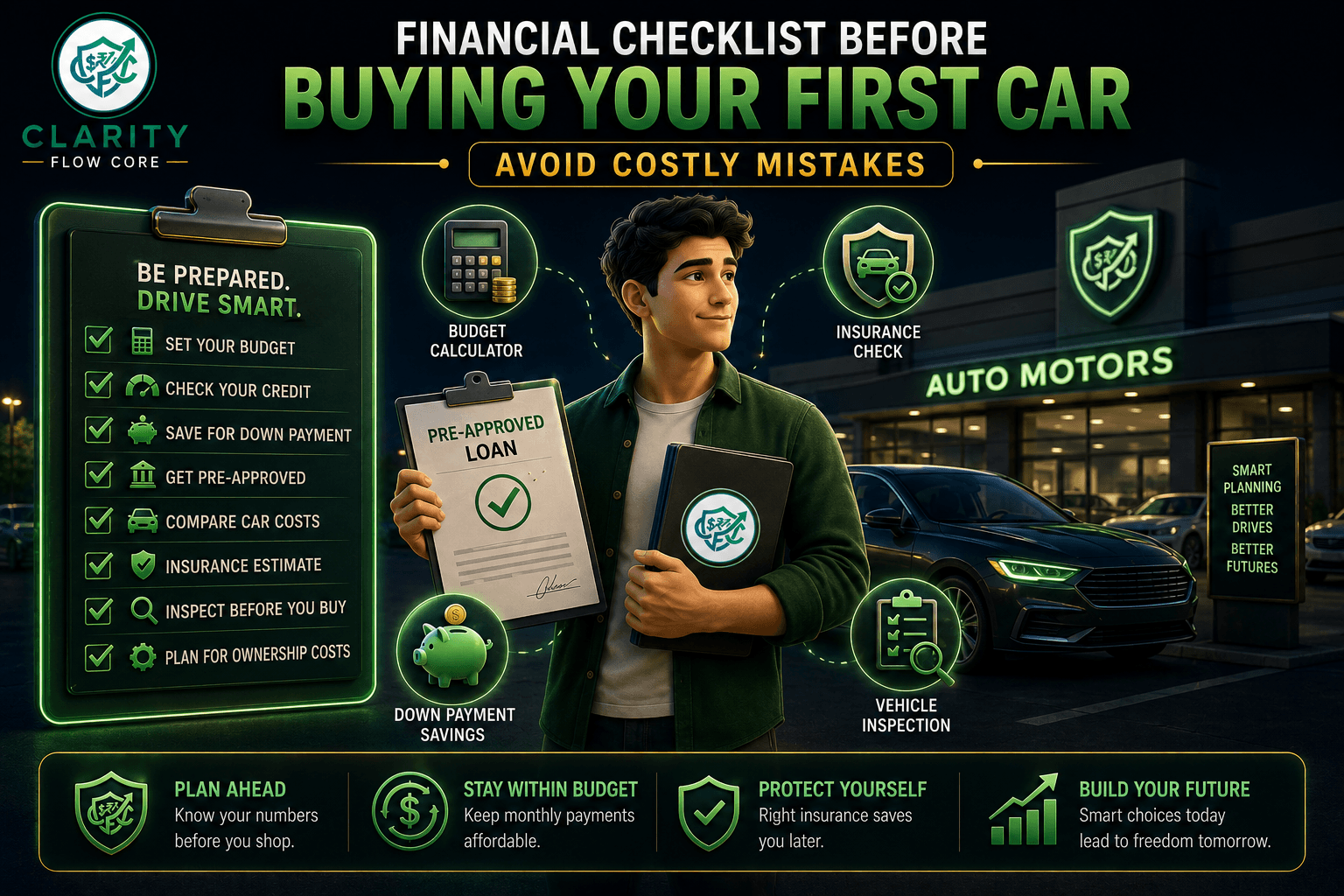
Financial Checklist Before Buying Your First Car: The Ultimate Guide
Getting the keys to your first vehicle is a massive milestone, but the process of buying it is a financial minefield. Dealerships are highly optimized sales machines, and they specialize in separating first-time buyers from their money.
If you walk onto a car lot without a strict financial checklist before buying your first car, you will likely fall into the “monthly payment trap,” where salespeople manipulate the length of a loan to hide the true, astronomical cost of the vehicle.
To protect your cash flow and secure a fair deal, you must handle the financing before you ever test drive a vehicle.
If you want to maintain your financial independence and avoid being suffocated by auto debt, you must execute every single step on this financial checklist before buying your first car.
Phase 1: The Pre-Dealership Matrix
The biggest mistake first-time buyers make is assuming the dealership is the best place to get a loan. The dealership is a middleman. The top priority on your financial checklist before buying your first car is establishing your own financial boundaries.
The First-Time Buyer Framework
Secure these three pillars before negotiating with a salesperson.
1. The Bank Pre-Approval
- The Rule: Never use dealer financing without a backup offer.
- Action: Apply for an auto loan at a local credit union or online bank to get a pre-approval letter showing your exact interest rate.
- The Leverage: This forces the dealer to beat your bank’s rate, saving you thousands in interest.
2. The 20% Cash Buffer
- The Rule: Save a 20% down payment in cash before buying.
- Why: Cars depreciate rapidly. Putting $0 down means you immediately owe more on the loan than the car is actually worth.
- Protection: A strong down payment protects you from negative equity.
3. The Insurance Quote
- The Reality: A cheap car might be incredibly expensive to insure, especially for a first-time buyer.
- Action: Find the VIN of the car you want and call your insurance agent for a precise monthly quote *before* you sign the paperwork.
Your Ecosystem Tool: Not sure how much car you can actually afford? Remember the 20/4/10 rule. Use the Smart Budget Planner & Cash Flow Analyzer to ensure your total car expenses (loan + insurance + gas) stay below 10% of your gross monthly income.
Real-World Scenario: The Registration & Loan Trap
When checking off items on your financial checklist before buying your first car, it is easy to focus only on the purchase date and forget the long-term administrative reality of vehicle ownership.
When you finance a vehicle, the bank legally owns a stake in it. Once you eventually make that final loan payment years down the road, the process isn’t automatically over. You must legally update the Registration Certificate (RC) to reflect the closed loan and remove the bank’s hypothecation from the vehicle’s title.
If you ever need to transfer the vehicle’s registration across city or state lines—for example, relocating a car’s registration from Chandigarh to Zirakpur—having a clean RC without a lingering bank lien is an absolute necessity. Understanding how title and registration transfers work before you sign the initial loan saves you from massive administrative roadblocks in the future.
4 Deadliest Mistakes for First-Time Car Buyers
As you finalize your financial checklist before buying your first car, avoid these four wealth-destroying traps:
❌ Negotiating the monthly payment: If you tell a salesman, “I can only pay $300 a month,” they will stretch the loan out to 84 months at a terrible interest rate just to hit that number. Always negotiate the total out-the-door price of the car.
❌ Skipping the Pre-Purchase Inspection (PPI): If you are buying a used car (which is the smartest financial move for a first-time buyer), never trust the dealer’s mechanic. Pay an independent, third-party mechanic $150 to inspect the car on a lift. It can save you from a $4,000 transmission failure next month.
❌ Buying unneeded dealership add-ons: In the finance office, they will try to sell you VIN etching, fabric protection, and overpriced extended warranties. Politely decline them all. They are high-margin profit boosters for the dealer, not necessary protections for you.
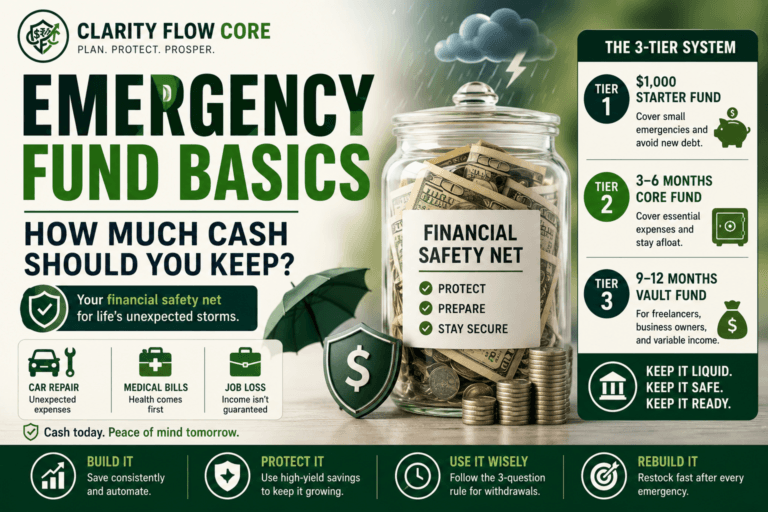
❌ Draining your emergency fund: Never use your entire savings account for a down payment. You must preserve a 3-to-6 month cash safety net. If you have to drain your emergency fund to afford the down payment, you cannot afford the car. (Calculate your exact safety net with the Emergency Fund Calculator).
Frequently Asked Questions
Is a longer loan term better because the payments are lower? No. Financing a car for 72 or 84 months is incredibly dangerous. The car will depreciate faster than you can pay off the principal, leaving you “underwater” on the loan. Stick to a maximum loan term of 48 months to minimize the interest you pay to the bank.
Should I buy a new or used car for my first vehicle? Used. Let someone else take the massive 20% depreciation hit that occurs the moment a brand-new car drives off the lot. A reliable, 3-to-4-year-old used car offers modern safety features and technology at a fraction of the total cost.
What is the “Out-the-Door” (OTD) price? The OTD price is the final, bottom-line number you will pay. It includes the sticker price of the car, plus all taxes, title fees, registration fees, and dealer documentation fees. When negotiating, only discuss the OTD price, never the sticker price alone.
Your Action Plan
Do not let the excitement of a test drive ruin your financial foundation for the next five years. Complete this financial checklist before buying your first car this weekend:
- Run your budget: Determine exactly what 10% of your gross monthly income is. Subtract your estimated insurance and gas costs from that number to find your maximum allowed monthly loan payment.
- Get pre-approved: Apply to a local credit union to get a firm interest rate offer in writing.
- Secure an independent mechanic: If you are shopping for a used car, find a highly-rated local mechanic and confirm they offer Pre-Purchase Inspections (PPIs) so you have them on standby when you find the right vehicle.
By taking control of the financing before you enter the dealership, you guarantee that your first car becomes a tool for freedom, not a financial anchor.
Sources & Further Reading
Official U.S. Guidelines & Consumer Resources
- Consumer Financial Protection Bureau (CFPB): Auto Loans and Financing Guide
- Federal Trade Commission (FTC): Buying a Used Car Safely
- Kelley Blue Book (KBB): Car Depreciation & True Cost to Own
Further Reading from Clarity Flow Core
- Smart Budget Planner & Cash Flow Analyzer
- How Much Should You Spend on a Car?
- The First 10 Financial Moves After College Graduation
- Emergency Fund Basics: How Much Cash Should You Keep?
Disclaimer: The information provided in this article is for educational and informational purposes only and does not constitute financial, legal, or tax advice. Auto loan terms, interest rates, and vehicle registration processes vary widely based on individual credit profiles and local jurisdictions. Always evaluate your specific cash flow needs and consult with a certified financial planner before signing any binding auto financing agreements.
About Author

Rishabh Nigam
Rishabh Nigam founded Clarity Flow Core to make personal finance easier to understand for everyday readers. He covers credit scores, debt repayment, credit utilization, loan readiness, taxes, and financial planning through practical guides, calculators, and educational resources. His content focuses on turning complex financial concepts into clear, actionable steps that readers can apply in real life.