Term vs. Permanent Life Insurance: What Young Adults Actually Need
If you have dependents, buying life insurance is not optional—it is a mandatory financial shield. But the moment you start shopping for a policy, you will immediately crash into the most heavily debated question in personal finance: term vs permanent life insurance.
If you ask a life insurance agent, they will almost always push you toward a permanent (whole life) policy, pitching it as a magical hybrid of life insurance and a secret investment account for the wealthy.
Do not fall for the pitch.
To settle the term vs permanent life insurance debate, you have to ignore the sales tactics and look at the math. For 99% of young adults and families, permanent life insurance is an incredibly expensive mistake that pays massive commissions to the salesperson while actively harming your ability to build wealth.
To protect your family without draining your paycheck, you need to understand the exact mathematical difference between these two policies.
The Baseline of Term vs Permanent Life Insurance
Before looking at the math, you have to understand how the underlying products are built in the term vs permanent life insurance comparison.
Term Life Insurance (The Shield)
Term life insurance is pure insurance. You pick a coverage amount (e.g., $1,000,000) and a set period of time (e.g., 20 years). If you die within those 20 years, your family gets $1,000,000 tax-free. If you do not die, the policy expires and pays out nothing. It functions exactly like car insurance or renters insurance—you hope you never have to use it. Because it is temporary and has no cash value, it is incredibly cheap.
Permanent / Whole Life Insurance (The Bundle)
Permanent life insurance lasts your entire life, meaning the insurance company is mathematically guaranteed to pay out eventually. To afford this, they charge you 10 to 15 times more per month than a term policy. Part of your massive premium goes toward the death benefit, and the rest goes into a “cash value” savings account that slowly grows over time.
The Head-to-Head Comparison Matrix
When evaluating term vs permanent life insurance, use this breakdown to see exactly where your monthly premiums are going.
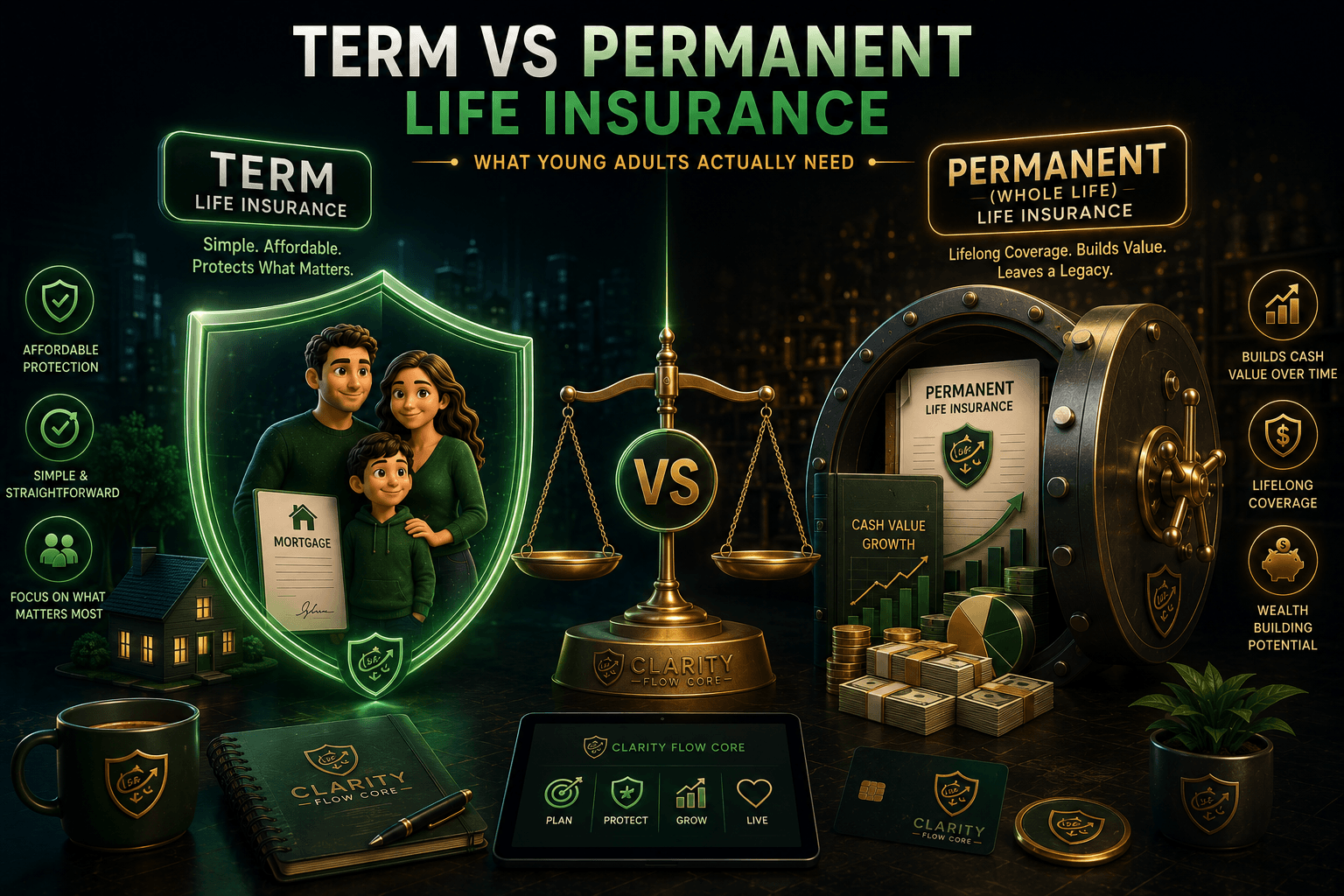
Term vs. Permanent Framework
How the two major policy types compare for a healthy 30-year-old.
Term Life Insurance
- Duration: 10 to 30 years (Your working years).
- Monthly Cost: ~$25 to $40 per month.
- Cash Value: $0. Pure insurance protection.
- Flexibility: Easy to cancel at any time with no penalty.
- Who it’s for: 99% of young adults, parents, and homeowners.
Permanent (Whole Life)
- Duration: Your entire life (until death).
- Monthly Cost: ~$300 to $500+ per month.
- Cash Value: Builds slowly. Fees eat your early returns.
- Flexibility: High surrender fees if you cancel early.
- Who it’s for: Ultra-wealthy estates & lifelong special needs dependents.
The Math: “Buy Term and Invest the Rest”
When agents sell permanent life insurance, they pitch it as an “investment.” They tell you that term life is “throwing your money away” because if you don’t die, you get nothing back.
The core of the term vs permanent life insurance argument comes down to one mathematically proven strategy: “Buy Term and Invest the Rest.”
Let’s assume you have $400 a month to allocate toward your family’s financial security.
Option A: The Permanent Life Trap You buy a $500,000 whole life policy. It costs you exactly $400 a month. Over 30 years, you will have paid $144,000 into the policy. Your “cash value” might slowly grow to $100,000. If you die, your family gets the $500,000. (Note: The insurance company keeps your cash value when you die; they only pay the death benefit).
Option B: Buy Term and Invest the Rest (The Smart Play) You buy a $1,000,000 term policy for just $30 a month. You take the remaining $370 and invest it directly into a broad-market index fund inside a Roth IRA.
- Assuming a standard historical 8% return, your $370 monthly investment will grow to $552,000 in cash over 30 years.
- If you die in year 29, your family gets the $1,000,000 from the insurance company PLUS the $552,000 from your investments.
By separating your insurance from your investments, you get double the coverage, keep total control of your own cash, and pay fewer fees.
Your Ecosystem Tool: Want to see exactly how much cash you could generate by investing the difference? Run your numbers through the Traditional IRA vs Roth IRA Planner to map your tax-free growth.
Real-World Scenario: The Freelancer’s Coverage
Consider an independent video editor who just got married and bought a house. They need to decide between term vs permanent life insurance to ensure their spouse isn’t stuck with the mortgage if the worst happens.
A financial advisor (who works on commission) pitches a $350/month permanent life policy, claiming the cash value acts as a “tax-free retirement asset.” Because independent contractors have a variable income, locking into a rigid $350/month bill is incredibly dangerous. If they hit a dry spell and miss a few payments, the policy will lapse, and they will lose thousands in surrender fees.
The Fix: They calculate their exact needs using the DIME Formula (Debt + Income + Mortgage + Education). They determine they need $750,000 in coverage. They buy a 20-year term policy for $28 a month. They route the remaining $322 into their own investment accounts, keeping their monthly overhead low and maintaining total control of their business cash flow.
(If you run your own business, never mix insurance products with your operational cash flow. Read our Freelance Video Editor Tax Guide for better ways to shelter your money).
Who Actually Needs Permanent Life Insurance?
Whole life insurance is a terrible product for the average person, but it is an excellent product for the top 1%. You only need to choose the permanent side of the term vs permanent life insurance debate if you fall into one of two categories:
- The Ultra-Wealthy: If your net worth is over the federal estate tax exemption limit (currently around $13.6 million per person), your heirs will face massive estate taxes when you die. A permanent life insurance policy provides immediate, tax-free liquid cash to pay those government taxes without forcing your family to sell off real estate or businesses.
- Lifelong Dependents: If you have a child with severe special needs who will require financial care and medical support for the rest of their life (long after you are gone), a permanent policy ensures a guaranteed trust payout regardless of what age you pass away.
If you do not fit into these two categories, the winner of the term vs permanent life insurance showdown is simply Term.
4 Deadliest Life Insurance Mistakes
When making your term vs permanent life insurance decision, avoid these financial traps:
❌ Relying entirely on your employer’s policy: Your job might offer a free policy equal to 1x or 2x your salary. This is not enough. Furthermore, if you get fired or quit, that policy does not come with you. Always own an independent policy.
❌ Mixing insurance with investments: Insurance is meant to manage risk. Investments are meant to build wealth. Combining them into one product (Whole Life, Universal Life, IUL) simply layers hidden fees on top of sub-par returns.
❌ Waiting too long to buy: Life insurance gets drastically more expensive every year you age, and any new medical diagnosis (even high blood pressure) can cause your rates to spike permanently. Lock in a 20-year or 30-year term while you are young and healthy.
❌ Ignoring the Emergency Fund: Never buy life insurance if you don’t have basic cash reserves. You are far more likely to get a flat tire tomorrow than to pass away. Use the Financial Safety & Emergency Fund Planner to build your base first.
Frequently Asked Questions
When comparing term vs permanent life insurance, how long of a term should I buy? Your term should match your longest financial obligation. If you just had a baby, a 20-year or 25-year term ensures coverage until they graduate college. If you just signed a 30-year mortgage, get a 30-year term.
What happens if I outlive my term life insurance policy? You throw a party. The goal of term life insurance is to reach the end of the term alive and wealthy. By the time your 20-year policy expires, your kids will be grown, your house will be mostly paid off, and your retirement accounts will be full. You are now “self-insured” and no longer need a life insurance company.
Do I need life insurance if I am single with no kids? Generally, no. If no one relies on your income to survive, you do not need a massive policy. The only exception is if you have private student loans co-signed by your parents. If you die, that debt falls on them. Buy a small term policy just large enough to cover the co-signed debt.
Your Action Plan
Stop letting commissioned salespeople dictate your financial security. Solve your term vs permanent life insurance debate today with these three steps:
- Calculate your exact need: Do not guess. Add up your debts, your remaining mortgage, and how many years of income your spouse would need to survive.
- Get Term quotes: Use online brokers (like Policygenius or Term4Sale) to instantly compare quotes from dozens of highly-rated insurers. Avoid captive agents who only sell for one specific company.
- Set up the investment auto-transfer: Take the $300 a month you just saved by avoiding whole life insurance, and set up an automatic transfer into your Roth IRA or brokerage account.
Protect your family’s today with term insurance, and protect their tomorrow by investing the rest.
Sources & Further Reading
Official U.S. Guidelines & Consumer Resources
- Consumer Financial Protection Bureau (CFPB): Life Insurance Basics & Guides
- Securities and Exchange Commission (SEC): Investor.gov – Understanding Investment Products
Further Reading from Clarity Flow Core
- Smart Budget Planner & Cash Flow Analyzer
- Traditional IRA vs Roth IRA: Which Is Better for Beginners?
- Emergency Fund Basics: How Much Cash Should You Keep?
- Freelance Video Editor Tax Guide: Deductions & Basics
Disclaimer: The information provided in this article is for educational and informational purposes only and does not constitute financial, legal, or tax advice. Always consult with a certified financial planner or independent insurance fiduciary regarding your specific financial situation before purchasing a policy.
About Author

Rishabh Nigam
Rishabh Nigam founded Clarity Flow Core to make personal finance easier to understand for everyday readers. He covers credit scores, debt repayment, credit utilization, loan readiness, taxes, and financial planning through practical guides, calculators, and educational resources. His content focuses on turning complex financial concepts into clear, actionable steps that readers can apply in real life.