Coast FIRE Explained: Can You Retire Early Without Saving Millions?
⚡ Quick Answer
Coast FIRE means you have saved enough money early in your career that compound interest will carry your portfolio to your ultimate retirement goal by age 65, even if you never invest another penny. Once you hit your Coast FIRE number, you only need to earn enough money to cover your current living expenses, freeing you to switch to a lower-stress job, take sabbaticals, or pursue passion projects.
If you have spent any time researching personal finance online, you have probably stumbled across the FIRE movement (Financial Independence, Retire Early).
The traditional FIRE strategy sounds incredible on paper: save aggressively, invest the difference, and retire in your 30s or 40s to sit on a beach forever. But when you look at the actual math, the reality hits you like a ton of bricks. To achieve standard FIRE, you often have to save 50% to 70% of your income. That means driving a fifteen-year-old car, skipping vacations, avoiding restaurants, and living an incredibly frugal, restrictive lifestyle for a decade or more.
For the average American making a normal salary, traditional FIRE feels impossible. You want financial freedom, but you do not want to completely deprive yourself of joy while you are young just to hoard two million dollars.
Fortunately, there is a realistic, flexible alternative: Coast FIRE.
Coast FIRE completely changes the math of early retirement. It does not require you to save millions of dollars by age 35, and it does not force you to live on rice and beans. Instead, it relies heavily on front-loading your investments to take advantage of compound interest.
Quick Coast FIRE Milestones
To give you an immediate idea of how achievable this strategy is, here is roughly how much money you need invested by age 35 to retire a millionaire at age 65 (assuming a standard 7% inflation-adjusted return):
| Desired Retirement Fund at 65 | Coast FIRE Number at Age 35 |
| $1,000,000 | ~$131,000 |
| $1,500,000 | ~$197,000 |
| $2,000,000 | ~$263,000 |
In this guide, we will break down exactly how Coast FIRE works, walk you through the math to find your personal target number, and show you how reaching this specific milestone can instantly lower your financial stress and change your career trajectory forever.
What is Coast FIRE?
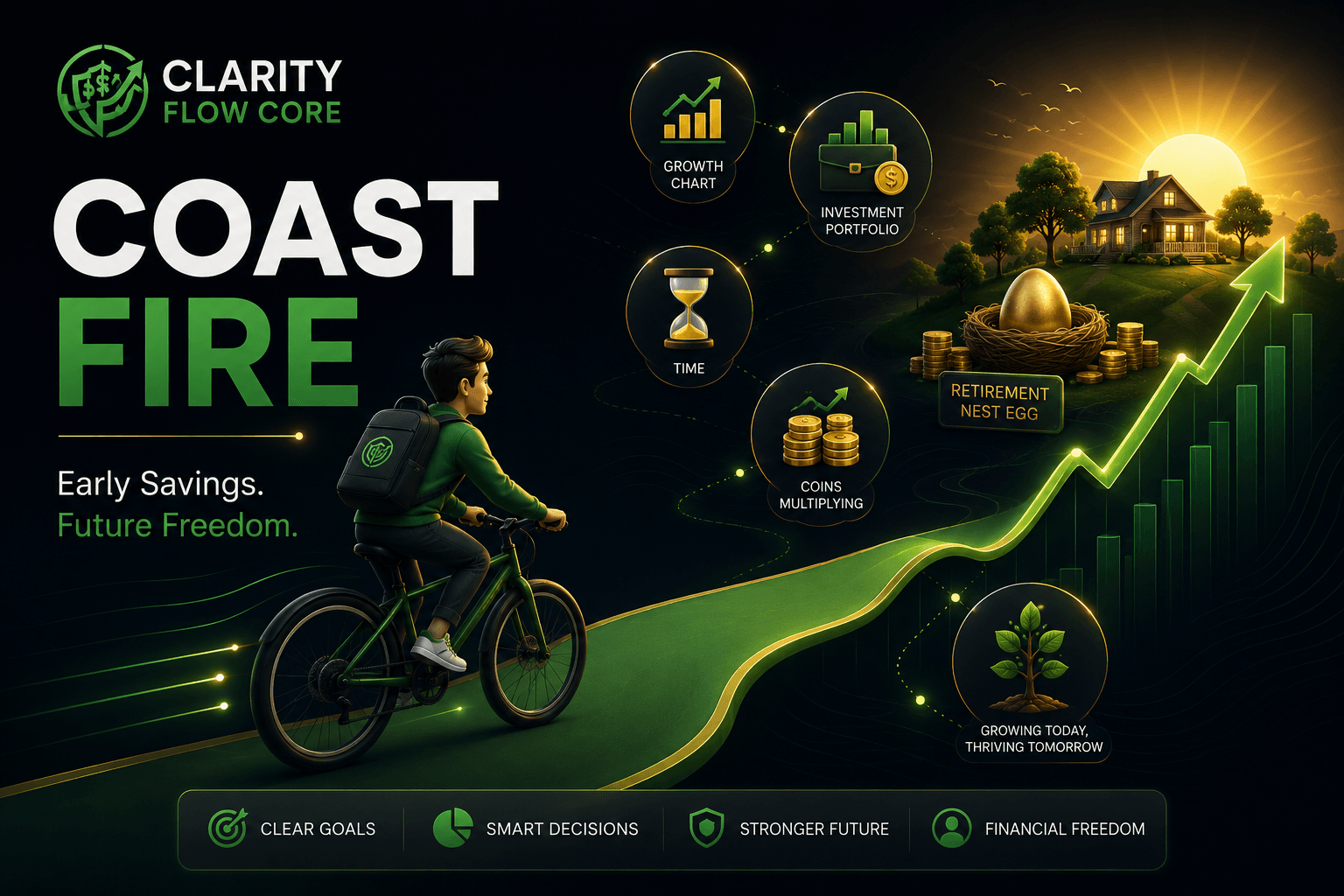
To understand Coast FIRE, you have to picture riding a bicycle up a massive hill.
In a traditional retirement plan, you spend forty years slowly pedaling your bicycle up the hill, saving 15% of your income every single month until you finally reach the peak at age 65.
Coast FIRE is different. With Coast FIRE, you pedal as hard and as fast as humanly possible during your 20s and 30s. You push your retirement portfolio up to a very specific point on the hill. Once you hit that point, gravity takes over. You can take your feet off the pedals and comfortably “coast” the rest of the way to the finish line.
In financial terms, hitting your Coast FIRE number means your current retirement portfolio is large enough that, based on historical stock market returns, it will grow into a fully funded retirement account by the time you hit traditional retirement age (usually 65).
The ultimate superpower of Coast FIRE is this: The moment you hit your number, you can completely stop contributing to your retirement accounts.
Because you no longer have to set aside hundreds or thousands of dollars a month for the future, you suddenly need significantly less money to survive. You only need to earn enough to cover your rent, groceries, and current lifestyle. This gives you the ultimate freedom to quit a high-stress corporate job, switch to a lower-paying career you actually love, start a business, or drop down to working part-time.
The Coast FIRE Math: How Compound Interest Does the Work
Coast FIRE feels like magic, but it is actually just basic mathematics. It relies entirely on compound interest—the process where your money earns interest, and then that interest earns interest on itself.
Historically, the stock market (specifically the S&P 500) has returned an average of about 10% per year. When you adjust for 3% annual inflation, you get a realistic “real” return of roughly 7%. While long-term returns average around 7% after inflation, actual returns vary significantly from year to year. This sequence of returns risk means you should always build a slight margin of safety into your calculations.
At a 7% return, your money will double approximately every 10 years. This is known as the “Rule of 72.”
Let’s look at a realistic scenario to see how this works in practice.
Sarah’s Coast FIRE Journey
Sarah is 30 years old. She decides she wants to retire at age 65 with a portfolio of $1,200,000.
If Sarah uses the Rule of 72, she knows her investments will double every ten years without her adding any new money. Let’s work backward from her age 65 goal:
| Sarah’s Age | Portfolio Balance Needed |
| Age 65 | $1,200,000 (Target Retirement Goal) |
| Age 55 | $600,000 |
| Age 45 | $300,000 |
| Age 35 | $150,000 |
If Sarah can hustle in her 20s and manage to build a portfolio of $150,000 by the time she turns 35, she is officially Coast FIRE.
At age 35, Sarah can completely stop investing. She does not have to put another dime into her 401(k) or IRA. Because she has a full thirty years before she turns 65, that $150,000 will double three times (to $300k, then $600k, then $1.2M). She will hit her exact retirement goal simply by leaving the money alone and letting the stock market do the heavy lifting.
If Sarah is making $80,000 a year, she is no longer forced to save $1,000 a month for her future. She can use that $1,000 to travel, upgrade her housing, or—most commonly—she can take a massive pay cut to work an easier, stress-free job that pays just enough to cover her daily bills.
How to Calculate Your Coast FIRE Number
You do not need an advanced finance degree to find your personal target. Calculating your Coast FIRE number requires three simple steps.
Step 1: Find Your Traditional Retirement Number
Before you can figure out where you are going, you need to know the final destination. How much total money do you need to retire comfortably?
Most experts use the 25x Rule. Estimate how much money you want to spend annually in retirement, and multiply it by 25.
- If you want to spend $60,000 a year in retirement: $60,000 x 25 = $1,500,000.
- Your final target goal is $1.5 million.
Step 2: Determine Your Timeline
Next, figure out how many years you have between your target Coast FIRE age and your final retirement age.
- If you want to hit Coast FIRE by age 35, and you plan to fully retire at age 65, you have 30 years for your money to grow.
Step 3: Run the Formula
You can use a free online Coast FIRE calculator, or use this basic formula to find out exactly how much you need in your portfolio today:
Coast FIRE Number = Final Retirement Goal / (1 + Growth Rate) ^ Years to Grow
Assuming a conservative 7% inflation-adjusted growth rate (0.07):
- $1,500,000 / (1 + 0.07) ^ 30
- $1,500,000 / (7.61)
- = $197,109
To hit Coast FIRE by age 35 and retire with $1.5 million at 65, you need to have $197,109 invested today.
If you want to see how these numbers shift based on different savings rates, plug your current monthly contributions into our Financial Freedom Planner to map out your exact timeline.
Find Your Coast FIRE Number
Are you closer to financial freedom than you think? Use our interactive analyzer to project your portfolio’s compound growth, find your exact Coast FIRE milestone, and see when you can stop aggressively saving.
Plan My RetirementMap Out Your Path to Financial Freedom
Stop winging your financial future. Use our free planner to set concrete goals, optimize your monthly savings rate, and calculate exactly when you will achieve total financial independence.
Build My Freedom PlanYou Might Be Closer Than You Think
If you are aiming for a comfortable $1.2 million at age 65, you might already be nearing financial freedom without even realizing it. Because time in the market is so powerful, your required portfolio balance is surprisingly low when you are young:
- Age 30: You need roughly $112,000 invested.
- Age 35: You need roughly $158,000 invested.
- Age 40: You need roughly $221,000 invested.
(Want to see how these aggressive early-retirement numbers compare to a standard, traditional retirement timeline? Check out our benchmark guide: How Much Should You Have Saved by Age 30, 40, and 50?)
Coast FIRE vs. Barista FIRE vs. Traditional FIRE
The early retirement community loves acronyms. If you are confused about how Coast FIRE fits into the broader picture, here is a quick breakdown of the different financial strategies.
| Type of FIRE | How It Works | Best For… |
| Traditional FIRE | Saving aggressively (often 50%+ of income) until your portfolio hits your 25x number, usually in your 40s. You stop working entirely. | High-income earners willing to live very frugally to escape the workforce permanently. |
| Lean FIRE | Same as traditional, but with a much smaller final portfolio goal. You plan to live a highly minimalist lifestyle in retirement (e.g., living on $30k/year). | Minimalists who prefer free time over luxury goods or travel. |
| Coast FIRE | Front-loading your investments while young. Once you hit a milestone, you stop saving for retirement but continue working to cover current living expenses. | People who do not hate working, but want the freedom to choose lower-stress jobs without worrying about retirement. |
| Barista FIRE | Saving a large nest egg, then quitting your career to work a part-time, low-stress job (like a barista) specifically to get health insurance and cover minor bills while your portfolio grows. | People who want to technically retire early but still need employer-sponsored healthcare. |
Where Should You Keep Your Coast FIRE Investments?
Coast FIRE relies on investing in the stock market. You cannot reach these goals by keeping your money in a standard bank account or a low-yielding CD. You need the historical returns of the S&P 500 or total market index funds.
To maximize your growth, you must use tax-advantaged accounts.
1. Your Employer 401(k) Match
If your employer offers a 401(k) match, this is your first priority. It is completely free money. If you put in 5% and they match 5%, you are getting a 100% immediate return on your investment.
2. The Roth IRA
Once you capture your employer match, funnel your cash into a Roth IRA. This is arguably the best tool for Coast FIRE because your money grows entirely tax-free. If you are not sure how to set this up, read our complete guide on Traditional IRA vs Roth IRA: Which Is Better for Beginners? and make sure you understand the Roth IRA Contribution Limits and Rules for 2026.
3. Brokerage Accounts
If you max out your retirement accounts and still want to save more to reach Coast FIRE faster, open a standard taxable brokerage account (through a company like Vanguard, Fidelity, or Charles Schwab). While you do not get special tax breaks here, there are zero restrictions on when you can pull the money out, offering immense flexibility.
For a deeper dive into structuring your monthly budget to hit these goals, read our breakdown on How Much Should You Save for Retirement Each Month?
Common Mistakes Beginners Make With Coast FIRE
Coast FIRE is highly mathematically sound, but human error can easily derail your plan. Avoid these massive financial traps.
Mistake 1: Forgetting About Inflation
If you estimate you need $60,000 a year to live on, you have to remember that $60,000 will buy significantly fewer goods in thirty years. This is why you must calculate your Coast FIRE number using an inflation-adjusted return (typically 7%) rather than the raw market return (10%). If you use a 10% assumption, your spreadsheet will look amazing today, but you will suffer a massive shortfall in purchasing power when you actually retire.
Mistake 2: Pulling Money Out of the Market
Coast FIRE only works if you do not touch the principal. You are letting compound interest do the heavy lifting for decades. If you hit your Coast FIRE number and decide to pull out $20,000 to fund a home renovation, your math completely collapses. The money must stay locked in the market.
Mistake 3: Skipping the Emergency Fund
Because your Coast FIRE money is locked up in the stock market (and often inside penalty-protected retirement accounts), you still need liquid cash to survive disasters. If you transition to a lower-paying job and your car engine blows up, you cannot sell your investments to fix it.
Before you start aggressively chasing Coast FIRE, run your numbers through our Advanced Emergency Fund Analyzer to ensure you have 3 to 6 months of living expenses sitting in a High-Yield Savings Account.
Is Your Emergency Fund Actually Big Enough?
Stop guessing how much cash you need for a rainy day. Calculate your exact savings target based on your baseline living expenses, income stability, and personal risk factors.
Calculate My Savings TargetYour Step-by-Step Coast FIRE Action Plan
Ready to secure your financial freedom without completely depriving yourself? Follow this precise roadmap.
- Stop High-Interest Bleeding: You cannot mathematically reach Coast FIRE if you are carrying 25% credit card debt. Use our Free Debt-to-Income (DTI) Analyzer & Loan Readiness Planner to assess your liability, and ruthlessly wipe out your bad debt first.
- Calculate Your Destination: Determine your exact traditional retirement number based on your expected lifestyle (e.g., $1.5 million).
- Find Your Coast Target: Work backward using the formula provided above to find the exact portfolio size you need to hit at your current age.
- Aggressively Front-Load: During your highest earning years, or before you have expensive dependents (like children), put your savings on overdrive. Capture your 401(k) match and max out your Roth IRA every year.
- Automate Your Index Funds: Do not try to pick individual stocks to speed up the process. Buy broadly diversified, low-cost index funds (like an S&P 500 or Total Market fund) and let the US economy do the work.
- Re-Evaluate Your Career: Once you hit your target number, take a breath. You won the game. You can now choose to keep your current job and upgrade your lifestyle, or drop down to a passion project that simply pays the bills.
Calculate Your True Borrowing Power
Find out exactly how lenders view your financial health. Calculate your Debt-to-Income (DTI) ratio instantly to see if you are in the safe zone before applying for a mortgage, auto loan, or new credit card.
Analyze My DTI RatioFrequently Asked Questions (FAQ)
Does Coast FIRE mean I can stop working entirely?
No. This is the biggest misconception. Coast FIRE means you can stop saving for retirement. You must still earn enough active income from a job, business, or side hustle to pay for your current rent, food, and daily lifestyle until you reach traditional retirement age.
What if the stock market crashes right after I hit my number?
Because your timeline for Coast FIRE is usually 20 to 30 years away, a short-term market crash is irrelevant. The 7% inflation-adjusted return we use in calculations accounts for recessions, bear markets, and economic downturns. Historically, the market always recovers over a 30-year horizon. Just do not panic sell.
Can I reach Coast FIRE if I am starting in my 40s?
Yes, but the math becomes significantly harder. Coast FIRE relies on time. If you start at 40 and plan to retire at 60, your money only has 20 years (two doubling cycles) to grow. You will need a much larger starting principal to hit your target compared to someone starting at 25.
Do I still get Social Security if I Coast FIRE?
Yes, assuming you continue to work and pay payroll taxes. However, because most people who reach Coast FIRE switch to lower-paying jobs for the remainder of their careers, your eventual Social Security check might be smaller than if you had maintained a high-income corporate job for 35 years. It is best to treat Social Security as a bonus rather than the foundation of your plan.
What if I want to retire before 65?
If you want to fully retire at 55 instead of 65, you simply adjust the math. You have fewer years for the money to compound, which means your Coast FIRE target number today needs to be significantly higher.
Should I stop investing completely once I hit my Coast FIRE number?
You do not have to. Many people find that once they build the habit of saving and investing, they prefer to keep doing it. Continuing to invest even after you hit your number creates a massive margin of safety, protects against worst-case economic scenarios, and allows you to potentially retire even earlier.
Conclusion
The traditional FIRE movement alienated millions of people by demanding extreme frugality and impossible savings rates. Coast FIRE strips away the anxiety. It offers a highly realistic, mathematically sound path to financial freedom that does not require you to hate your life today.
By aggressively front-loading your investments and taking advantage of compound interest, you buy yourself the ultimate luxury: options. Once you hit your Coast FIRE number, your career is no longer dictated by the terrifying fear of being broke at age 70. You can choose the job you actually want, rather than the job you need.
The math works. The timeline is up to you. Start automating your investments today, and let gravity do the rest.
References
- Consumer Financial Protection Bureau (CFPB): Educational resources on planning for retirement, compound interest, and understanding different types of investment accounts.
- Internal Revenue Service (IRS): Official guidelines on IRA contribution limits, 401(k) deduction rules, and tax-advantaged growth.
- Investor.gov (U.S. Securities and Exchange Commission): Free tools, official compound interest calculators, and information regarding asset allocation and index funds.
- Federal Deposit Insurance Corporation (FDIC): Recommendations on establishing baseline savings habits and emergency funds before entering the stock market.
Disclaimer: The information provided in this guide is for educational purposes only and does not constitute financial, investment, or tax advice. All financial products and offers are subject to individual credit approval and specific lender terms. Please consult with a qualified financial professional to determine if the strategies or products discussed in this guide are the right fit for your personal financial situation.
About Author

Rishabh Nigam
Rishabh Nigam founded Clarity Flow Core to make personal finance easier to understand for everyday readers. He covers credit scores, debt repayment, credit utilization, loan readiness, taxes, and financial planning through practical guides, calculators, and educational resources. His content focuses on turning complex financial concepts into clear, actionable steps that readers can apply in real life.