
Understanding Your Pay Stub: Every Number Explained
If you want to take control of your money this year, understanding your pay stub is the most important financial skill you can master.
Most people look at a single number on payday: the final deposit amount. If it looks roughly correct, they close the app and move on.
This is a costly mistake.
Your pay stub is not just a receipt; it is a financial control panel. It dictates how much you are investing, what safety nets you are funding, and exactly how much of your money the government is holding onto. A single unchecked box on your HR paperwork can result in thousands of dollars in overpaid taxes or missed retirement matches over a year.
Before you start: Grab your latest pay stub (a PDF or a paper copy). As you read this guide, compare each section with your own paycheck. By the end, you should understand every deduction and know whether any action is needed.
The Visual Guide to Understanding Your Pay Stub
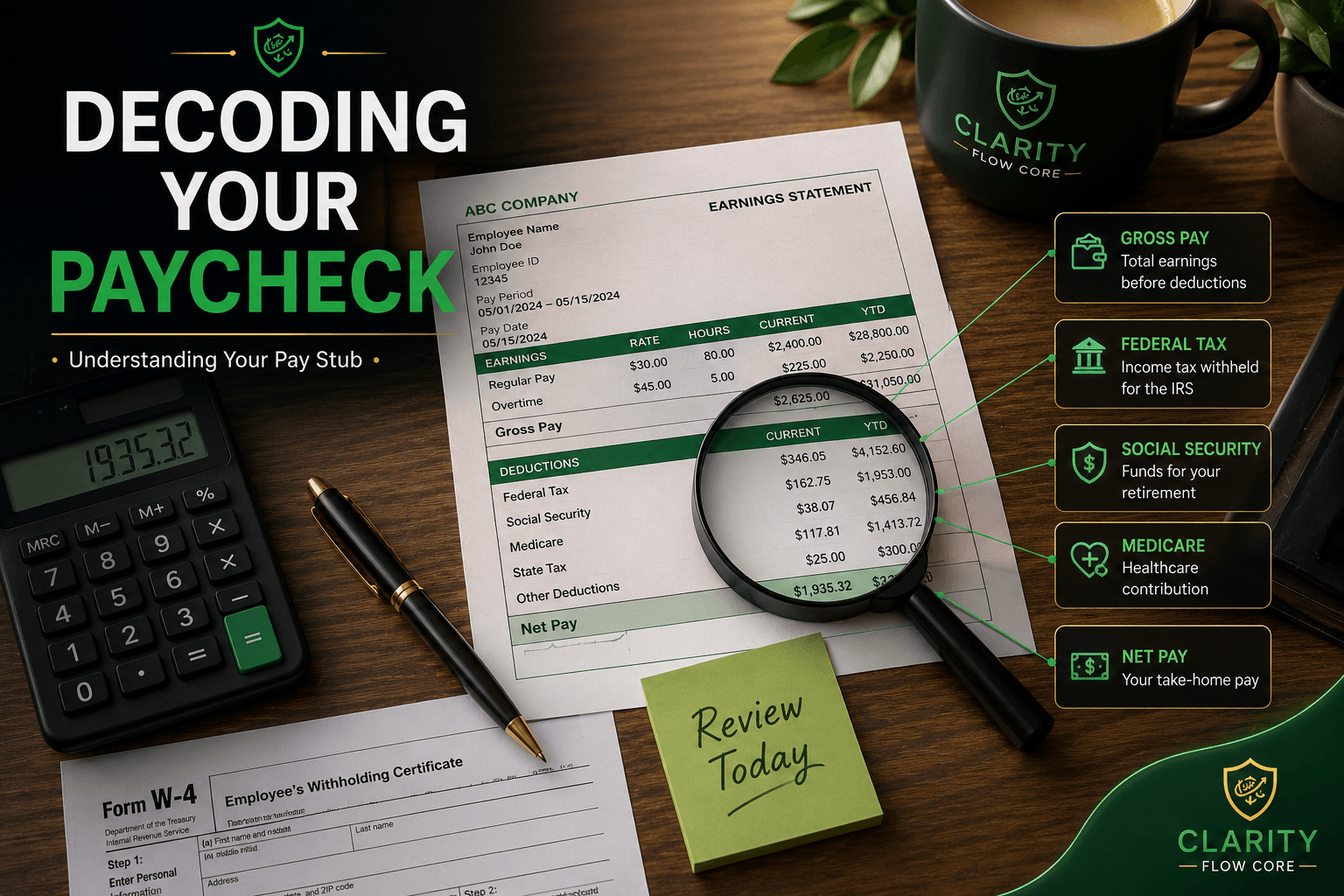
If you look at your pay stub right now, it likely resembles this structure.
Gross Pay ………………….. $3,250
Federal Tax ………………… -$420
State Tax ………………….. -$120
Social Security …………….. -$201
Medicare …………………… -$47
401(k) Contribution …………. -$130
Health Insurance ……………. -$95
Net Pay ……………………. $2,237
To understand how $3,250 shrank to $2,237, we have to look at the terminology. Payroll software varies wildly by company, meaning the abbreviations on your stub might look like a foreign language.
Know Your Acronyms Quick Reference
| Abbreviation | Meaning |
| FIT | Federal Income Tax |
| FICA | Federal Insurance Contributions Act |
| OASDI | Social Security (Old-Age, Survivors, and Disability Insurance) |
| MED | Medicare |
| YTD | Year-to-Date |
| PTO | Paid Time Off |
| HSA | Health Savings Account |
| FSA | Flexible Spending Account |
Here is how to decode the two most important lines on that document:
- Gross Pay: Usually located near the top. This is the total amount you earned during the pay period before any taxes or benefits are removed.
- Net Pay (Take-Home Pay): Usually at the very bottom. This is the actual money deposited into your checking account.
Phase 1: The Mandatory Tax Deductions
A crucial step in understanding your pay stub is recognizing that you do not have a choice regarding these deductions. Federal and state laws require your employer to withhold them.
1. Federal Income Tax
This is the money withheld to pay your annual federal income tax bill. The amount removed is directly controlled by the W-4 form you filled out when you were hired.
- Often appears as: FIT, Fed Tax, Federal WH, or FWHT.
2. State and Local Taxes
Depending on where you live, your state and city may also take a cut. If you live in a state with no income tax, this line will be zero.
- Often appears as: SIT, State Tax, State WH, or [State Abbreviation] Tax.
3. FICA (Federal Insurance Contributions Act)
FICA is a mandatory payroll tax that funds two separate government programs. It usually appears as two distinct line items:
- Social Security: A flat 6.2% tax on your gross income (up to an annual limit set by the Social Security Administration). Often appears as OASDI, SS, Soc Sec, or FICA-SS.
- Medicare: A flat 1.45% tax that funds healthcare for seniors. Often appears as MED, HI, Med Tax, or FICA-Med.
The 1099 vs. W-2 Reality Check
If you transition from a freelance video editing career into a full-time W-2 studio role, the biggest shock is often the pay stub itself. As a freelancer, your invoice amount is exactly what hits your bank account—meaning you have to calculate and save for taxes yourself. On a W-2 pay stub, your employer does the heavy lifting by removing federal taxes and paying half of your FICA burden.
If you still earn freelance side income, you must manage those taxes separately. Review our breakdown on 1099 Taxes Explained for Freelancers and Side Hustlers to ensure you don’t get hit with a surprise bill in April.
Phase 2: The Elective Deductions (The Wealth Builders)
When understanding your pay stub, the elective deductions are where you actually build wealth. Once the government takes its mandatory cut, you control these choices.
Pre-Tax Deductions
These are removed from your Gross Pay before federal taxes are applied. This lowers your taxable income, meaning you actually pay less in federal taxes.
- Traditional 401(k) / 403(b): Money sent to your retirement account.
- Health Insurance Premiums: Your portion of your medical, dental, or vision coverage.
- HSA / FSA: Tax-free money set aside specifically for medical expenses.
Post-Tax Deductions
These are removed after all taxes have been applied. They do not lower your tax bill.
- Roth 401(k) Contributions: You pay taxes on this money now, so it grows entirely tax-free for retirement.
Real-World Scenario: Tracking the Money
Let’s look at Sarah. She earns an annual salary of $75,000 and gets paid semi-monthly (24 paychecks a year).
Step 1: The Gross Pay
Sarah’s Gross Pay is $3,125 per paycheck ($75,000 ÷ 24).
Step 2: The Wealth Building (Pre-Tax)
Sarah contributes 5% to her traditional 401(k) to get her employer match, and she pays for health insurance.
- 401(k): -$156.25
- Health Insurance: -$100.00
- Her new taxable income drops to $2,868.75.
Step 3: The Taxes
The government takes its cut based on her new, lower taxable amount.
- Federal & State Tax: ~$450.00 (varies by state/W-4)
- Social Security (6.2% of Gross): -$193.75
- Medicare (1.45% of Gross): -$45.31
Quick Tip: Notice why Gross ≠ Taxable? Your taxes aren’t always calculated on your full gross pay. Pre-tax deductions like traditional 401(k) contributions, HSA contributions, and certain insurance premiums reduce your taxable income before federal income tax is calculated. Social Security and Medicare, however, generally still apply to your full gross wages.
Step 4: The Net Pay
After subtracting taxes and benefits from her gross pay, Sarah’s final take-home deposit is roughly $2,179.69.
Your Ecosystem Tool: Not sure if your net pay is distributed properly? Input your final take-home amount into the Smart Budget Planner & Cash Flow Analyzer to automatically split your cash into housing, savings, and debt payoff categories.
5 Pay Stub Red Flags That Need Immediate Action
You know what the numbers mean. Now, you need to know what should trigger concern. Audit your stub for these five warning signs:
- ⚠ No employer match visible: If your company offers a 401(k) match and your contribution line is $0, you are actively rejecting free money as part of your compensation package. If your employer matches 4% and you contribute only 2%, you’re leaving part of your compensation unclaimed.
- ⚠ FICA exceeds the expected percentage: Social Security and Medicare combined should equal exactly 7.65% of your gross pay. If the math doesn’t match, your payroll software has a critical error.
- ⚠ Unknown deductions: Legally, an employer can only deduct mandatory taxes and court garnishments without your consent. If you see a mystery fee, contact HR immediately.
- ⚠ Negative or missing PTO: Payroll glitches happen frequently. Ensure your vacation and sick hours are actually increasing each pay period according to your contract.
- ⚠ Wrong tax status: If you are married but your pay stub lists your federal filing status as “Single” (or vice versa), your tax withholdings are wrong.
Frequently Asked Questions
Why was my bonus taxed so much?
Bonuses are considered “supplemental income” by the IRS. Employers typically withhold federal taxes on bonuses at a flat rate of 22%, which is often much higher than your regular paycheck withholding rate. You aren’t necessarily paying more taxes overall; the extra withholding will balance out when you file your tax return in April.
Why did my net pay suddenly change this month?
The most common reasons are: a change in your insurance premium costs (usually at the start of a new year), a new tax bracket due to a raise, or you finally hit the annual Social Security tax limit (meaning the 6.2% tax drops off your stub for the rest of the year).
What is YTD on my pay stub?
YTD stands for “Year-to-Date.” It shows the total amount of money earned, or taxes paid, from January 1st of the current year up to the date of that specific paycheck.
Should I change my W-4 if I get married or have a child? Yes. Major life events drastically change your tax liability. You should submit a new W-4 to your HR department immediately to ensure your pay stub reflects your new tax bracket and dependent credits. Read our guide on the W-4 Form Explained: How Tax Withholding Actually Works to get this exactly right.
Your Action Plan
- Check your retirement rate: Verify that your pre-tax or post-tax 401(k) line item is high enough to capture your employer’s full match. If you want to project how those contributions will grow, run the numbers through the Retirement Readiness Planner & Retirement Income Analyzer.
- Optimize your withholdings: Stop giving the IRS an interest-free loan. Use the Tax Withholding & Paycheck Optimizer to calculate exactly what your W-4 should say, and submit an update to your HR department this week.
Understanding your pay stub is the first step toward financial control. It is more than proof that you got paid. It’s a monthly report card on your taxes, benefits, retirement savings, and financial habits. Learning to read it today can help you avoid costly mistakes for years to come.
Sources & Further Reading
Official U.S. Guidelines & Tools
- Internal Revenue Service (IRS): Tax Withholding Estimator
- Social Security Administration (SSA): Understanding FICA and OASDI Limits
- Department of Labor (DOL): Pay and Deduction Regulations
Further Reading from Clarity Flow Core
- W-4 Form Explained: How Tax Withholding Actually Works
- Tax Withholding & Paycheck Optimizer
- 1099 Taxes Explained for Freelancers and Side Hustlers
- How Much Should You Save for Retirement Each Month?
Disclaimer: The information provided in this article is for educational and informational purposes only and does not constitute financial, legal, or tax advice. Always consult with a certified financial planner, CPA, or registered investment advisor regarding your specific financial situation before making any major financial decisions.
About Author

Rishabh Nigam
Rishabh Nigam founded Clarity Flow Core to make personal finance easier to understand for everyday readers. He covers credit scores, debt repayment, credit utilization, loan readiness, taxes, and financial planning through practical guides, calculators, and educational resources. His content focuses on turning complex financial concepts into clear, actionable steps that readers can apply in real life.






One Comment
Comments are closed.