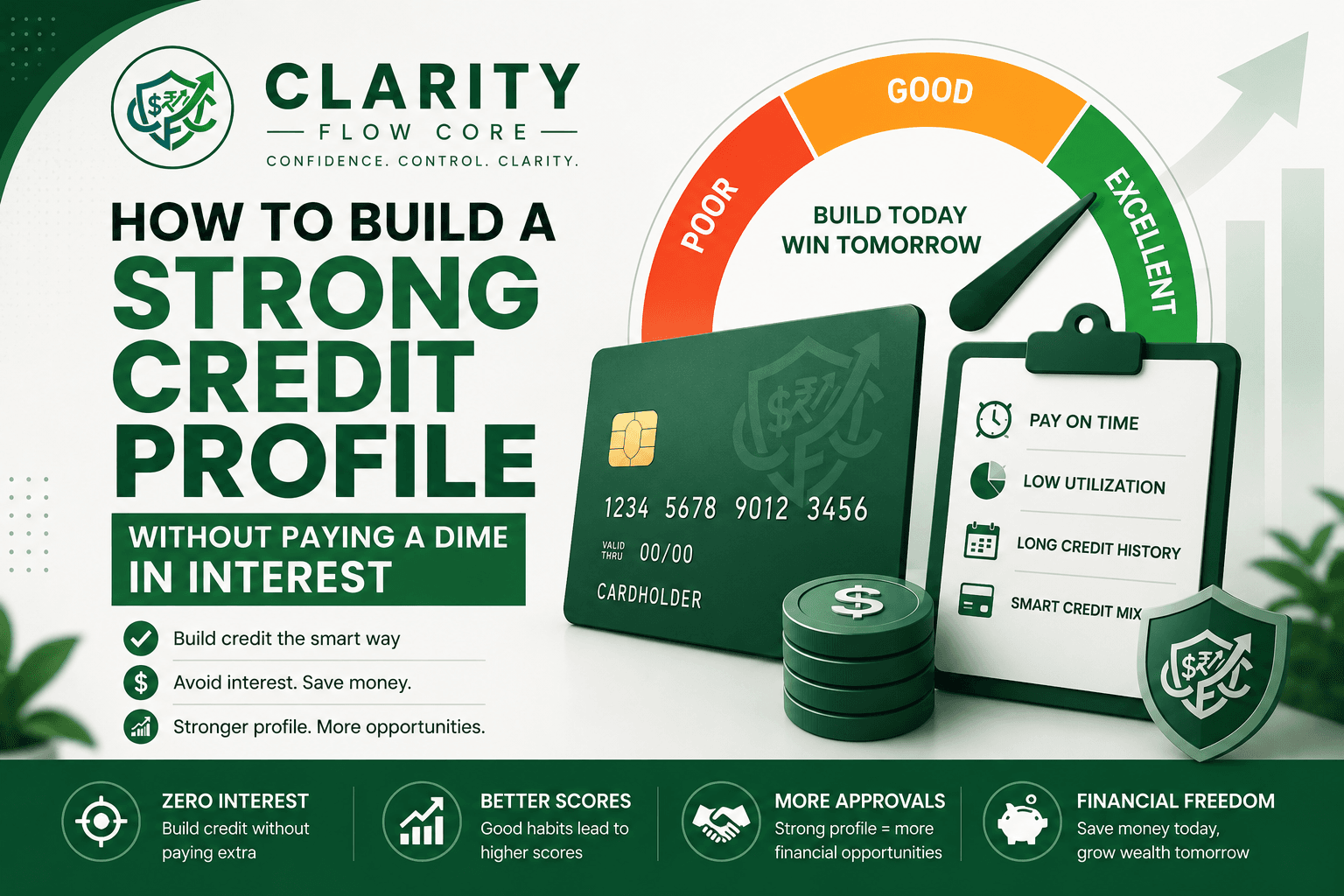
How to Build a Strong Credit Profile Without Paying a Dime in Interest
If you want to learn how to build credit without interest, you have to stop listening to the myth about carrying a monthly balance.
It usually goes something like this: “If you want to build your credit score, you need to carry a small balance on your credit card every month. It shows the banks you are actually using it.”
Let’s clear this up right now: That is completely false. In fact, it is one of the most expensive myths in modern personal finance. You absolutely do not need to pay banks a single penny in interest to build an excellent credit score.
Society often pushes the narrative that credit cards are inherently evil, or that building credit requires playing a dangerous game of debt. It is completely normal to feel anxious about getting your first card, especially if you have watched friends or family get trapped in minimum payment cycles.
But when you strip the emotion and the myths out of the equation, the credit system is just a mathematical formula. Here is an honest, practical look at exactly how to play the game, prove to the credit bureaus that you are responsible, and build a fortress of a credit score without ever paying interest.
The Core Problem: Why We Get Confused About Credit
The reason so many people fall for the “carry a balance” myth is that the credit system feels like a black box.
When you look at your credit report, you see a three-digit number and a lot of confusing terminology. The credit bureaus (Experian, Equifax, and TransUnion) want to see that you have a history of borrowing money and paying it back.
Logically, a lot of beginners think, “If I pay my card off to zero the second I buy something, the bank won’t have anything to report to the credit bureaus. Therefore, I should leave $20 on the card so it gets reported.”
Banks have zero incentive to correct this misunderstanding because they make billions of dollars a year off credit card interest. When you leave that $20 on your card past your due date, you lose your “grace period.” The bank starts charging you an Annual Percentage Rate (APR)—usually upwards of 24%—calculated daily.
You are effectively paying a monthly subscription fee just to have a credit score.
The Mechanics: Statement Date vs. Due Date
To build credit for free, you only need to understand the difference between two dates on your monthly credit card bill. This is where almost everyone messes up.
1. The Statement Closing Date
Think of this as a snapshot. Once a month, your credit card company takes a picture of whatever your balance is on that exact day. They take that number, put it on your official monthly bill, and report that specific number to the credit bureaus. This proves you are using the card.
2. The Payment Due Date
This usually falls about 21 to 25 days after your Statement Closing Date. This is the deadline to pay the bill.
If you pay the full amount shown on that statement by your Payment Due Date, you pay $0 in interest. The credit bureaus saw that you used the card (because of the statement snapshot), and they saw that you paid it back on time. You get all the positive points for your credit score, and the bank gets nothing in interest.
What This Looks Like in Reality
Let’s say you buy a $50 tank of gas and $100 in groceries during the month.
- On your Statement Closing Date, your bank takes a snapshot. They report a $150 balance to the credit bureaus. (Your credit report now shows active usage. Perfect.)
- They send you a bill for $150.
- Three weeks later, on your Payment Due Date, you log into your app and pay the exact $150.
You just built your credit history for the month, completely for free.
Common Beginner Mistakes (And When They Backfire)
Building credit is a slow process, and trying to rush it usually ends up hurting your score. Here are the traps you need to avoid.
Mistake 1: The High Utilization Trap
Credit utilization is the percentage of your total available credit that you are currently using. If you have a card with a $1,000 limit, and you spend $900 on it, your utilization is 90%.
When this backfires: Even if you pay that $900 off in full at the end of the month, the credit bureaus might pull your snapshot when the balance was sitting at $900. High utilization makes you look desperate for cash in the eyes of the algorithm. It will temporarily tank your score.
The Fix: Always keep your utilization below 30% (and ideally below 10%). If your limit is $1,000, try not to let the balance creep over $100 to $300 before paying it down.
📈 Check Your Credit Utilization Risk
Credit utilization is one of the most influential credit score factors. Use our Credit Utilization Calculator & Recovery System to see where you stand and discover ways to improve your utilization ratio.
Mistake 2: Opening Too Many Cards at Once
When you decide you want to build credit, it is tempting to apply for a store card at Target, a cash-back card from your bank, and an airline card all in the same weekend.
When this backfires: Every time you apply for a new line of credit, the bank does a “hard inquiry” on your report. This knocks a few points off your score. If you have four hard inquiries pop up in one month, the algorithm assumes you are in a financial crisis and trying to borrow as much money as possible. You will likely be denied for the last few cards, and your score will drop.
The Fix: Space out your credit card applications by at least six months.
Mistake 3: Closing Old Accounts
You finally got a great cash-back card, so you decide to cancel the basic, no-rewards starter card you got two years ago because you never use it anymore.
When this backfires: Fifteen percent of your credit score is based on the length of your credit history. When you close your oldest account, you effectively wipe out your track record. Additionally, you lower your total available credit, which instantly pushes your utilization ratio higher.
The Fix: Unless a card has an expensive annual fee, just keep it open. Put a tiny recurring charge on it (like a $5 Patreon subscription) and set it to autopay. It keeps the account alive and quietly builds your history in the background.
The Real Cost of Carrying a Balance
To put this in perspective, here is a breakdown of what happens when you decide to leave a balance on your card compared to paying it off entirely.
| Strategy | Action Taken | Credit Score Impact | Interest Paid |
| The Myth (Carrying a Balance) | You leave $200 on the card to “show usage” and pay the rest. | Positive (On-time payment) | You pay roughly 24% APR on that $200. |
| The Minimum Trap | You only pay the $35 minimum payment required by the bank. | Positive (On-time payment) | You are charged interest on the entire remaining balance. |
| The Smart Method | You pay the full Statement Balance by the due date. | Positive (On-time payment) | $0. |
Both methods build your credit score. Only one method keeps your hard-earned cash in your own pocket.
Practical Solutions: How to Build Credit Without Interest
If you are ready to start building your profile, you need a system that removes the temptation to overspend. Here are three highly practical ways to do it without stressing yourself out.
Strategy 1: Treat It Exactly Like a Debit Card
The easiest way to get into credit card debt is viewing your credit limit as “extra money.” It is not. If your checking account has $400 in it, your credit card limit is functionally $400, regardless of what the bank says. Only swipe the card for things you already have the cash in the bank to pay for right that second.
Strategy 2: The “Netflix and Autopay” Method
If you are terrified of accidentally overspending or forgetting a payment, this is the safest route for beginners:
- Get a basic credit card.
- Put exactly one recurring monthly subscription on it (like Netflix, Spotify, or your gym membership).
- Take the physical plastic card, put it in a drawer, and leave it at home.
- Log into your bank app and set the credit card to “Autopay: Full Statement Balance” every single month.
You will build twelve months of perfect payment history a year without ever thinking about it, and you will never pay a cent in interest.
Strategy 3: Start with a Secured Credit Card
If you have no credit history at all, or a bad history from past mistakes, traditional banks might reject your application. Your best move is a secured credit card.
With a secured card, you hand the bank a cash deposit upfront (usually $200 to $500). That deposit becomes your credit limit. You use the card normally, and pay the bill every month. If you vanish and stop paying, the bank just keeps your deposit, so there is no risk for them.
After 6 to 12 months of responsible use, the bank will typically upgrade you to a normal “unsecured” card and mail your original deposit back to you. It is the perfect training wheel for building a profile.
If you’re ready to open your first secured card, Best Secured Credit Cards for Beginners in 2026 compares the best options based on security deposits, annual fees, graduation policies, and credit-building features.
Your Beginner-Friendly Action Plan
If you want to start building your credit this week, here is your exact checklist:
- Check where you stand: Pull your free credit report to see if you have any existing history.
- Apply for the right starter card: Look for a card with zero annual fees. If you have no history, look at secured options from Discover or Capital One.
- Set up the automation: The day the card arrives, download the app and turn on autopay for the full statement balance.
- Use it for one category: Commit to only using the card for gas, or only for groceries.
- Let time do the work: Credit building is a waiting game. Pay it off fully every month and watch your score slowly climb over the next year.
Frequently Asked Questions
Does checking my own credit score lower it?
No. When you check your own credit score through an app (like Credit Karma or your bank’s dashboard), it is considered a “soft inquiry.” Soft inquiries have absolutely zero impact on your score. You can check it every day if you want to. A “hard inquiry”—which temporarily lowers your score—only happens when a lender checks your credit because you applied for new debt.
Can I build my credit score using a debit card?
No. Debit cards are linked directly to your own checking account. You are spending your own cash, not borrowing money, so there is nothing for the banks to report to the credit bureaus.
What is considered a “Good” credit score?
FICO scores range from 300 to 850. Generally, anything above 670 is considered “Good.” Once you cross the 740 mark, you are in the “Very Good” to “Exceptional” tier, meaning you will qualify for the best interest rates on cars and mortgages. There is no practical difference between a 780 and an 850; they will both get you the exact same prime rates.
The Bottom Line
Building a strong credit profile doesn’t require a finance degree, and it certainly doesn’t require paying the banks a monthly tribute in the form of interest charges.
The system is designed to test your reliability. If you only borrow what you already have the cash to cover, keep your utilization low, and automate your payments so you never miss a due date, you will beat the system every single time. Strip the emotion out of it, treat the card like a tool, and let your responsible habits build the foundation for your financial future.
Further Reading & Official Resources
The strategies discussed in this guide are based on educational materials published by credit scoring companies, government consumer protection agencies, and major credit reporting organizations. If you’d like to learn more, these resources provide additional detail on responsible credit use and how credit scores are calculated.
- FICO® — What’s in Your FICO® Score?
Learn how payment history, credit utilization, length of credit history, and other factors influence your FICO® Score. - Consumer Financial Protection Bureau (CFPB) — Credit Cards
Consumer guidance on using credit cards responsibly, understanding billing cycles, and avoiding unnecessary costs. - Consumer Financial Protection Bureau (CFPB) — Credit Reports and Scores
- Experian — How Credit Cards Help Build Credit
Explains how responsible card use can strengthen your credit history without carrying a balance. - AnnualCreditReport.com — Official source for free credit reports from Equifax, Experian, and TransUnion, authorized by federal law.
- Federal Trade Commission (FTC) — Credit, Loans, and Debt
Practical consumer information on building credit, managing debt, and avoiding common credit misconceptions.
Disclaimer: The information provided in this guide is for educational purposes only and does not constitute financial, investment, or tax advice. All financial products and offers are subject to individual credit approval and specific lender terms. Please consult with a qualified financial professional to determine if the strategies or products discussed in this guide are the right fit for your personal financial situation.
About Author

Rishabh Nigam
Rishabh Nigam founded Clarity Flow Core to make personal finance easier to understand for everyday readers. He covers credit scores, debt repayment, credit utilization, loan readiness, taxes, and financial planning through practical guides, calculators, and educational resources. His content focuses on turning complex financial concepts into clear, actionable steps that readers can apply in real life.