How Much Money Do You Need to Feel Financially Secure?
There is a dangerous myth in personal finance that financial anxiety magically disappears the moment your net worth hits a million dollars.
In reality, many high-earners live in a state of constant financial panic, while people making average salaries sleep perfectly soundly at night. If you are exhausted by the daily stress of managing your cash flow, you have likely asked yourself: how much money do you need to feel financially secure?
The reason you feel anxious is that you are aiming at a moving target. Without a strict mathematical definition of “security,” your brain will always convince you that you need just a little bit more.
To definitively answer how much money do you need to feel financially secure, you must stop looking at your gross income and start looking at your baseline survival metrics. Security is not a universal number; it is a highly personalized ratio based on your exact monthly burn rate.
Here is the step-by-step formula to calculate your personal financial security number so you can finally stop stressing.
Phase 1: The Three Tiers of Security
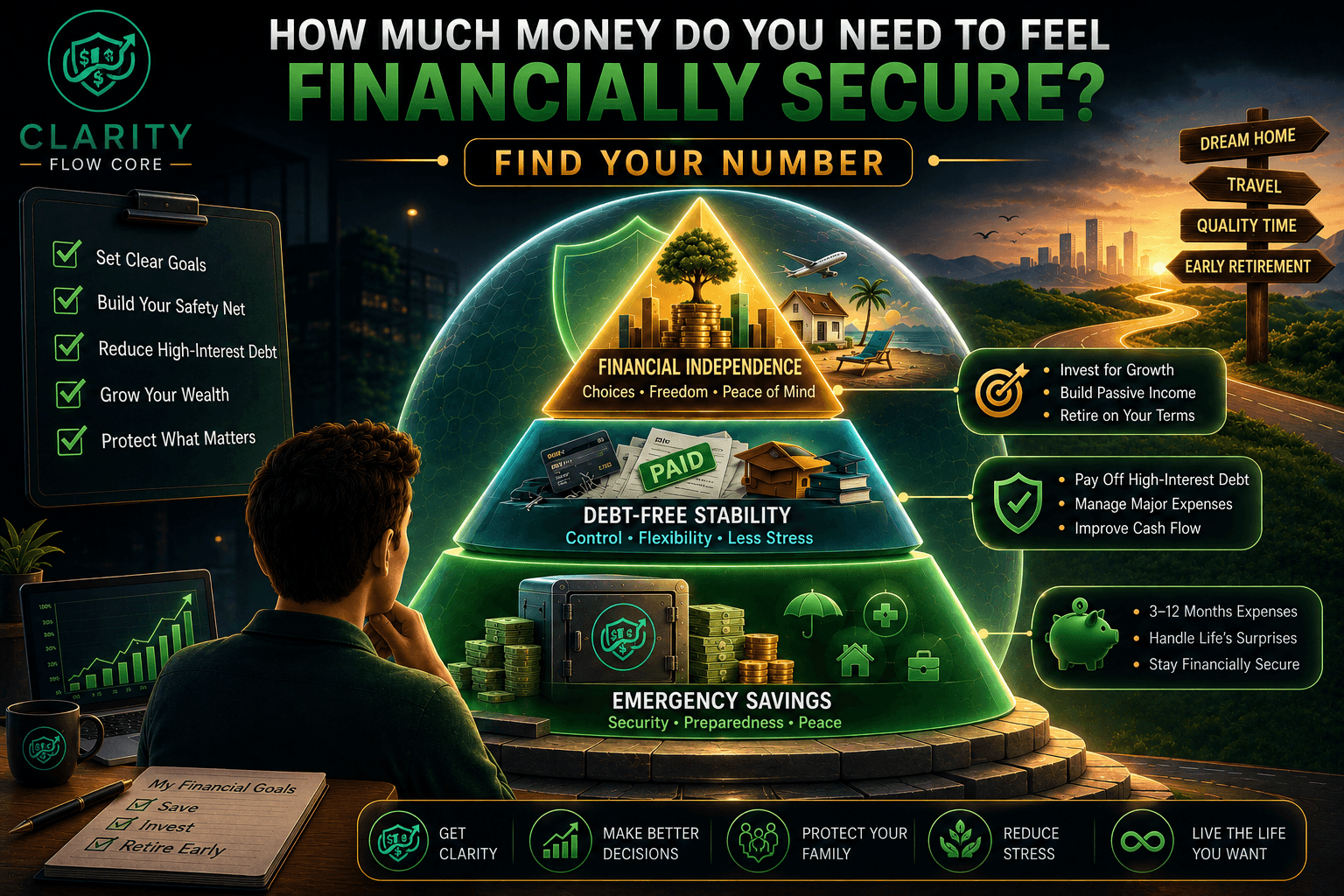
When people ask how much money do you need to feel financially secure, they are usually confusing three different psychological milestones. True financial security is built in a pyramid. You cannot skip a step without the structure collapsing.
The Financial Security Pyramid
The mathematical milestones required to eliminate money anxiety.
Tier 1: Survival
- The Math: 3 to 6 months of bare-bones living expenses in cash.
- The Feeling: You no longer panic when a car tire pops or an unexpected medical bill arrives.
- The Reality: This is the foundation. Without this cash buffer, every other tier is an illusion.
Tier 2: Stability
- The Math: Zero high-interest consumer debt (no credit card balances).
- The Feeling: Your paycheck actually belongs to you, not to a bank. You stop living paycheck-to-paycheck.
- The Reality: This is where daily anxiety vanishes because your required monthly overhead drops drastically.
Tier 3: Independence
- The Math: Your invested assets total 25x your annual expenses (The 4% Rule).
- The Feeling: Working becomes a choice, not a requirement.
- The Reality: You are fully “secure” because your investments generate enough cash to pay your bills indefinitely.
Your Ecosystem Tool: You cannot calculate your security number if you don’t know your survival number. Run your necessary expenses (housing, food, utilities) through the Smart Budget Planner & Cash Flow Analyzer to find your absolute minimum monthly burn rate.
Phase 2: The Psychology of the Goalpost
According to classic behavioral economics studies, emotional well-being and income are correlated—but only up to a certain point. The Consumer Financial Protection Bureau (CFPB) defines financial well-being not by a specific salary, but by having a sense of control over your day-to-day finances and the freedom to make choices.
If you earn $200,000 a year but spend $195,000 to maintain a massive mortgage and two luxury car leases, your security level is zero. A single missed paycheck will destroy your life.
Conversely, if you earn $60,000 a year, live on $40,000, and have $20,000 in a savings account, you will feel incredibly secure because your cash flow is positive and protected.
Real-World Scenario: The Freelancer’s Variable Security
When answering how much money do you need to feel financially secure, self-employed individuals face an entirely different psychological landscape.
Consider an independent freelance video editor. One month they land a massive corporate contract for $10,000; the next month, they only bring in $1,500. For a freelancer, typical advice like “save 10% of your paycheck” does not create security—it creates anxiety.
The Fix: To feel secure, this freelancer calculates their “Survival Tier” (rent, groceries, internet, and basic software subscriptions). Let’s say it is $3,000 a month. Because their income is highly volatile, a standard 3-month emergency fund ($9,000) won’t let them sleep at night.
Instead, they build a 9-month cash runway ($27,000) and hold it in a High-Yield Savings Account. By having nearly a year of guaranteed survival money on hand, the freelancer can confidently reject low-paying, toxic client work. The cash in the bank translates directly into business leverage and emotional peace.
(If you are self-employed, isolating your business cash from your personal cash is the first step to feeling safe. Read our Freelance Video Editor Tax Guide to structure your accounts correctly).
4 Deadliest Mistakes That Destroy Financial Security
Even if you know mathematically how much money do you need to feel financially secure, these four behaviors will keep you feeling broke:
❌ Lifestyle Creep: Every time you get a raise, you buy a nicer car or rent a more expensive apartment. Your income goes up, but your required survival number goes up with it, ensuring you never actually feel safe. (Learn how to audit your budget for lifestyle creep).
❌ Tying Security to a House: Being “house poor” is a massive cause of anxiety. If all your net worth is tied up in the equity of your primary residence, you look rich on paper but have zero liquid cash to fix a broken furnace.
❌ Comparing Your Number: Your financial security number is completely irrelevant to your neighbor’s. If they have three kids and a massive mortgage, they need vastly more money to feel safe than a single person renting a modest apartment.
❌ Ignoring the “What Ifs”: You will never feel secure if you know a medical emergency or an untimely death would ruin your family. True security requires proper Term Life Insurance to transfer catastrophic risk away from your bank account.
Frequently Asked Questions
Is $100,000 in savings enough to answer how much money do you need to feel financially secure? It entirely depends on your burn rate. If your monthly expenses are $4,000, having $100,000 in cash gives you two full years of security—which is incredible. If your monthly expenses are $20,000, that $100,000 will be gone in five months.
Does earning more money automatically increase financial security? No. High income only creates security if the gap between what you earn and what you spend widens. If your spending rises equally with your income, your financial vulnerability remains exactly the same.
How do I calculate my ultimate “Financial Independence” number? Take your total annual expenses and multiply them by 25 (this is known as the 4% Rule). If you spend $60,000 a year to live comfortably, you need $1,500,000 invested in broad-market index funds to technically never have to work again.
Your Action Plan
Stop guessing what your goalpost is. If you want to know how much money do you need to feel financially secure, take these three concrete steps today:
- Define the Baseline: Calculate your absolute minimum monthly survival number (Housing, Food, Utilities, Transport, Insurance). Be brutally honest.
- Set the Cash Target: Multiply that baseline number by 6. This is the exact dollar amount required to reach Tier 1 Security. Enter this number into the Financial Safety & Emergency Fund Planner.
- Attack the Debt: Once your cash target is hit, redirect every extra dollar toward high-interest credit card debt. Eliminating those monthly payments will instantly lower your baseline survival number, creating a rapid snowball effect of security.
Financial security isn’t about being a millionaire; it is about knowing your math so well that the unknown stops being scary.
Sources & Further Reading
Official U.S. Guidelines & Consumer Resources
- Consumer Financial Protection Bureau (CFPB): Financial Well-Being Resources
- Securities and Exchange Commission (SEC): Investor.gov – Building Wealth
Further Reading from Clarity Flow Core
- Smart Budget Planner & Cash Flow Analyzer
- Emergency Fund Basics: How Much Cash Should You Keep?
- How Much Money Should You Have Before Having a Baby?
- Should Couples Combine Their Finances?
Disclaimer: The information provided in this article is for educational and informational purposes only and does not constitute financial, legal, or investment advice. Financial security metrics vary widely based on individual circumstances, location, and risk tolerance. Always consult with a certified financial planner (CFP®) before making major financial decisions or determining long-term investment goals.
About Author

Rishabh Nigam
Rishabh Nigam founded Clarity Flow Core to make personal finance easier to understand for everyday readers. He covers credit scores, debt repayment, credit utilization, loan readiness, taxes, and financial planning through practical guides, calculators, and educational resources. His content focuses on turning complex financial concepts into clear, actionable steps that readers can apply in real life.