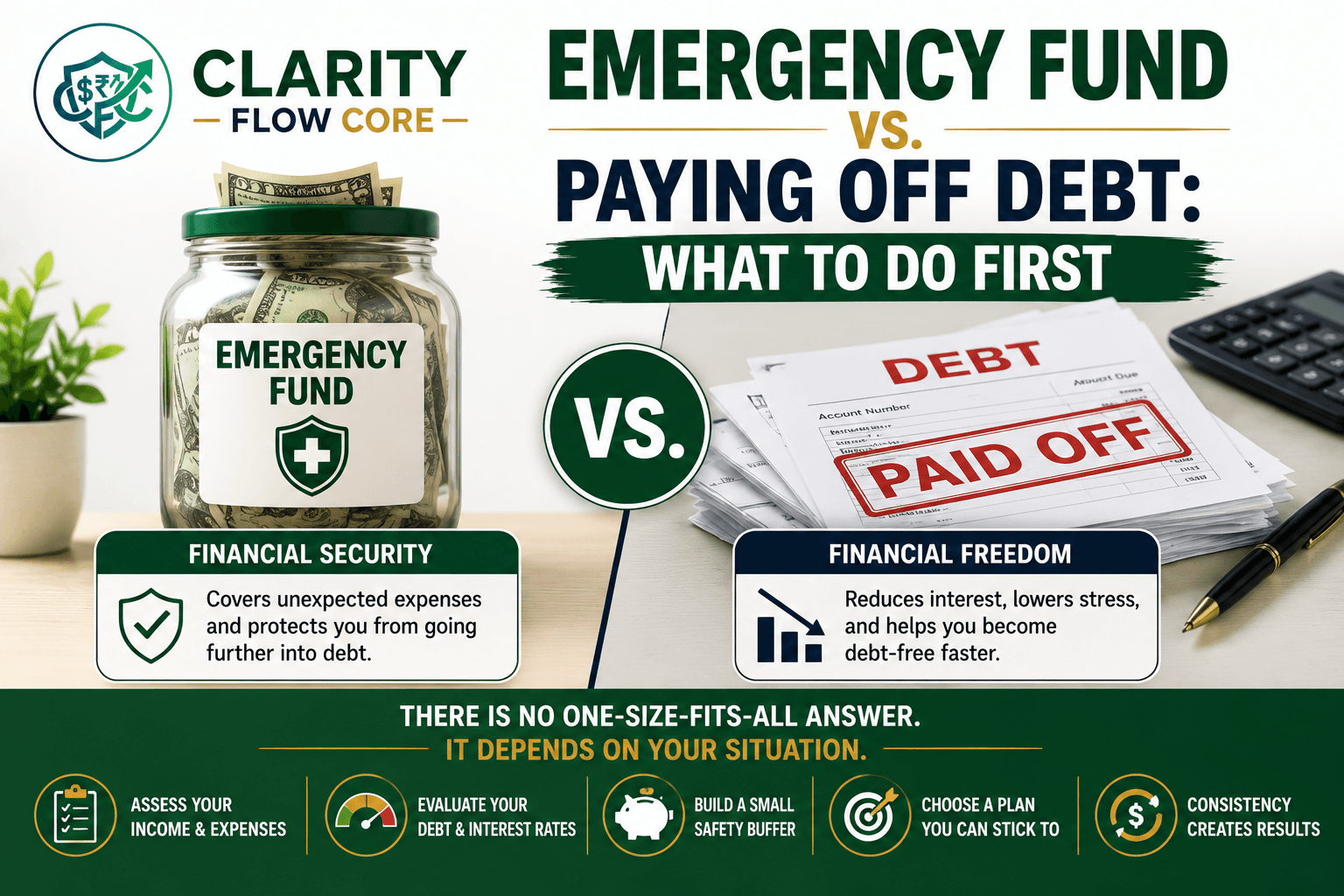
Emergency Fund vs. Paying Off Debt: Which Should You Do First?
It is 2:00 AM on a Tuesday, and you are staring at the ceiling.
In your checking account, you have exactly $2,400. On your credit card, you owe $4,800.
Your brain is playing an exhausting game of financial ping-pong. If you take that cash and throw it at your credit card, you instantly cut your debt in half. You will save a ton of money on interest, and you will feel a massive weight lift off your shoulders.
But what if your car breaks down next week? What if your dog swallows something he shouldn’t and needs an emergency vet visit? What if you are a freelance video editor and your biggest client suddenly delays paying your invoice by 45 days? If you empty your bank account to pay the credit card, you have zero cash buffer. You will be forced to put that vet bill or grocery run right back on the very credit card you just paid off.
It feels like a trap. No matter which choice you make, it feels like the wrong one.
If you are currently paralyzed by the “emergency fund vs paying off debt” dilemma, take a deep breath. You are not alone, and you are not bad with money just because you are struggling to figure this out.
Quick Answer
For most people, the best approach is to build a small starter emergency fund of $1,000–$2,000 (or one month of essential expenses) before aggressively paying off high-interest debt. This creates a financial safety net while allowing you to focus on eliminating expensive debt as quickly as possible.
Today, we are going to untangle this mess. We are going to look past the generic textbook advice and break down the emotional realities of money, the common mistakes that keep people trapped in anxiety, and the exact step-by-step strategy to protect your life while destroying your debt.
The Real Problem: The War Between Math and Emotion
When you ask financial experts whether you should save or pay off debt first, you will usually get two completely opposite answers. This is because personal finance is fundamentally split into two camps: the Math Camp and the Emotion Camp.
The Math Camp says: “Always pay off your debt first. Your high-yield savings account is paying you 4% interest, but your credit card is charging you 26% interest. Mathematically, you are losing money every single day you hold onto cash instead of paying down debt.”
The Emotion Camp says: “Always save an emergency fund first. If you don’t have cash, you are living on a tightrope without a safety net. The peace of mind that comes from having money in the bank is worth paying a little extra in credit card interest.”
The real problem is that both camps are absolutely right.
If you ignore the math, you will bleed thousands of dollars in compound interest. But if you ignore your emotions and your need for security, you will panic the moment life goes wrong. We don’t make financial decisions in a spreadsheet; we make them in the real world, where flat tires, medical emergencies, and unexpected layoffs actually happen.
| Option | Main Benefit | Main Risk |
| Pay Off Debt First | Saves interest | No cash for emergencies |
| Build Emergency Fund First | Financial safety net | Debt continues growing |
| Hybrid Approach | Balances both goals | Requires discipline |
Why We Struggle: The Cash Flow Trap
Most normal people struggle with this decision because they simply do not have enough cash flow to do both at the same time.
If you are already stretching every single dollar just to cover rent, utilities, and groceries, you might only have $150 left over at the end of the month. When your resources are that limited, you are forced to make an impossible choice.
Society tells you that you need a fully funded six-month emergency fund to be responsible. Society also tells you that carrying a balance on a credit card is a financial emergency that needs to be fixed immediately.
When you are hit with conflicting, extreme advice, your brain gets overwhelmed. And when humans get overwhelmed, we tend to freeze. We end up doing nothing. We leave the cash sitting in a checking account doing nothing, while the credit card debt continues to grow, leaving us feeling paralyzed and guilty.
Find Extra Cash to Pay Off Debt
Struggling to find extra money for your Starter Emergency Fund or credit card payments? If you get a big tax refund every year, you are overpaying the IRS. Use our optimizer to adjust your W-4 and get that cash back in your monthly paycheck right now.
Optimize My W-4The Panic Trap: Common Beginner Mistakes
When you finally decide to take action, it is very easy to swing too far in one direction. Trying to fix the problem too quickly often leads to these three incredibly common mistakes.
Mistake 1: Draining Your Savings to Zero
This is the most dangerous trap. You get so sick and tired of looking at your credit card balance that you take every single penny you have—down to your last five dollars—and transfer it to the credit card company.
While your debt goes down, your risk skyrockets. You now have zero dollars to your name. The very next time life hands you an inconvenience—a broken water heater, a parking ticket, a sudden prescription—you have no cash. You have to swipe the credit card again. This creates a deeply demoralizing cycle where you feel like you are taking two steps forward and three steps back.
Mistake 2: Hoarding Cash While Debt Explodes
This is the opposite extreme. Because you are terrified of running out of money, you refuse to pay more than the minimum payment on your credit cards until you have $10,000 saved up in the bank.
This is a mathematically fatal error. If you have $5,000 on a credit card at 25% interest, that debt is growing like a weed. By the time you finally save up your $10,000 safety net, your credit card balance might have ballooned to $7,000 because of the compounding interest charges. You are essentially paying a massive monthly fee just for the privilege of keeping your own money in the bank.
Mistake 3: Treating All Debt Exactly the Same
Not all debt is a hair-on-fire emergency. If you have a $50,000 student loan at a 4% interest rate, you should not be losing sleep over it the same way you would over a 29% retail store credit card. Pausing all your savings goals just to aggressively pay off a low-interest car loan or a medical bill on a 0% payment plan is a strategic mistake that limits your financial flexibility.
(If you are overwhelmed by medical costs right now, read our guide on What To Do If Medical Bills Are Destroying Your Budget).
What Counts As High-Interest Debt?
Many beginners get stuck simply because they don’t know which debts to attack first. Many financial experts consider debt above 8% to 10% interest to be high interest and worth prioritizing after establishing a basic emergency fund.
Here is a quick cheat sheet on how to prioritize your accounts:
| Debt Type | Usually High Priority? |
| Credit Cards (20%+) | Yes |
| Payday Loans | Yes |
| Personal Loans (10%+) | Usually |
| Auto Loans (3%–7%) | Often No |
| Federal Student Loans | Usually No |
| 0% Medical Payment Plans | Usually No |
Rule of Thumb
If your debt carries an interest rate above 10%, focus on building a small starter emergency fund first, then aggressively paying off the debt. If the debt is below 5%, building long-term savings may deserve higher priority.
Real Consequences: The Vicious Cycle
So, what happens if you handle this balance poorly?
If you choose to only pay off debt without keeping a cash buffer, you remain trapped in the debt cycle forever. You pay the card off, an emergency happens, you swipe the card, you pay the card off again. You never actually build wealth; you just continuously bail water out of a sinking boat.
If you choose to hoard cash while ignoring high-interest debt, your monthly cash flow is eventually swallowed whole by minimum payments. You might have cash in the bank, but every month, a massive chunk of your paycheck goes directly to a bank just to cover interest. This makes it incredibly difficult to save for a house, invest for retirement, or even take a simple vacation without feeling guilty.
You need a strategy that breaks the cycle entirely.
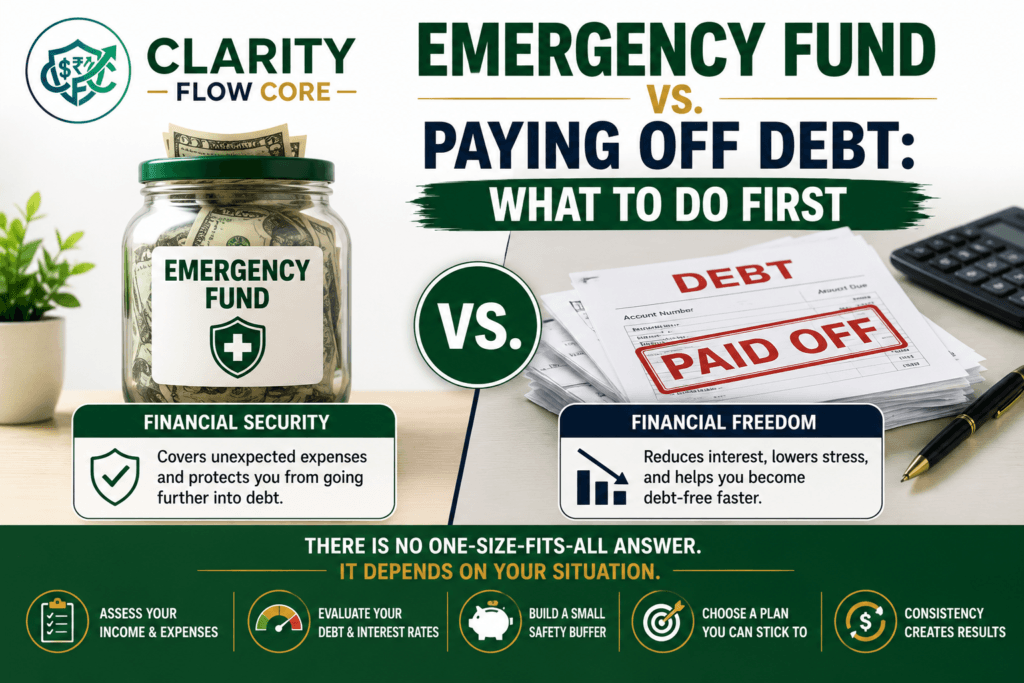
Emergency Fund vs Paying Off Debt: The Hybrid Strategy
The secret to winning the “emergency fund vs paying off debt” battle is to stop treating it like an either/or scenario. You are going to do both, but you are going to do them in a very specific, strategic sequence.
Here is the realistic, hybrid approach to protecting your life while crushing your debt.
⚖️ Stop Guessing, Map Out Both Goals
The “savings vs. debt” debate ends when you look at your complete financial dashboard. Plug your current savings, total debts, and monthly income into our free Financial Freedom Planner to calculate your exact Financial Health Score, track your emergency fund months, and find your estimated debt-free date all in one place.
Phase 1: The Starter Emergency Fund
Before you pay a single extra penny toward your credit cards or loans, you must build a protective wall between you and the rest of the world.
You need a Starter Emergency Fund.
For most people, a good target is $1,000 to $2,000, or exactly one month of essential living expenses (rent, groceries, basic utilities).
Why this amount? Because it is large enough to cover about 80% of the minor emergencies that pop up in daily life. It covers a new set of tires, an insurance deductible, or a sudden trip to urgent care. It gives you just enough breathing room so that when a normal inconvenience happens, you don’t have to reach for a credit card.
While you are building this starter fund, you pay only the absolute minimum payments on all your debts. Your singular focus is hoarding cash until you hit that $1,000 to $2,000 mark.
Phase 2: Capture the Free Money (Employer Match)
If you work a traditional job and your employer offers a 401(k) match, you should contribute just enough to get that match before attacking your debt.
An employer match is literally free money. If they offer a 100% match on the first 3% of your salary, that is a guaranteed 100% return on your investment. There is no credit card interest rate on earth that beats a 100% return. Capture the free money, then move immediately to Phase 3. (If you are a freelancer or don’t have a match, skip this step entirely).
Phase 3: Aggressive Debt Elimination
Once your starter fund is fully funded and sitting safely in a separate savings account, it is time to pivot. You flip the switch from defense to offense.
Now, you take every single extra dollar you can scrape together and throw it at your high-interest debt.
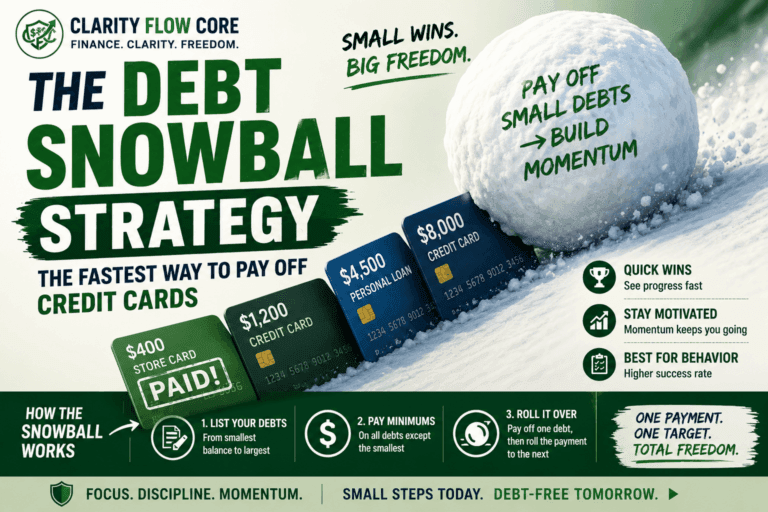
You can use the Debt Avalanche method (paying off the highest interest rate first to save the most money) or the Debt Snowball method (paying off the smallest balance first to get a quick psychological win).
During this phase, you are not adding to your savings. Your $1,000 starter fund is your only safety net. This is supposed to feel a little uncomfortable—that discomfort is the motivation you need to stay focused, cut unnecessary expenses, and get the debt out of your life as quickly as possible.
As you rapidly pay down credit card balances, you will likely notice your credit score jumping up. (For a deeper dive on how this works, see The Fastest Ways To Lower Credit Utilization and How Long Does It Really Take To Rebuild Bad Credit?).
Phase 4: Build the 3-to-6 Month Fortress
The day you make your final credit card payment is a day worth celebrating. You are officially free of toxic, high-interest debt.
Now, you take all that money you were previously sending to the credit card companies every month, and you redirect it back into your savings account. You grow your $1,000 Starter Emergency Fund into a fully funded, 3-to-6-month fortress.
If you are a W-2 employee with a very stable job, three months of expenses might be enough. If you are a freelancer with variable income, lean toward six months. This is the cash that protects you against major, life-altering events like losing a job or experiencing a long-term medical issue.
🛡️ Calculate Your Fortress Target
Stop guessing how much cash you actually need to be safe. Plug your essential monthly expenses into our free Advanced Emergency Fund Analyzer to instantly calculate your exact 1-month starter fund, 3-month baseline, and 6-month fortress goals.
What Happens After You’re Debt-Free?
Once your debt is crushed and your cash fortress is built, it is time to focus on serious wealth. Use our interactive analyzer to see how redirecting your old debt payments into retirement accounts will accelerate your timeline to financial freedom.
Plan My RetirementYour Beginner-Friendly Action Plan
If you are ready to stop stressing and start executing, here is your step-by-step checklist for the next 30 days.
Step 1: Calculate Your Starter Number
Sit down today and calculate exactly what one month of bare-bones survival looks like for you. Add up your rent, basic groceries, required transportation, and minimum debt payments. That number is your Phase 1 target.
Step 2: Open a Separate Account
Do not keep your emergency fund in the same checking account you use for daily spending. You will accidentally spend it. Open a separate High-Yield Savings Account (HYSA) at a different bank. Make it slightly inconvenient to access.
Step 3: Pause Everything Else
Temporarily stop investing (except for an employer match). Stop saving for a vacation. Stop buying non-essentials. Route every spare dollar into that new savings account until you hit your starter target.
(If you are wondering where to find extra cash right now, check out Behind on Bills? Which Payments Should You Prioritize First?).
Step 4: Shift the Cannon
The moment you hit your starter savings goal, log into your banking app and set up aggressive, automatic payments toward your most toxic credit card debt. Let the momentum carry you forward.
Frequently Asked Questions (FAQs)
Should I stop investing to pay off debt?
In many cases, it makes sense to pause extra investing while building a starter emergency fund and eliminating high-interest debt. However, if your employer offers a retirement match, contributing enough to receive the full match is often still worthwhile.
Should I pay off my car loan before building a full 6-month emergency fund?
It depends entirely on the interest rate. If your car loan is at 3% or 4%, it is generally safer to build your full 3-to-6 month emergency fund first, as your money can earn that much sitting in a high-yield savings account. However, if your car loan is at 15% or 20%, you should treat it exactly like toxic credit card debt and pay it off aggressively right after building your starter emergency fund.
What if an emergency happens while I am paying off debt?
This is exactly why the Starter Emergency Fund exists! If you get a flat tire that costs $200, you pause your extra debt payments, pull $200 from your emergency fund, and pay for the tire in cash. Then, your very next goal is to pause the debt payoff just long enough to refill the emergency fund back to its original starter amount. Once it is full again, you resume attacking the debt.
Is a credit card an emergency fund?
Absolutely not. Relying on an open credit card limit as your safety net is incredibly dangerous. If the economy takes a downturn, credit card companies can—and routinely do—slash credit limits or close accounts without warning. If you lose your job and the bank suddenly cuts your credit limit to zero, you have no money and no options. Cash is the only true emergency fund.
Should I use my 401(k) to pay off my credit cards?
Almost never. If you pull money out of a 401(k) early, you will be hit with a 10% penalty fee, plus you will have to pay ordinary income taxes on the entire amount. By the time the IRS is done with you, you might lose 30% to 40% of the money you withdrew. It is almost always better to leave retirement accounts alone and tackle debt using your current cash flow.
A Final Word of Encouragement
The tension between wanting to feel safe with cash in the bank and wanting to be free from the heavy weight of debt is a universal struggle. It is okay if you have felt paralyzed by it.
The most important thing to realize is that you do not have to fix everything today. Personal finance is a process of untangling knots, one string at a time.
By building a small, focused cash buffer first, you protect yourself from the immediate dangers of everyday life. You break the psychological cycle of relying on plastic every time the wind blows. Once that safety net is in place, you give yourself the permission and the focus to aggressively hunt down your debt and eliminate it for good.
Give yourself some grace, build your starter fund, and take it one step at a time. The math will work out, and your peace of mind will follow.
Explore These Trusted Resources
Choosing between saving and paying off debt depends on your financial situation. The resources below offer reliable guidance on emergency savings, debt repayment, budgeting, and long-term financial planning.
- Consumer Financial Protection Bureau (CFPB) – Managing Your Money – Explore practical guidance on budgeting, emergency savings, and building a stronger financial foundation.
- Federal Deposit Insurance Corporation (FDIC) – Money Smart – Free financial education covering emergency funds, saving strategies, debt management, and everyday money decisions.
- National Foundation for Credit Counseling (NFCC) – Learn about nonprofit credit counseling, Debt Management Plans (DMPs), and personalized debt repayment strategies.
- MyMoney.gov – U.S. government financial education with tools and resources for budgeting, saving, debt reduction, and setting financial goals.
- Consumer Financial Protection Bureau (CFPB) – Credit Cards – Learn how credit card interest, minimum payments, and repayment strategies affect your long-term financial health.
- Investor.gov – Discover why balancing debt repayment with long-term investing is an important part of building financial security.
Disclaimer: The information provided in this guide is for educational purposes only and does not constitute financial, investment, or tax advice. All financial products and offers are subject to individual credit approval and specific lender terms. Please consult with a qualified financial professional to determine if the strategies or products discussed in this guide are the right fit for your personal financial situation.
About Author

Rishabh Nigam
Rishabh Nigam founded Clarity Flow Core to make personal finance easier to understand for everyday readers. He covers credit scores, debt repayment, credit utilization, loan readiness, taxes, and financial planning through practical guides, calculators, and educational resources. His content focuses on turning complex financial concepts into clear, actionable steps that readers can apply in real life.