ETF vs. Mutual Fund vs. Index Fund: Which Should Beginners Choose?
When you finally decide to start investing, you are immediately hit with a wall of confusing acronyms. You log into a brokerage account and are forced to make a choice without any context: ETF vs mutual fund vs index fund.
Which one is safer? Which one has hidden fees? Which one is actually going to grow your wealth?
The financial industry intentionally makes these terms sound complicated to convince you that you need to hire an expensive financial advisor. In reality, the concepts are incredibly simple once you strip away the jargon.
To solve the ETF vs mutual fund vs index fund debate, you just need to understand the difference between what you are buying (the strategy) and how it is packaged (the vehicle).
Here is exactly how to choose the right investment for your first portfolio.
The Big Secret: They Are Not All Different Things
Before we dive into the exact ETF vs mutual fund vs index fund comparison, you must understand their relationship. The biggest source of confusion for beginners is assuming these three terms are entirely separate, competing concepts. They are not.
Think of it like buying groceries. An Index Fund is the actual food you want to buy (like a dozen eggs). A Mutual Fund and an ETF are just the different types of shopping bags you use to carry those eggs out of the store.
1. The Strategy: What is an Index Fund?
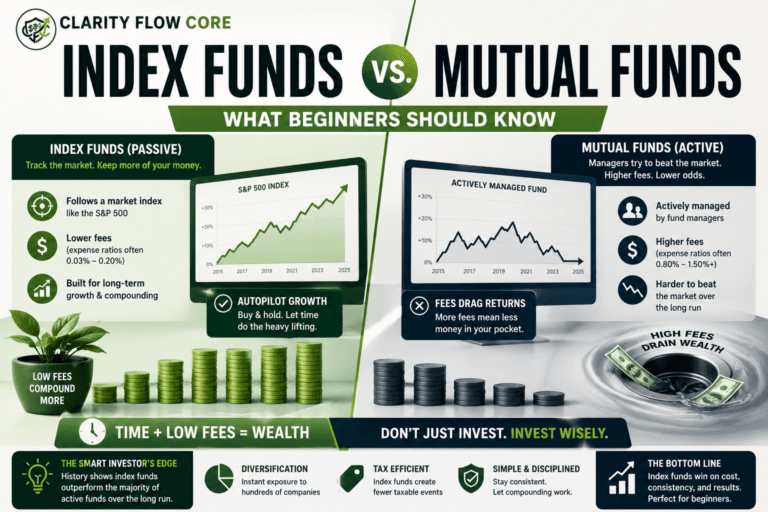
An index fund is not a specific stock; it is a mathematical rule. Instead of paying a highly compensated Wall Street manager to guess which stocks will go up, an index fund simply buys a tiny piece of every company in a specific market (like the S&P 500, which tracks the 500 largest U.S. companies).
- The Benefit: Because a computer runs it automatically, it is incredibly cheap. Historically, broad-market index funds outperform 90% of highly paid human fund managers over a 15-year period.
2. The Vehicles: Mutual Funds vs. ETFs
Once you decide you want to invest in an index (the eggs), you have to choose how to package it.
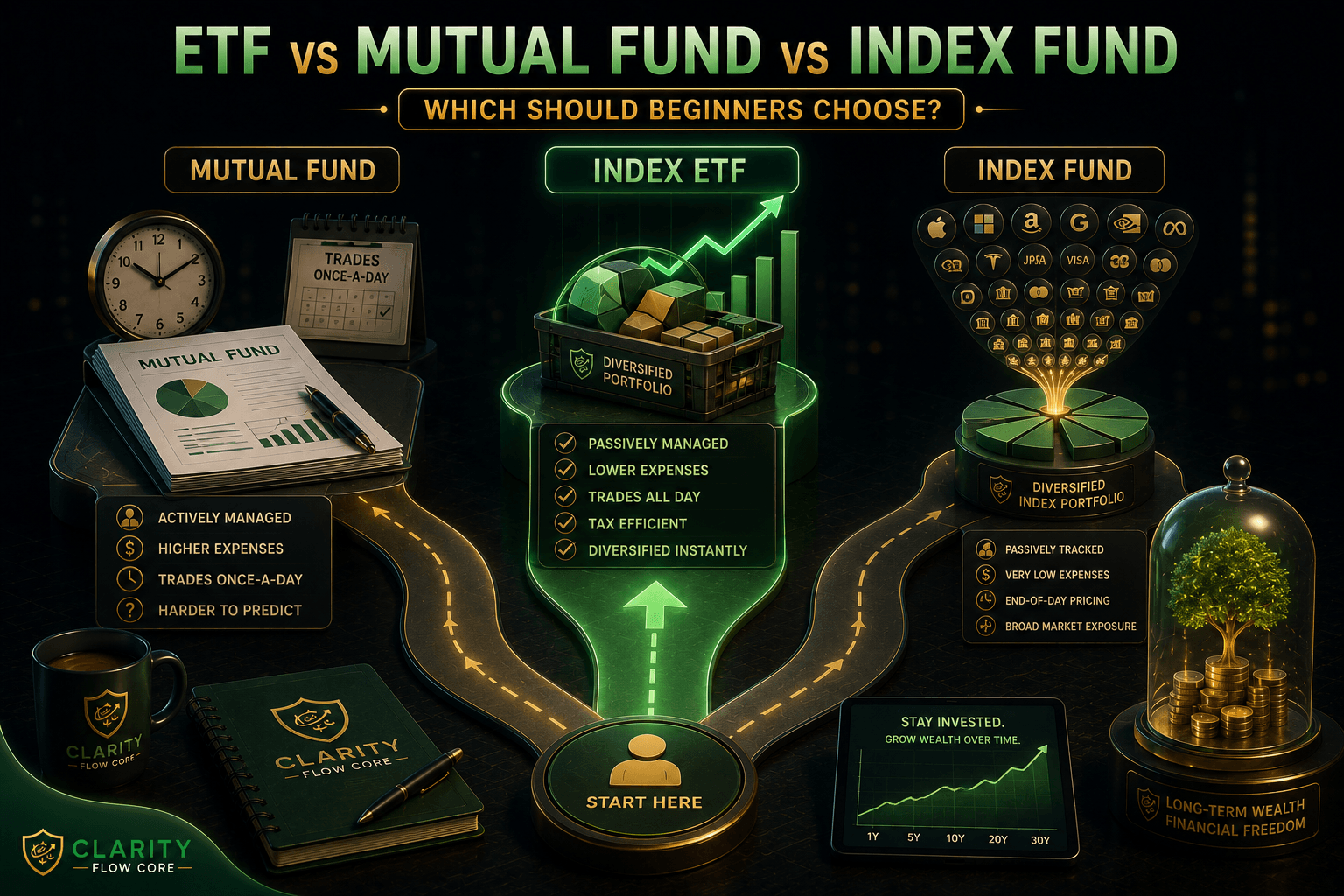
- Mutual Fund: The older, traditional shopping bag. You pool your money with thousands of other investors. Mutual funds only trade once a day, at the very end of the day, after the market closes. They often require higher minimum investments (e.g., $3,000 to start).
- ETF (Exchange-Traded Fund): The modern, high-tech shopping bag. ETFs can be bought and sold instantly throughout the day, exactly like regular stocks. They usually have zero minimum investment requirements—you can buy a single share for $50.
The Core Breakdown: ETF vs Mutual Fund vs Index Fund
To properly compare an ETF vs mutual fund vs index fund, we need to look at how they impact your cash flow and your taxes over the long term.
The Investment Comparison Matrix
How the primary investment options stack up for beginners.
Index Fund (The Strategy)
- What it is: A passive rule that tracks a whole market (like the S&P 500).
- Cost: Very Low (No human managers).
- Risk: Moderate (You own the whole market, so you never lose everything on one bad stock).
- Best For: Long-term, passive wealth building.
Mutual Fund (The Old Vehicle)
- Trading: Can only be bought/sold once a day at 4:00 PM EST.
- Minimums: Often high ($1,000 – $3,000 to start).
- Taxes: Less tax-efficient (can trigger surprise capital gains taxes).
- Best For: Automated hands-off investing inside a 401(k).
ETF (The Modern Vehicle)
- Trading: Traded instantly all day long, just like a stock.
- Minimums: None. Buy 1 share (or fractional shares for $5).
- Taxes: Highly tax-efficient due to how they are structured.
- Best For: Beginners using standard brokerage accounts or Roth IRAs.
Your Ecosystem Tool: Before you invest a single dollar, you must ensure your daily cash flow is stabilized. Run your income through the Smart Budget Planner & Cash Flow Analyzer to determine exactly how much cash you can safely allocate to investments each month.
Real-World Scenario: The Freelancer’s First Portfolio
Consider an independent video editor who just wrapped a massive corporate project. They have $2,000 sitting in their checking account that they want to invest. They open an account at Vanguard or Fidelity and are faced with the ETF vs mutual fund vs index fund decision.
If they choose a traditional Mutual Fund (like VFIAX, the Vanguard S&P 500 mutual fund), they might hit a wall: Vanguard requires a $3,000 minimum just to open that specific mutual fund. The freelancer is locked out.
The Fix: Instead, they choose an Index ETF (like VOO, the Vanguard S&P 500 ETF). Because it is an ETF, there are no minimums. They use their $2,000 to buy roughly four shares of the ETF instantly.
By utilizing the ETF vehicle to buy an Index strategy, the freelancer gains immediate access to the exact same top 500 companies, pays lower fees, and maintains ultimate flexibility over their variable business cash flow.
(If you run your own business, choosing tax-efficient vehicles is critical. Read our Freelance Video Editor Tax Guide to ensure you aren’t paying unnecessary capital gains).
4 Deadliest Beginner Investing Mistakes
When navigating the ETF vs mutual fund vs index fund landscape, avoid these wealth-destroying traps:
- ❌ Paying for active management: Many mutual funds are “actively managed,” meaning a human picks the stocks and charges you a 1% to 2% fee every year. That 2% fee will eat nearly a third of your total wealth over 30 years. Always choose passive index funds or ETFs.
- ❌ Day-trading ETFs: Because ETFs can be traded instantly on your phone, beginners often try to time the market, buying and selling them daily. This destroys your returns. Buy them and hold them for decades.
- ❌ Investing before building a safety net: Do not put your rent money into the stock market. You must build a cash reserve first. Use the Financial Safety & Emergency Fund Planner to secure 3-6 months of expenses before buying your first fund.
- ❌ Confusing the account with the investment: Opening a Roth IRA is not investing. A Roth IRA is just an empty bucket. You must put money into the bucket, and then actively use that money to buy the ETF or index fund.
Frequently Asked Questions
In the ETF vs mutual fund vs index fund debate, which is best for a beginner? The ultimate combination for a beginner is an Index ETF (an ETF that tracks a broad market index). It gives you the safety and diversification of the index strategy, combined with the low costs and zero minimums of the ETF vehicle.
Do ETFs pay dividends? Yes. If the underlying companies inside the ETF pay dividends (like Apple or Microsoft), the ETF will collect those payments and distribute them to you, usually on a quarterly basis.
Are mutual funds bad? No, mutual funds are not inherently bad. If you have a 401(k) through your employer, your money is almost certainly invested in mutual funds, because 401(k) systems are built on older architecture. Inside a tax-sheltered 401(k), low-cost index mutual funds are fantastic. In a standard brokerage account, ETFs are usually better.
Your Action Plan
Do not let financial jargon keep you out of the market. The ultimate answer to the ETF vs mutual fund vs index fund question is simply to start.
Now that you understand the ETF vs mutual fund vs index fund differences, take these three steps today:
- Open the right account: If you are investing for retirement, open a tax-advantaged account. (Read Traditional IRA vs Roth IRA: Which Is Better for Beginners? to choose yours).
- Find a broad-market Index ETF: Look for ticker symbols that track the S&P 500 or the Total Stock Market (such as VOO, VTI, SPY, or IVV).
- Set up automated buying: The secret to wealth is consistency. Set your account to automatically buy $50, $100, or $500 of your chosen fund every single month, regardless of what the news says.
Sources & Further Reading
Official U.S. Guidelines & Consumer Resources
- Securities and Exchange Commission (SEC): Investor.gov – Mutual Funds and ETFs
- Financial Industry Regulatory Authority (FINRA): Understanding Exchange-Traded Funds (ETFs)
- Consumer Financial Protection Bureau (CFPB): Saving and Investing Basics
Further Reading from Clarity Flow Core
- Smart Budget Planner & Cash Flow Analyzer
- Traditional IRA vs Roth IRA: Which Is Better for Beginners?
- Emergency Fund Basics: How Much Cash Should You Keep?
- Freelance Video Editor Tax Guide: Deductions & Basics
Disclaimer: The information provided in this article is for educational and informational purposes only and does not constitute financial, investment, or tax advice. Always consult with a certified financial planner or fiduciary before making investment decisions. All investments carry risk, including the possible loss of principal.
About Author

Rishabh Nigam
Rishabh Nigam founded Clarity Flow Core to make personal finance easier to understand for everyday readers. He covers credit scores, debt repayment, credit utilization, loan readiness, taxes, and financial planning through practical guides, calculators, and educational resources. His content focuses on turning complex financial concepts into clear, actionable steps that readers can apply in real life.


3 Comments
Comments are closed.