
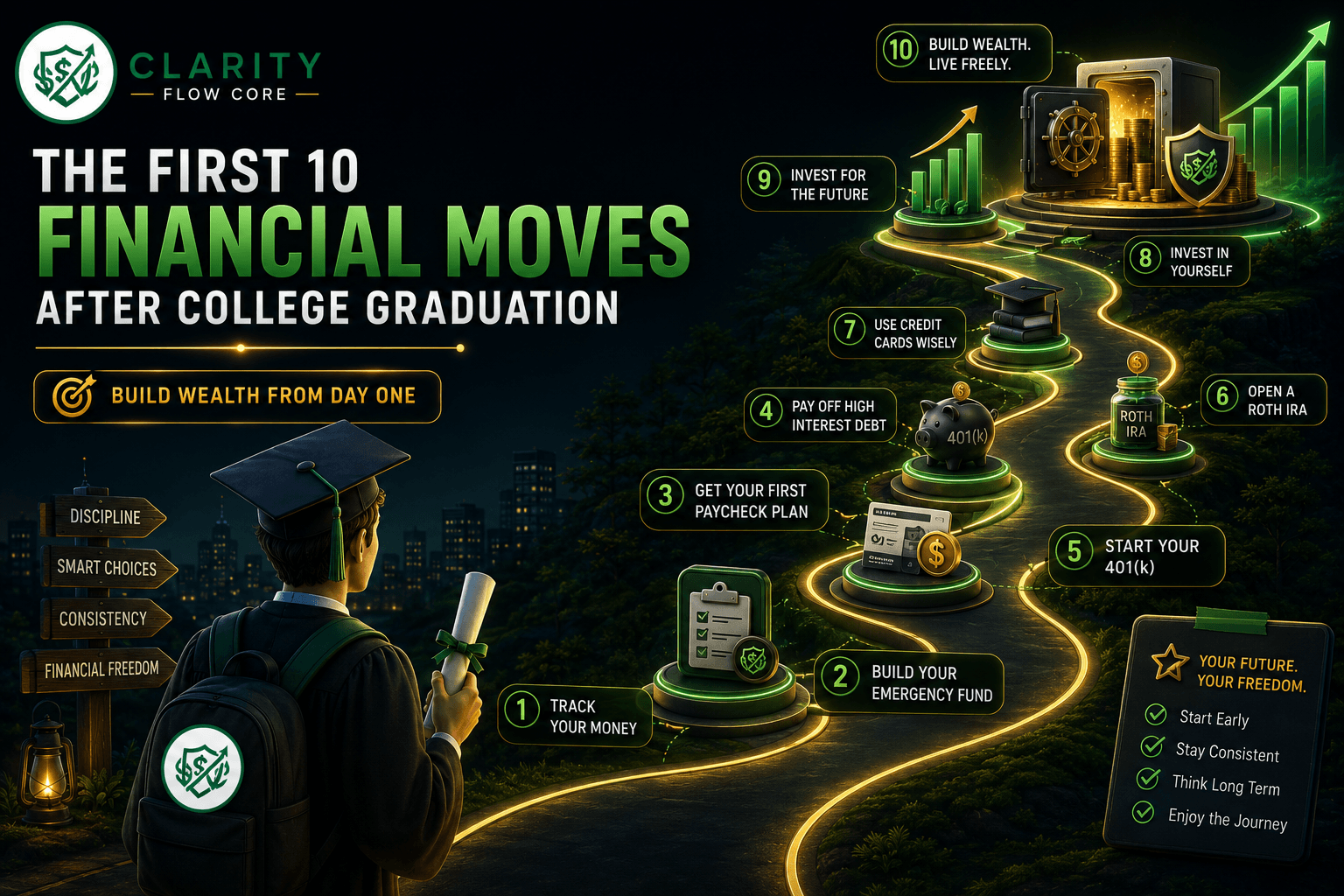
The First 10 Financial Moves After College Graduation
Walking across the stage to get your diploma is an incredible milestone, but it immediately thrusts you into an entirely new reality: the adult financial system.
For the last four years, your finances likely consisted of part-time jobs, student loans, and surviving on cheap food. Now, you are about to receive your first professional paycheck. If you do not have a strict system in place before that money hits your checking account, it will vanish into expensive rent, new car payments, and weekend trips.
To avoid the traps that keep most young adults broke for a decade, you must execute a strategic checklist. If you are wondering where to start, executing the first 10 financial moves after college graduation is the only way to build a bulletproof foundation.
This is not theory. This is the exact mathematical blueprint to build wealth in your twenties. Here are the exact first 10 financial moves after college graduation to secure your cash flow.
The Blueprint: Structuring Your New Income
Before diving into the detailed list, you need to understand how these first 10 financial moves after college graduation work together. They are broken into three distinct phases: Foundation, Defense, and Offense.
The Post-Grad Action Plan
How your financial checklist is structured for maximum efficiency.
Phase 1: Foundation
- Focus: Getting your money into the right accounts and capturing free employer cash.
- Moves: High-Yield Savings, Zero-Based Budgeting, 401(k) Match.
Phase 2: Defense
- Focus: Protecting yourself from debt, medical emergencies, and unexpected expenses.
- Moves: Health Insurance, Starter Emergency Fund, Student Loan Strategy.
Phase 3: Offense
- Focus: Automating wealth building and building a bulletproof credit profile.
- Moves: Roth IRA, Credit Cards, Automation, Lifestyle Creep Audit.
Phase 1: The Foundation
When tackling the first 10 financial moves after college graduation, your foundation begins with where your money lives.
1. Open a High-Yield Savings Account (HYSA) Do not leave your money in a traditional brick-and-mortar bank checking account earning 0.01% interest. Open an FDIC-insured HYSA immediately. This is where your savings and emergency fund will live, earning significantly more interest every single month.
2. Build a Zero-Based Budget Before you spend a single dollar of your new salary, give every dollar a job. A zero-based budget means your Income minus your Expenses equals exactly zero. Use the Smart Budget Planner & Cash Flow Analyzer to map out your rent, groceries, and savings targets before the month begins.
3. Claim Your Employer 401(k) Match If your new job offers a 401(k) match (e.g., they match 100% of your contributions up to 5% of your salary), you must contribute enough to get that match. It is a 100% guaranteed return on your investment. Declining a 401(k) match is the equivalent of taking a voluntary pay cut on your first day.
Phase 2: The Defense
As you progress through your first 10 financial moves after college graduation, you must build a defensive shield.
4. Pick the Right Health Insurance You have 60 days after graduation (or aging out of your parents’ plan at 26) to secure health insurance. If your employer offers plans, read the fine print. If you are young and healthy, a High Deductible Health Plan (HDHP) with a Health Savings Account (HSA) is often the most mathematically efficient choice. (Read HSA vs FSA: Which Actually Saves You More Money?).
5. Build a 1-Month Starter Emergency Fund Before aggressively paying off debt or buying a new car, you must save exactly one month of living expenses in your HYSA. If your car breaks down or you have a medical emergency, this prevents you from putting the bill on a 24% interest credit card.
6. Map Out Your Student Loan Repayment Log into Federal Student Aid and your private loan portals. Find out exactly when your grace period ends (usually 6 months post-grad) and what your monthly minimums will be. Do not wait for the first bill to arrive in the mail—build the payment into your budget today.
Phase 3: The Offense
Executing the offensive strategy is the most crucial part of the first 10 financial moves after college graduation, as this is what actually builds long-term wealth.
7. Open and Fund a Roth IRA Once you have your employer match and your starter emergency fund, open a Roth IRA. This is an individual retirement account where your money grows completely tax-free forever. If you start maxing this out at age 22, the compound interest over 40 years will be astronomical. (Learn more in Traditional IRA vs Roth IRA: Which Is Better for Beginners?).
8. Secure a Starter Credit Card Your credit score dictates your ability to rent an apartment, buy a house, and even get certain jobs. If you don’t have credit, apply for a basic, no-annual-fee credit card. Put a single small subscription (like Netflix) on it, set it to autopay the statement balance in full every month, and throw the physical card in a drawer.
9. Automate Your Financial Life Willpower is a finite resource. Set up your direct deposit so that 20% of your paycheck automatically routes to your savings and investment accounts before it ever touches your primary checking account. If you never see the money, you won’t miss it.
10. Audit for Lifestyle Creep The moment you get your first raise, the temptation to upgrade your apartment or finance a luxury car will be overwhelming. Keep living like a broke college student for the first two years of your career. Route all raises and bonuses directly toward your investments. (See How to Audit Your Budget for Lifestyle Creep to stay on track).
Real-World Scenario: The Graduating Freelancer
The first 10 financial moves after college graduation look slightly different if you don’t have a corporate HR department handling your taxes and benefits.
Consider a recent grad who decides to launch a career as a freelance video editor right out of school. They don’t have an employer offering a 401(k) match or subsidized health insurance. If they treat their business income like personal spending money, they will be bankrupted by the IRS in April.
The Fix: By customizing the first 10 financial moves after college graduation for self-employment, this freelancer survives. For Move 3 (The Employer Match), they instead open a Solo 401(k) or SEP IRA to build their own retirement architecture. For Move 4 (Health Insurance), they navigate the ACA Healthcare Marketplace. Most importantly, before doing anything else, they set up a dedicated LLC business checking account to quarantine 30% of every client payment strictly for estimated taxes.
(If you are graduating into the gig economy, you must read our Freelance Video Editor Tax Guide to protect your income).
3 Traps That Keep New Grads Broke
When navigating the first 10 financial moves after college graduation, avoid these common wealth-destroying mistakes:
❌ Buying a New Car on a 72-Month Loan: The biggest mistake new grads make is celebrating their first job by financing a $40,000 car. Tying up 20% of your new income in a depreciating asset will destroy your ability to invest. Buy a reliable, used commuter car for cash if possible.
❌ Ignoring the “Grace Period” Interest: Federal student loans often give you a 6-month grace period before payments are due. However, on unsubsidized loans, interest is silently accruing and adding to your principal balance during those 6 months. Make interest payments immediately if you can.
❌ Paying Only the Minimum on Credit Cards: Carrying a balance on a credit card cancels out every other smart financial move you make. Paying 24% interest to a bank will drain your wealth faster than any investment can grow it.
Frequently Asked Questions
Is it too late to execute the first 10 financial moves after college graduation if I graduated 3 years ago? Absolutely not. If you are 25 or 26 and still living paycheck to paycheck, you can implement this exact checklist today. Start at Move 1 and work your way down the list.
What is the hardest part of the first 10 financial moves after college graduation? Avoiding lifestyle creep. Seeing your peers go on expensive vacations or lease luxury cars on social media makes it incredibly difficult to stick to a zero-based budget. Stay focused on your own math.
Should I invest or pay off my student loans first? It depends on the interest rate. If your student loans are at 4% or 5%, it is generally mathematically better to invest in the S&P 500 (which averages 8-10% historically) while making the minimum loan payments. If your private loans are at 9% to 12%, you must aggressively pay off the debt before investing heavily.
Your Action Plan
Do not let the excitement of a new salary blind you to the math of adulthood. Tackle the first 10 financial moves after college graduation this week:
- Open the Accounts: Open a High-Yield Savings Account and a Roth IRA today. It takes less than 15 minutes online.
- Log into HR: Ensure you are contributing enough to get 100% of your employer’s 401(k) match.
- Run the Numbers: Input your new salary into the Smart Budget Planner & Cash Flow Analyzer to figure out exactly what your rent limit is before you sign a lease.
By building this financial infrastructure in your first year out of school, you guarantee that your hard work translates into actual, lasting wealth.
Sources & Further Reading
Official U.S. Guidelines & Consumer Resources
- Federal Student Aid: Repaying Your Loans
- Consumer Financial Protection Bureau (CFPB): Managing Money as a Young Adult
- Securities and Exchange Commission (SEC): Introduction to Investing
Further Reading from Clarity Flow Core
- Smart Budget Planner & Cash Flow Analyzer
- Emergency Fund Basics: How Much Cash Should You Keep?
- How Much Should You Spend on a Car?
- ETF vs Mutual Fund vs Index Fund: Which to Choose?
Disclaimer: The information provided in this article is for educational and informational purposes only and does not constitute financial, investment, or tax advice. Student loan terms, interest rates, and tax-advantaged account rules vary and frequently change. Always evaluate your specific cash flow needs and consult with a certified financial planner (CFP®) or fiduciary advisor before making major financial decisions.
About Author

Rishabh Nigam
Rishabh Nigam founded Clarity Flow Core to make personal finance easier to understand for everyday readers. He covers credit scores, debt repayment, credit utilization, loan readiness, taxes, and financial planning through practical guides, calculators, and educational resources. His content focuses on turning complex financial concepts into clear, actionable steps that readers can apply in real life.




One Comment
Comments are closed.