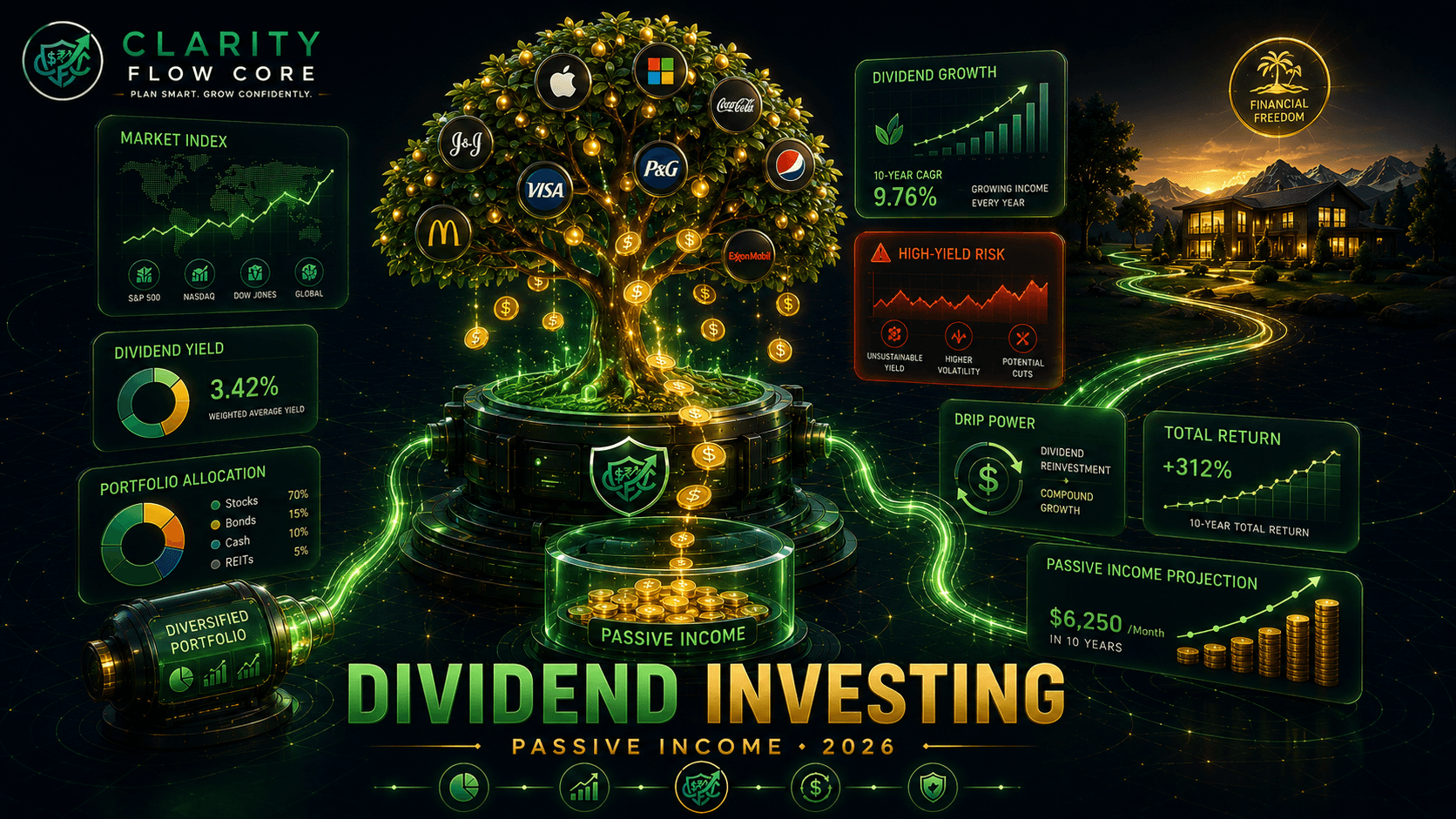
Dividend Investing for Beginners: Should You Live Off Dividends?
The ultimate financial dream is to stop trading your time for money and live entirely off passive income. On social media, you will frequently see influencers promoting dividend investing as the ultimate shortcut to this freedom, claiming you can easily pay your rent just by holding the right stocks.
The core concept is undeniably powerful: you buy shares in a profitable U.S. corporation, and in exchange for your investment, they deposit a portion of their cash profits directly into your brokerage account every single quarter. You don’t have to sell a single share to get paid.
But can you actually quit your job and survive on these payouts?
If you are researching dividend investing for beginners, you must separate the internet hype from the mathematical reality. Here is exactly how dividend yields work, the hidden traps that destroy new investors, and how to calculate the exact portfolio size you need to generate a permanent paycheck.
Phase 1: How the Market Prices Passive Income
Before you buy a dividend stock, you have to understand how yields are calculated. The “Dividend Yield” is simply the company’s annual cash payout divided by its current stock price.
If a stock costs $100 and pays out $3 a year in dividends, the yield is 3%.
In the 2026 U.S. economy, not all yields are created equal. You must understand the three primary categories of dividend investments before you allocate a single dollar.
The Dividend Yield Matrix
How the U.S. stock market actually categorizes payouts.
1. The S&P 500 Baseline
- The Target: Broad U.S. market index funds (like VOO or SPY).
- The Yield: Currently hovering around 1.1% to 1.4% in 2026.
- The Reality: Highly diversified and safe, but requires massive upfront capital to generate meaningful monthly cash flow.
2. Dividend Aristocrats
- The Target: U.S. companies that have increased payouts for 25+ consecutive years (e.g., Target, PepsiCo).
- The Yield: Typically ranges between 2% and 4.5%.
- The Reality: Excellent stability and consistent income, but slower overall stock price growth than aggressive tech stocks.
3. The High-Yield Trap
- The Target: Struggling companies offering massive 8% to 12% yields to attract desperate investors.
- The Math: Yields spike when the stock price plummets. An artificially high yield is usually a massive red flag.
- The Reality: Often leads to slashed dividends and massive capital losses.
Your Ecosystem Tool: Not sure how to properly balance dividend stocks with regular growth funds? Plug your accounts into the Investment Portfolio Planner & Goal Allocation Analyzer to see if you are taking on too much risk.
Phase 2: The Math of “Living Off Dividends”
To answer the question, should you live off dividends?, you must do the math on your required portfolio size. The calculation is straightforward: Annual Expenses / Dividend Yield = Required Portfolio Size.
If you determine that you need $60,000 a year to live comfortably in retirement, you cannot achieve that by investing $100,000.
- If you build a highly stable portfolio of Dividend Aristocrats yielding 3%, you need exactly $2,000,000 invested ($60,000 / 0.03 = $2,000,000).
- If you rely on a standard S&P 500 index fund yielding 1.3%, you would need over $4,600,000 invested to generate that same $60,000 in cash.
This mathematical reality highlights why dividend investing is a “get rich slow” strategy. You need substantial capital to generate a livable wage without touching your principal.
(Want to calculate your exact freedom number? Use the Financial Freedom Planner to track your required portfolio size).
Real-World Scenario: Total Return vs. Income
Consider an independent U.S. freelance video editor. Because their project income is wildly unpredictable, they love the idea of generating a stable $1,000 a month in dividends to cover their baseline utilities and software subscriptions.
To generate $12,000 a year, they calculate they need a portfolio of $400,000 yielding 3%. However, they only have $100,000 saved.
To speed up the process, they make a fatal error: they move their entire $100,000 into a risky, declining telecommunications company offering a 12% yield. For the first few months, they receive massive dividend checks. But because the company is fundamentally failing, the stock price crashes by 40%. The company then slashes its dividend entirely to avoid bankruptcy.
The freelancer chased income, but ignored Total Return (Stock Price Appreciation + Dividend Yield).
Instead of chasing risky high yields, they should have focused on Total Return by investing their profits into a broad-market index fund. Even if the dividend yield was only 1.5%, the underlying stock price would appreciate over time, ultimately growing their net worth faster safely. (To understand this balance, review Asset Allocation Strategies for Beginners: The 2026 Guide).
4 Deadliest Mistakes of Dividend Investing
If you are exploring dividend investing for beginners, avoid these four wealth-destroying traps:
❌ Failing to DRIP during the accumulation phase: DRIP stands for Dividend Reinvestment Plan. While you are still working and saving for retirement, you should never spend your dividend checks. You must set your brokerage account to automatically use those dividends to buy more shares of the stock, supercharging your compound interest.
❌ Ignoring the tax drag: If you hold dividend-paying stocks in a standard taxable brokerage account, the IRS taxes those payouts every single year, even if you reinvest them. To avoid this tax drag, try to hold high-yield dividend funds inside tax-advantaged accounts like a Roth IRA. (Calculate your liability with the Tax Strategy Planner & Annual Tax Savings Analyzer).
❌ Falling for the “Value Trap”: A company paying a 9% yield is almost always doing so because their stock price just collapsed, not because they are wildly profitable. Never buy a stock solely for its yield without looking at the company’s cash flow.
❌ Sacrificing diversification: If you build a portfolio exclusively out of high-dividend utility companies and banks, you completely miss out on the explosive growth of the technology and healthcare sectors (which traditionally pay very low dividends but offer massive stock price appreciation).
Frequently Asked Questions
What is the Ex-Dividend Date? This is the cutoff date to receive a dividend. To get the upcoming payout, you must purchase the stock before the ex-dividend date. If you buy the stock on or after this date, you will not receive the current dividend; it will go to the previous owner.
Are dividends guaranteed by the company? No. Unlike the interest on a bank savings account or a U.S. Treasury bond, corporate dividends are never legally guaranteed. If a company faces a harsh recession or declining profits, the Board of Directors can cut or entirely suspend the dividend at a moment’s notice.
Does a stock’s price drop when a dividend is paid? Yes. On the ex-dividend date, the stock exchange automatically adjusts the share price downward by the exact amount of the dividend. The cash is physically leaving the company’s balance sheet, so the company is theoretically worth slightly less on that specific day.
Your Action Plan
Do not let the complexity of the stock market keep you on the sidelines. If you want to leverage dividend investing to build passive income, execute these three steps today:
- Define Your True Cash Need: You cannot build a dividend strategy until you know your exact baseline expenses. Audit your cash flow using the Smart Budget Planner & Cash Flow Analyzer.
- Turn on Auto-Reinvest: Log into your U.S. brokerage accounts (Vanguard, Fidelity, Schwab) and verify that “Dividend Reinvestment” (DRIP) is turned on for all your current holdings.
- Run the Retirement Stress Test: Input your total portfolio balance and your target retirement date into the Retirement Readiness Planner & Retirement Income Analyzer to see if a strict dividend income strategy is mathematically viable for your timeline.
Sources & Further Reading
Official U.S. Guidelines & Consumer Resources
- Securities and Exchange Commission (SEC): Investor Bulletin: Dividends
- Financial Industry Regulatory Authority (FINRA): Understanding Dividend Yields and Risks
Essential Tools from Clarity Flow Core
- Investment Portfolio Planner & Goal Allocation Analyzer
- Financial Freedom Planner
- Tax Strategy Planner & Annual Tax Savings Analyzer
- Smart Budget Planner & Cash Flow Analyzer
- Retirement Readiness Planner & Retirement Income Analyzer
Further Reading from Clarity Flow Core
- Asset Allocation Strategies for Beginners: The 2026 Guide
- Index Funds vs. Mutual Funds: What Beginners Should Know
- Coast FIRE Explained: Can You Retire Early Without Saving Millions?
- Traditional IRA vs Roth IRA: Which Is Better for Beginners?
Disclaimer: The information provided in this article is for educational and informational purposes only and does not constitute financial, legal, or tax advice. Dividend yields and payouts are never guaranteed and can be reduced or eliminated by a corporation at any time. Investing in the stock market involves risk, including the possible loss of principal. Always consult with a certified financial planner (CFP®) or a registered investment advisor before executing an income-focused investment strategy or relying on dividends for your retirement income.
About Author

Rishabh Nigam
Rishabh Nigam founded Clarity Flow Core to make personal finance easier to understand for everyday readers. He covers credit scores, debt repayment, credit utilization, loan readiness, taxes, and financial planning through practical guides, calculators, and educational resources. His content focuses on turning complex financial concepts into clear, actionable steps that readers can apply in real life.