
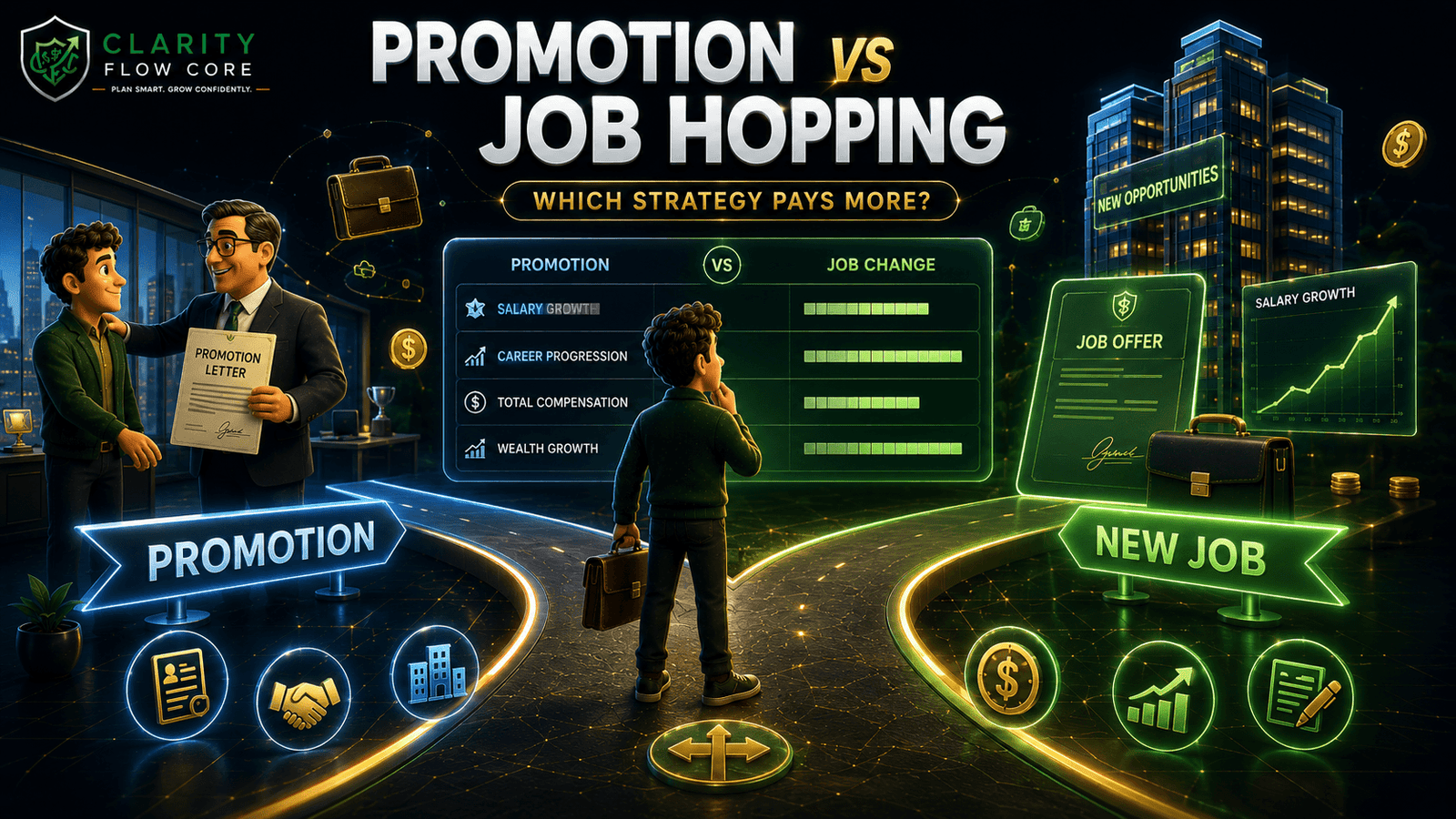
Promotion vs Job Hopping: Which Pays More?
Promotion vs Job Hopping: Which Pays More?
Corporate loyalty is a noble concept, but in the modern U.S. economy, it is rarely rewarded with cash. If you stay at the exact same company for a decade, waiting patiently for management to recognize your hard work, you are almost certainly underpaid.
This financial phenomenon is known as the “Loyalty Tax.” Because companies know it requires immense effort and risk for an employee to interview and switch jobs, they are heavily incentivized to offer you the smallest possible annual raise required to keep you from leaving.
If you want to rapidly scale your income, you have to face the ultimate career debate: promotion vs job hopping. While one offers comfort and stability, the other offers aggressive mathematical growth. Here is exactly how the numbers break down so you can plan your next career move.
Quick Answer: Which Strategy Actually Pays More?
Statistically, job hopping pays significantly more than waiting for an internal promotion. The average annual merit increases for staying in your current role is roughly 3% to 5%, which barely outpaces standard inflation. Even if you secure an internal promotion with a title change, companies typically cap internal raises at 8% to 12%. Conversely, switching companies allows you to completely bypass internal HR salary caps and negotiate at the current open-market rate. Job hoppers routinely secure 10% to 20% salary bumps with every move, compounding their wealth exponentially faster than their loyal peers.
The Financial Reality (By the Numbers)
When deciding between staying and leaving, you cannot rely on emotion. Look at the baseline data dictating the modern labor market.
The Strategic Comparison Table
Understanding the nuances of promotion vs job hopping goes beyond just the base salary. Each strategy carries entirely different risks and operational benefits.
| Metric | Internal Promotion | Job Hopping |
| Financial Upside | Moderate (Capped by internal HR bands). | High (Negotiated at current open-market rates). |
| Onboarding Friction | Low (You already know the systems and culture). | High (Must learn a new company, boss, and culture). |
| Resume Impact | Shows deep loyalty, progression, and staying power. | Can look erratic if you switch every single year. |
| Leverage | You must prove you are ready for the next level. | The new company is actively competing to win your talent. |
| Benefits/Equity | You keep your unvested 401(k) match and stock options. | You may lose unvested benefits, but can negotiate a sign-on bonus. |
Real-World Scenario: The Independent Freelancer
The rules of the “Loyalty Tax” apply just as heavily to independent contractors as they do to corporate employees.
Consider a freelance video editor who has spent the last two years on a $3,000 monthly retainer for a digital marketing agency. Over those two years, the editor’s skills have sharpened, their rendering hardware has improved, and they are delivering final cuts twice as fast.
If the editor asks the agency for a “promotion” (a retainer increase), the agency will likely push back. The client is anchored to the original $3,000 price tag, and mentally, they struggle to justify paying 20% more for the exact same person.
However, if the video editor takes their newly refined portfolio and pitches a brand new client—a financial education platform—they can easily quote $4,500 a month for the same workload. The new client has no prior price anchor; they simply look at the high-end portfolio and accept the open-market rate. By “job hopping” to a new client contract rather than begging an old client for a raise, the editor instantly scales their monthly revenue.
(If you are balancing multiple contracts, ensure you organize your incoming cash using How to Budget as a Freelancer When Income Changes Every Month).
4 Deadliest Mistakes When Switching Roles
Whether you decide to stay or go, avoid these four wealth-destroying traps:
❌ Ignoring the mortgage impact: If you plan to buy a house this year, aggressive job hopping can spook mortgage lenders. They prefer to see two years of steady employment history in the same field. (Run your affordability numbers first using the Mortgage Affordability Calculator & Home Buying Planner).
❌ Ignoring unvested compensation: If you job hop after 11 months, but your company’s 401(k) match requires 12 months to vest, you just abandoned thousands of dollars of free money. Always calculate your Total Compensation (base pay + unvested stock + bonuses) before jumping ship.
❌ Hopping too frequently: A 15% raise is great, but if you have five different jobs on your resume over the span of three years, hiring managers will view you as a massive flight risk. Try to stay at least 18 to 24 months before jumping, a metric often supported by data from the Bureau of Labor Statistics regarding average employee tenure.
❌ Accepting a counter-offer: If you resign and your current company suddenly offers to match the new salary, do not accept it. They now know you are disloyal, and they are only paying you to stick around until they can find a cheaper replacement.
Frequently Asked Questions
Is job hopping bad for my career long-term? Not if it is executed strategically. In the modern tech and digital media sectors, changing companies every two to three years is entirely normal and often expected. It only becomes a red flag if you are leaving roles every 6 to 9 months without clear progression.
How do I calculate if a job hop is worth it? You must subtract the hidden costs. A new job might offer $10,000 more in base salary, but if the commute is 30 minutes longer and the health insurance premiums are $300 more expensive per month, your actual take-home increase might be negligible. Always use the Salary & Raise Impact Planner to calculate your exact after-tax reality.
Can I use a job offer to get a promotion at my current company? You can, but it is highly risky. While bringing an outside offer forces your current employer’s hand, it permanently damages the trust between you and management. It is generally safer to either negotiate a promotion internally using market data, or cleanly leave for the new offer.
Your Action Plan
Stop wondering if you are underpaid and take control of your earning timeline. Make your decision this week by executing these three steps:
- Define Your Market Value: Do not guess. Spend 30 minutes on Glassdoor researching your exact title, experience level, and zip code to see what competitors are actively paying for your skill set.
- Audit Your Vesting Schedule: Log into your employer’s HR portal or 401(k) provider. Note exactly when your retirement matches, stock options, or annual bonuses formally vest so you do not accidentally walk away from cash.
- Project the Cash Flow: Plug your potential new salary into the Salary & Raise Impact Planner. Compare your current take-home pay against the new offer to ensure the jump is mathematically worth the friction of switching roles.
Sources & Further Reading
Essential Tools from Clarity Flow Core
- Salary & Raise Impact Planner
- Net Worth Tracker & Wealth Growth Planner
- Mortgage Affordability Calculator & Home Buying Planner
Further Reading from Clarity Flow Core
- How to Budget as a Freelancer When Income Changes Every Month
- How to Start a Video Editing Side Hustle (Even as a Beginner)
- What to Do With Your First Paycheck: A Complete Financial Checklist
Disclaimer: The information provided in this article is for educational and informational purposes only and does not constitute career, legal, or financial advice. Labor markets and salary expectations vary significantly based on industry, geographic location, and individual skill level. Always review your personal employment contracts and consult with a career professional before making major employment decisions.
About Author

Rishabh Nigam
Rishabh Nigam founded Clarity Flow Core to make personal finance easier to understand for everyday readers. He covers credit scores, debt repayment, credit utilization, loan readiness, taxes, and financial planning through practical guides, calculators, and educational resources. His content focuses on turning complex financial concepts into clear, actionable steps that readers can apply in real life.