
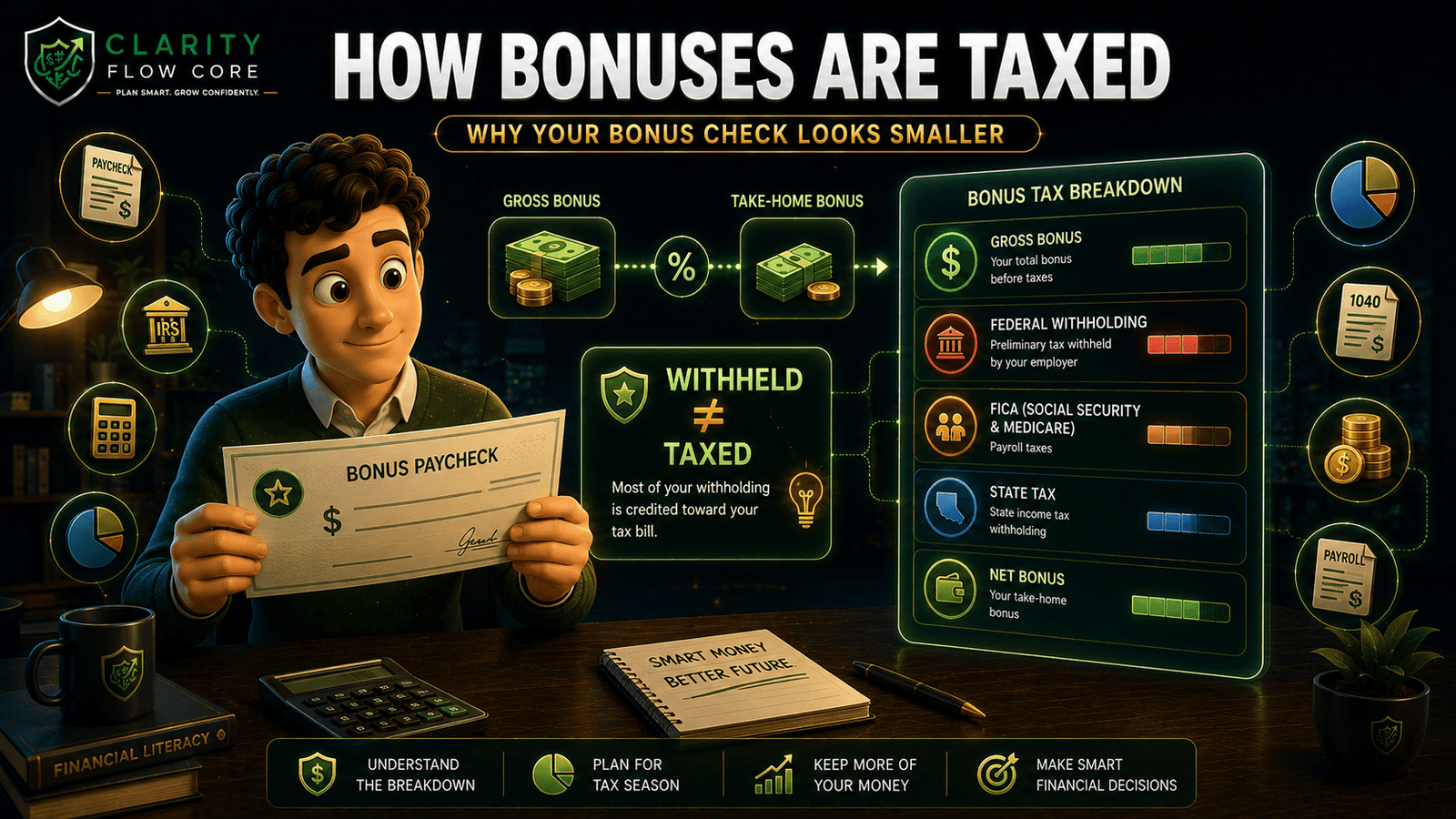
How Bonuses Are Taxed: The Supplemental Income Guide
Receiving a bonus at work is an exciting moment—until you actually look at your pay stub. Most employees are stunned to see that a massive chunk of their hard-earned reward has seemingly vanished into the hands of the IRS.
This leads to a widespread financial myth: “Bonuses are taxed at a much higher rate than regular income.”
This is mathematically false. Your bonus is not ultimately taxed at a higher rate; it is simply withheld differently upfront. To accurately project your cash flow and understand where your money is going, you must learn exactly how bonuses are taxed under U.S. federal law. Here is the definitive guide to decoding your supplemental pay.
Quick Answer: How Are Bonuses Taxed?
The IRS categorizes bonuses as “supplemental wages.” Because this money is paid in addition to your regular salary, employers are required to withhold taxes on it using one of two specific methods. The most common is the Percentage Method, where your employer withholds a flat 22% for federal income taxes (if the bonus is under $1 million). The alternative is the Aggregate Method, where your employer combines your bonus with your regular paycheck, which temporarily pushes that specific paycheck into a much higher withholding bracket.
However, when you file your tax return at the end of the year, your bonus is simply added to your total annual income. It is ultimately taxed at your standard marginal tax bracket. If your employer withheld too much money upfront, you will receive the difference back as a tax refund.
Phase 1: The Withholding Matrix
To predict your actual take-home pay, you must understand the three layers of taxes that will be pulled from your bonus check before it ever hits your bank account.
The Bonus Withholding Breakdown
How the IRS treats your supplemental income.
1. The Percentage Method
- The Math: The IRS mandates a flat 22% federal withholding rate for supplemental wages.
- The Reality: If you get a $10,000 bonus, your employer automatically sends $2,200 to the IRS for federal taxes. (If your bonus exceeds $1 million, the rate jumps to 37%).
2. The Aggregate Method
- The Math: Your bonus is added to your regular paycheck, and taxes are calculated as if that massive sum is your normal weekly pay.
- The Reality: This often pushes you into the highest possible withholding bracket, making it look like your bonus was taxed at 35% or 40%.
3. FICA & State Taxes
- The Math: You still owe 7.65% for FICA (Social Security & Medicare), plus any applicable state taxes.
- The Reality: The 22% federal rate is just the beginning. Once FICA and state taxes are pulled, it is common to lose 35% to 40% of the gross bonus upfront.
The Strategic Comparison Table
Employers get to choose which withholding method they use. Here is how their choice impacts your immediate cash flow.
| Metric | The Percentage Method | The Aggregate Method |
| How it is calculated | Bonus is processed separately at a flat 22%. | Bonus is lumped in with your standard base salary. |
| Immediate Take-Home Pay | Usually higher (unless you are in a top tax bracket). | Usually lower (withholding assumes you make this much every check). |
| End of Year Result | You may owe a little extra at tax time if your actual tax bracket is above 22%. | You will likely get a larger tax refund because they over-withheld upfront. |
(To see exactly where all these deductions go, review Understanding Your Pay Stub: Every Number Explained).
Real-World Scenario: The Corporate Bonus vs. The Freelancer
The rules for supplemental income apply exclusively to W-2 corporate employees.
Consider a marketing director who earns an $80,000 base salary and receives a $10,000 year-end performance bonus. Their employer uses the flat Percentage Method. Before the money hits their bank account, the employer deducts 22% for federal taxes ($2,200) and 7.65% for FICA ($765). Assuming a 5% state tax ($500), the director’s actual take-home pay is roughly $6,535.
Now, consider an independent freelancer who secures a $10,000 performance bonus from a client for finishing a project early. Because freelancers are 1099 independent contractors, the IRS supplemental wage rules do not apply. The client cuts the freelancer a check for the full $10,000 with exactly zero dollars withheld.
However, the freelancer must have the discipline to set aside roughly 25% to 30% of that cash immediately. When the next quarter ends, they are legally required to send that money to the IRS themselves.
(Freelancers: Ensure you do not get penalized at year-end by mastering your Quarterly Estimated Taxes Explained for Freelancers and Side Hustlers).
4 Deadliest Mistakes When Handling a Bonus
Do not let a sudden influx of cash ruin your financial plan. Avoid these four common traps:
❌ Confusing “withheld” with “taxed”: If your employer uses the Aggregate Method and withholds 38% of your bonus, you were not taxed at 38%. When you file your Form 1040, the IRS calculates your actual tax bracket. If you only owed 22%, the IRS will refund you the excess 16% your employer withheld.
❌ Spending the gross amount: Never commit to buying a $10,000 car or vacation because your boss promised you a “$10,000 bonus.” You must budget based on the net amount, which will likely be closer to $6,000 to $6,500.
❌ Ignoring 401(k) deductions: If you have your 401(k) set to automatically deduct 10% of your paycheck, that rule often applies to bonuses as well. If you were expecting cash but your company diverted 10% into your retirement account, your take-home pay will be even lower than expected.
❌ Mismanaging your W-4: If you consistently get massive bonuses and massive tax refunds, you are giving the government a free, 0% interest loan all year. Adjust your forms to keep more money in your pocket today. (Learn how in W-4 Form Explained: How Tax Withholding Actually Works).
Frequently Asked Questions
Can I avoid paying taxes on a bonus?
You cannot completely avoid taxes, but you can defer them. If your employer allows it, you can direct your bonus straight into a traditional 401(k) or traditional IRA. Because these are pre-tax accounts, you will not pay income taxes on that money until you withdraw it in retirement.
Do sign-on bonuses work the same way?
Yes. Sign-on bonuses, relocation bonuses, severance pay, and commission payouts are all legally categorized by the IRS as supplemental wages and are subject to the exact same withholding rules.
Why was my bonus taxed at nearly 40%?
Again, it wasn’t taxed at 40%, it was withheld at 40%. This happens when your employer uses the Aggregate Method, pushing you into a higher temporary withholding bracket, combined with the mandatory 7.65% FICA tax and your state income tax. It all evens out when you file your annual tax return.
Your Action Plan
Now that you understand how bonuses are taxed, you can protect your cash flow. Take these three steps the next time a bonus is announced:
- Calculate the Reality: Expect to only see about 60% to 65% of the gross bonus amount in your checking account. Check your employer’s HR portal to see if they use the Percentage Method or Aggregate Method to make a more accurate projection.
- Optimize Your Withholding: Run your projected income through the Tax Withholding & Paycheck Optimizer to ensure you are not over-withholding on your regular paychecks just because of a one-time bonus.
- Assign the Cash Immediately: A bonus is the fastest way to accelerate your wealth, but only if you give the dollars a job before they hit your account. Plug the incoming cash into the Smart Budget Planner & Cash Flow Analyzer to ensure it goes toward debt payoff or investments, rather than lifestyle creep.
Sources & Further Reading
Official U.S. Guidelines & Consumer Resources
- Internal Revenue Service (IRS): Publication 15 (Circular E), Employer’s Tax Guide – Supplemental Wages
- Securities and Exchange Commission (SEC): Maximizing Your Earning Potential
Essential Tools from Clarity Flow Core
- Tax Withholding & Paycheck Optimizer
- Smart Budget Planner & Cash Flow Analyzer
- Net Worth Tracker & Wealth Growth Planner
Further Reading from Clarity Flow Core
- Understanding Your Pay Stub: Every Number Explained
- W-4 Form Explained: How Tax Withholding Actually Works
- Quarterly Estimated Taxes Explained for Freelancers and Side Hustlers
- How to Audit Your Budget for Lifestyle Creep (Without Feeling Deprived)
Disclaimer: The information provided in this article is for educational and informational purposes only and does not constitute tax, legal, or financial advice. Tax laws, withholding rates, and IRS guidelines are subject to change. Always consult with a Certified Public Accountant (CPA) or a registered tax professional regarding your specific financial situation before altering your tax documents or financial plans.
About Author

Rishabh Nigam
Rishabh Nigam founded Clarity Flow Core to make personal finance easier to understand for everyday readers. He covers credit scores, debt repayment, credit utilization, loan readiness, taxes, and financial planning through practical guides, calculators, and educational resources. His content focuses on turning complex financial concepts into clear, actionable steps that readers can apply in real life.