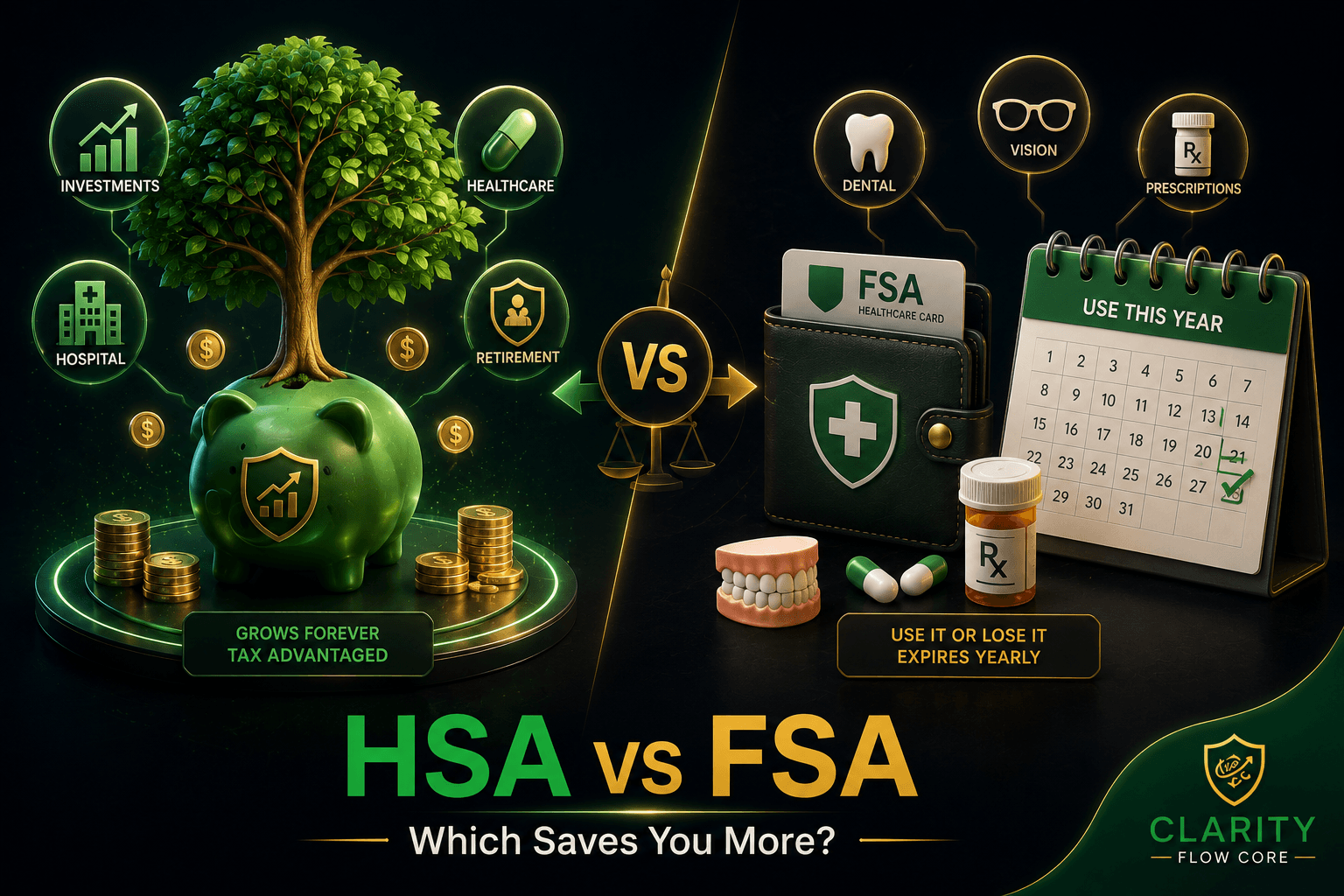
HSA vs FSA: Which Actually Saves You More Money?
Every year during open enrollment, millions of people blindly select their health insurance and randomly guess the winner of the HSA vs FSA debate for their family.
This guesswork is incredibly expensive.
Choosing the right side in the HSA vs FSA decision is not just a medical choice; it is a major tax and wealth-building decision. Pick the wrong one, and you could forfeit thousands of dollars back to your employer at the end of the year. Pick the right one, and you unlock the single most powerful tax shelter in the U.S. tax code.
Before you start: Grab your employer’s open enrollment packet or your health insurance marketplace plan details. As you read this guide, check your plan’s deductible. Your deductible amount dictates exactly which of these accounts you are legally allowed to use.
Know Your Acronyms Quick Reference
The healthcare industry runs on confusing abbreviations. Keep this cheat sheet handy as you evaluate your options:
| Abbreviation | Meaning | How It Works |
| HSA | Health Savings Account | You own it forever. Your money rolls over year to year. |
| FSA | Flexible Spending Account | Your employer owns it. You lose unused money at year-end. |
| HDHP | High Deductible Health Plan | A cheap monthly insurance plan required to open an HSA. |
| LPFSA | Limited Purpose FSA | A special FSA just for dental/vision if you already have an HSA. |
| OTC | Over-the-Counter | Meds (like Tylenol) that you can buy tax-free with these accounts. |
The Baseline: What Do HSA vs FSA Accounts Actually Do?
When comparing HSA vs FSA accounts, it helps to understand their shared baseline: They both allow you to pay for medical expenses using tax-free money.
Normally, if you earn $1,000, the Internal Revenue Service (IRS) takes roughly 20-30% in taxes, leaving you with $700 to pay for a doctor’s visit. With either account, you bypass the IRS entirely. You contribute $1,000, no taxes are removed, and you have the full $1,000 to spend at the pharmacy.
That is where the similarities end.
The Head-to-Head Matchup: HSA vs FSA
Compare these two accounts against your current financial habits to see which structure fits your life.
| Feature | Health Savings Account (HSA) | Flexible Spending Account (FSA) |
| Who owns the money? | You. It stays with you even if you quit or get fired. | Your employer. If you leave the job, they keep the money. |
| Rollover Rules | All unused money rolls over to the next year forever. | Use it or lose it. Unused funds disappear on Dec 31st (with minor exceptions). |
| Eligibility | You must be enrolled in a High Deductible Health Plan (HDHP). | You do not need an HDHP. Anyone whose employer offers an FSA can use it. |
| Investment Options | Yes. You can invest the cash in the stock market to grow wealth. | No. The money sits in cash until you spend it. |
| Contribution Timing | You can change how much you contribute at any time during the year. | You must lock in your annual contribution amount during open enrollment. |
The HSA: The “Triple Tax Advantage” Secret
Financial planners overwhelmingly pick the HSA in the HSA vs FSA debate because it is the only account in America that offers a triple tax advantage. It beats both the Traditional IRA and the Roth IRA in sheer mathematical efficiency.
Here is how the triple tax advantage works:
- Tax-Free Contributions: Money goes in completely tax-free (lowering your taxable income today).
- Tax-Free Growth: You can invest the money in index funds. It grows tax-free for decades.
- Tax-Free Withdrawals: When you pull the money out for medical expenses, you pay zero taxes.
The Secret Retirement Loophole:
Once you turn 65, the rules change. You can withdraw money from an HSA for non-medical reasons (like buying a boat or paying for a vacation) without paying the standard 20% penalty. You simply pay normal income tax on it, exactly like a 401(k). If you never get sick, your HSA seamlessly transforms into a massive retirement account.
Your Ecosystem Tool: Want to see how much an HSA could lower your tax bill today? Run your salary and planned HSA contribution through our Tax Withholding & Paycheck Optimizer to see your exact new take-home pay.
The FSA: The Immediate Cash Flow Solution
While the FSA lacks long-term investment power, it has one massive, unique superpower in the HSA vs FSA comparison: The funds are front-loaded.
If you elect to contribute $2,400 to your FSA for the year, your employer will deduct $200 from your paycheck every month. However, on January 1st, the entire $2,400 is immediately available on your FSA debit card.
This makes the FSA the perfect tool if you know you have a major, predictable medical expense coming up early in the year (like childbirth, scheduled surgery, or braces for your child) but do not have the cash saved up yet.
Real-World Scenarios: HSA vs FSA in Action
Do not choose an account based on theory. Choose it based on your actual life circumstances.
Scenario 1: The Healthy Freelancer
Consider an independent freelancer who rarely visits the doctor and buys their own insurance on the healthcare marketplace.
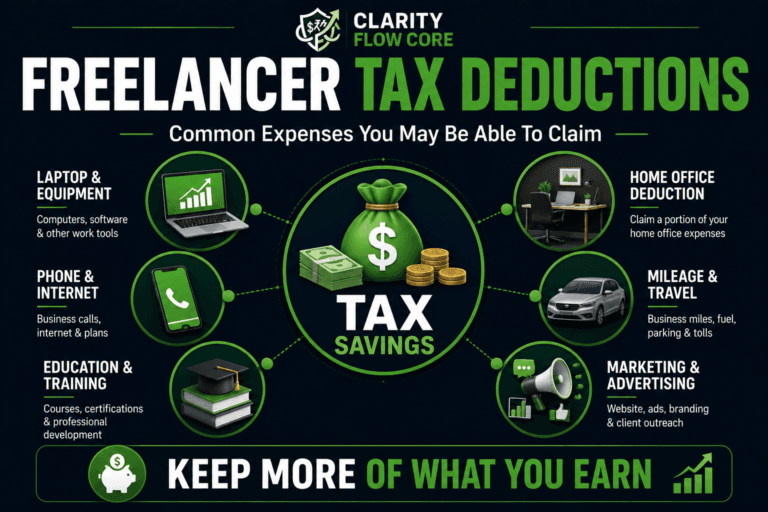
- The Strategy: They should choose a High Deductible Health Plan (HDHP) because the monthly premiums are incredibly cheap. This unlocks the HSA. Because they rarely have medical bills, they can max out their HSA contributions, invest the cash in index funds, and use it as a secondary, tax-deductible retirement account. As a freelancer, this lowers their taxable net profit significantly (for more on freelance write-offs, review our Freelance Video Editor Tax Guide).
Scenario 2: The Family Planning for Braces
A family with three kids has a traditional, low-deductible health plan through an employer. They know one child needs $4,000 in orthodontic work this year.
- The Strategy: Because they do not have a High Deductible Health Plan (HDHP), they cannot use an HSA. Instead, during open enrollment, they elect to put $3,000 into a standard FSA. This lowers their taxable income by $3,000, and they get access to the full amount on January 1st to pay the orthodontist tax-free.
Your Ecosystem Tool: If you are trying to budget for a known medical expense like braces or surgery, plug the total cost into the Smart Budget Planner & Cash Flow Analyzer to calculate exactly how much you need to divert from your paycheck.
The 4 Biggest HSA vs FSA Mistakes
When managing your healthcare accounts, avoid these common traps:
⚠ Failing to invest your HSA: Most HSAs leave your money sitting in a cash settlement fund earning 0%. You must actively log into your HSA portal and click “Invest” to allocate those funds into the stock market.
⚠ Overfunding the FSA: Because the FSA is “use it or lose it,” contributing $3,000 when you only expect $1,000 in medical bills means you will forfeit $2,000 back to your employer on December 31st.
⚠ Not keeping your receipts: If the IRS audits your account, you must prove that the funds were used for qualified medical expenses. Always save the itemized receipts, not just the credit card slips.
⚠ Using an HSA to pay for minor bills today: The mathematical ideal is to pay for minor medical bills out-of-pocket (using cash) and let your HSA money stay invested and compounding for decades. Keep your receipts; you can legally reimburse yourself from your HSA 20 years from now.
Frequently Asked Questions
When comparing an HSA vs FSA, can I have both at the same time?
Generally, no. The IRS strictly prohibits having a standard medical FSA and an HSA at the same time. However, there is a loophole: You can have an HSA and a Limited Purpose FSA (LPFSA). An LPFSA can only be used for dental and vision expenses, allowing you to save your HSA funds strictly for medical emergencies and investing.
What happens to my FSA if I quit my job?
If you quit or are fired, you immediately lose access to your FSA funds. (Pro tip: If you know you are quitting next month, spend your remaining FSA balance on eligible items like new glasses or first-aid kits before you hand in your notice).
What happens to my HSA if I quit my job?
Nothing. You own the HSA. The account goes with you, and the funds remain yours forever, just like a personal checking account or an IRA.
Can I buy over-the-counter (OTC) medicine with these accounts?
Yes. You can use both HSA and FSA funds to buy Tylenol, allergy medication, sunscreen (SPF 15+), menstrual care products, and first-aid kits tax-free.
Your Action Plan
Do not let default HR settings drain your paycheck. Solve your HSA vs FSA debate today by taking these three steps before your open enrollment period closes:
- Check your deductible: Verify if your current (or proposed) health insurance plan qualifies as a High Deductible Health Plan (HDHP). If it does, you unlock the HSA.
- Audit your past medical spending: Look at your bank statements from the last 12 months. If you only spent $500 on healthcare, do not put $2,500 into a “use it or lose it” FSA.
- Factor this into your retirement strategy: If you are using an HSA as an investment vehicle, map out how it impacts your long-term independence using the Retirement Readiness Planner & Retirement Income Analyzer.
Your healthcare dollars should work for you, not your insurance company. Make the mathematical choice today.
Sources & Further Reading
Official U.S. Guidelines & Tools
- Internal Revenue Service (IRS): Publication 969: HSAs and Other Tax-Favored Health Plans
- Healthcare.gov: Understanding High Deductible Health Plans (HDHP)
Further Reading from Clarity Flow Core
- How to Save on Insurance Without Cutting Your Coverage
- Tax Withholding & Paycheck Optimizer
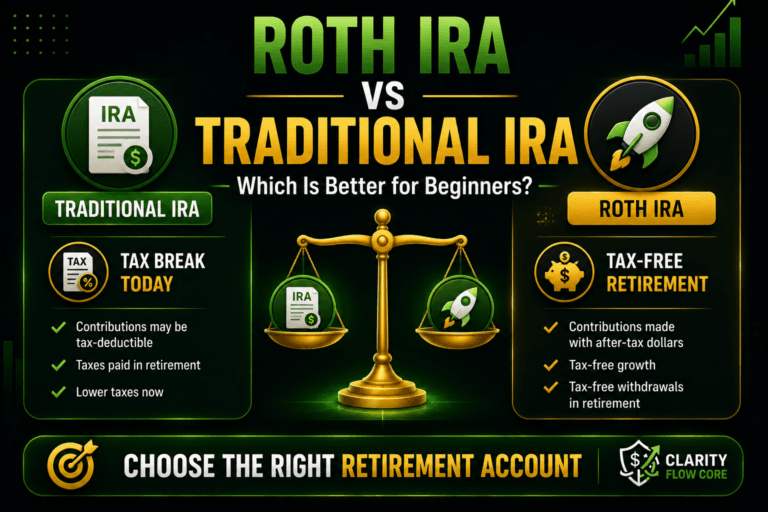
- Traditional IRA vs Roth IRA: Which Is Better for Beginners?
- Freelance Video Editor Tax Guide: Deductions, Write-Offs & Basics
Disclaimer: The information provided in this article is for educational and informational purposes only and does not constitute financial, legal, or tax advice. Always consult with a certified financial planner, CPA, or HR benefits coordinator regarding your specific financial situation before making any major financial decisions.
About Author

Rishabh Nigam
Rishabh Nigam founded Clarity Flow Core to make personal finance easier to understand for everyday readers. He covers credit scores, debt repayment, credit utilization, loan readiness, taxes, and financial planning through practical guides, calculators, and educational resources. His content focuses on turning complex financial concepts into clear, actionable steps that readers can apply in real life.