
Umbrella Insurance Explained: Do You Need It?
When you buy auto or homeowners insurance, you are buying a specific amount of financial protection. But what happens if you are sued for a catastrophic amount of money that completely blows past those limits?
When searching for who actually needs umbrella insurance, many people falsely assume it is a luxury product strictly for ultra-wealthy CEOs and celebrities. The reality is much more dangerous. We live in a highly litigious society where a single, severe car accident or a freak injury on your property can result in a million-dollar lawsuit.
If your standard insurance runs out, the courts do not just forgive the rest of the debt—they come after your personal savings, your investments, and your future wages.
If you are wondering who actually needs umbrella insurance, the answer comes down to a simple calculation of your personal risk and asset accumulation. Here is exactly how umbrella policies work and how to determine if your net worth requires one.
Phase 1: The Liability Coverage Gap
To understand who actually needs umbrella insurance, you must first understand the limits of the insurance you already have. Umbrella insurance is a secondary “fail-safe” policy. It only activates after your primary insurance (like auto or home) is completely exhausted.
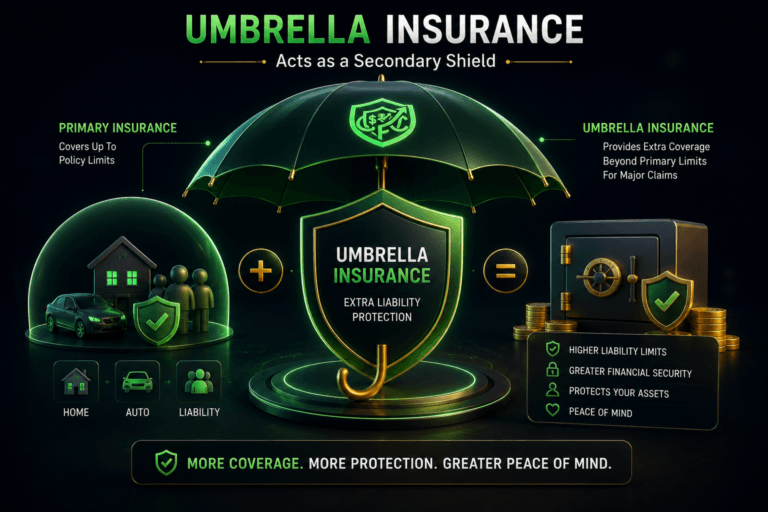
The Liability Shield Framework
How an umbrella policy stacks on top of your primary insurance.
1. The Auto Limit
- The Baseline: A standard, robust auto insurance policy usually caps bodily injury liability at $250,000 to $500,000.
- The Threat: If you cause a multi-car accident with severe injuries, medical bills can easily exceed $1 million.
2. The Property Limit
- The Baseline: Homeowners or renters insurance typically caps personal liability around $300,000.
- The Threat: This covers dog bites, pool accidents, or guests slipping and falling. If a guest requires long-term care, $300,000 will not cover it.
3. The Umbrella Shield
- The Activation: The moment a lawsuit exhausts your $300k or $500k primary limit, the Umbrella policy kicks in.
- The Coverage: It provides an additional $1 million to $5 million in legal defense and settlement funds, protecting your personal net worth.
Your Ecosystem Tool: Not sure how much your total net worth actually is? Add up your liquid cash, investment accounts, and home equity using our Net Worth Tracker & Wealth Growth Planner to see exactly how much wealth you stand to lose in a lawsuit.
Phase 2: The Math of Wage Garnishment
A common misconception when asking who actually needs umbrella insurance is thinking, “I don’t have a million dollars in the bank, so I don’t have anything to protect.”
This is a dangerous trap. If a judge rules against you in a $1 million liability lawsuit and your insurance only covers $300,000, you owe the plaintiff $700,000. If you don’t have the cash, the court can legally authorize wage garnishment.
According to the U.S. Department of Labor, federal law allows courts to siphon up to 25% of your disposable earnings to settle judgments. They will garnish your future paychecks for years (or decades) until the debt is settled. When evaluating who actually needs umbrella insurance, you must realize you are not just protecting the money you currently have—you are protecting the money you are going to make over the next 20 years.
Real-World Scenario: The Commuting Freelancer
The question of who actually needs umbrella insurance becomes highly relevant when you frequently drive or manage complex property scenarios. Auto accidents are the single most common trigger for umbrella insurance claims.
Consider an independent freelance video editor who frequently drives back and forth between clients. Because they drive heavily during high-traffic hours, their statistical risk of a severe auto accident increases. One afternoon, they cause a severe multi-car pileup. The medical bills, rehabilitation costs, and property damage for the other drivers total $850,000.
Their auto insurance policy covers the first $300,000, leaving a $550,000 shortfall. Without an umbrella policy, the court drains their savings, forces them to liquidate their retirement accounts, and garnishes their future freelance earnings.
However, if they had purchased a $1 million umbrella policy (which typically costs a remarkably low $200 to $300 per year), the insurance company would have simply written a check for the remaining $550,000. Their personal wealth and business cash flow would remain entirely untouched. You can use the Insurance Coverage Analyzer & Protection Planner to map out these exact coverage gaps across your life.
4 Deadliest Liability Mistakes
When figuring out who actually needs umbrella insurance, avoid these four massive financial errors:
❌ Assuming an LLC protects everything: If you run a business, an LLC offers protection. But if you personally cause a car accident while driving to a client meeting, the plaintiff can sue you personally, bypassing the LLC entirely.
❌ Dropping your underlying limits: To buy a $1M umbrella policy, insurers require you to max out your primary auto and home insurance liability limits first (usually to $300,000 or $500,000). You cannot buy state-minimum auto insurance and then try to slap an umbrella policy over it.
❌ Thinking it is too expensive: Because umbrella insurance only activates after a catastrophe, the premiums are incredibly cheap. A $1 million policy often costs less than $1 a day. Learn more about optimizing these costs in our guide on How to Save on Insurance Without Cutting Your Coverage.
❌ Forgetting about legal defense fees: Even if a lawsuit is entirely frivolous and you win the case, defending yourself in court can cost $50,000 to $100,000 in attorney fees. An umbrella policy usually covers your legal defense costs in addition to the settlement payout.
Frequently Asked Questions
Exactly who actually needs umbrella insurance? The golden rule is: You need umbrella insurance the moment your total net worth (cash, investments, home equity, and future earning potential) exceeds the maximum liability limits of your primary auto or homeowners insurance policy.
Does a personal umbrella policy cover my business? No. A standard personal umbrella policy specifically excludes business and commercial liabilities. If you are a freelancer or business owner, you need a separate Commercial Umbrella Policy or a General Liability Policy to cover professional errors or commercial accidents.
Does umbrella insurance cover my own medical bills? No. Umbrella insurance is strictly liability insurance. It pays out to other people when you are legally at fault for injuring them or damaging their property. It does not cover your own medical bills or damage to your own car.
Your Action Plan
Do not leave your net worth exposed to a freak accident. If you now understand who actually needs umbrella insurance, take these three steps today to secure your financial perimeter:
- Calculate Your Net Worth: Add up your retirement accounts, savings, and home equity. If that number is higher than $300,000, you are likely in the danger zone.
- Check Your Current Limits: Log into your auto and homeowners insurance portals. Look at your “Bodily Injury Liability” limits. If they are below $300,000/$500,000, you need to raise them before you can buy an umbrella policy.
- Request a Quote: Call your current auto insurance provider. Insurers offer massive discounts if you bundle your auto, home, and umbrella policies together. Ask for a quote on a $1 million umbrella policy—you will likely be shocked by how affordable it is.
Sources & Further Reading
Official U.S. Guidelines & Consumer Resources
- Insurance Information Institute (III): What is an Umbrella Liability Policy?
- Department of Labor (DOL): Wage Garnishment Rules
Further Reading from Clarity Flow Core
- Net Worth Tracker & Wealth Growth Planner
- Insurance Coverage Analyzer & Protection Planner
- How to Save on Insurance Without Cutting Your Coverage
- The Ultimate Financial Health Checkup (Annual Personal Finance Checklist)
Disclaimer: The information provided in this article is for educational and informational purposes only and does not constitute financial, legal, or insurance advice. Policy limits, exclusions, and premium costs vary significantly by provider and jurisdiction. Always consult with a licensed insurance broker or certified financial planner to evaluate your specific risk profile and coverage needs before purchasing a policy.
About Author

Rishabh Nigam
Rishabh Nigam founded Clarity Flow Core to make personal finance easier to understand for everyday readers. He covers credit scores, debt repayment, credit utilization, loan readiness, taxes, and financial planning through practical guides, calculators, and educational resources. His content focuses on turning complex financial concepts into clear, actionable steps that readers can apply in real life.