Gap Insurance vs. Full Coverage: The Complete Guide
When you sit in a dealership finance office, you are bombarded with insurance jargon. The finance manager will likely tell you that you need both “full coverage” and a “gap policy.” If you don’t understand the mechanics of gap insurance vs. full coverage, it is incredibly easy to feel like you are being scammed into buying duplicate products.
Here is the truth: they do not do the same thing. In fact, they are entirely different financial tools that protect completely different aspects of your net worth.
Assuming that “full coverage” will pay off your car loan if you total your vehicle is one of the most devastating financial mistakes a driver can make. If you owe more on your vehicle than it is currently worth, you are walking into a massive liability trap.
To protect your savings, you must understand exactly how these policies work together. Here is the definitive breakdown of gap insurance vs. full coverage so you can secure your vehicle without overpaying.
Phase 1: Gap Insurance vs. Full Coverage (The Core Differences)
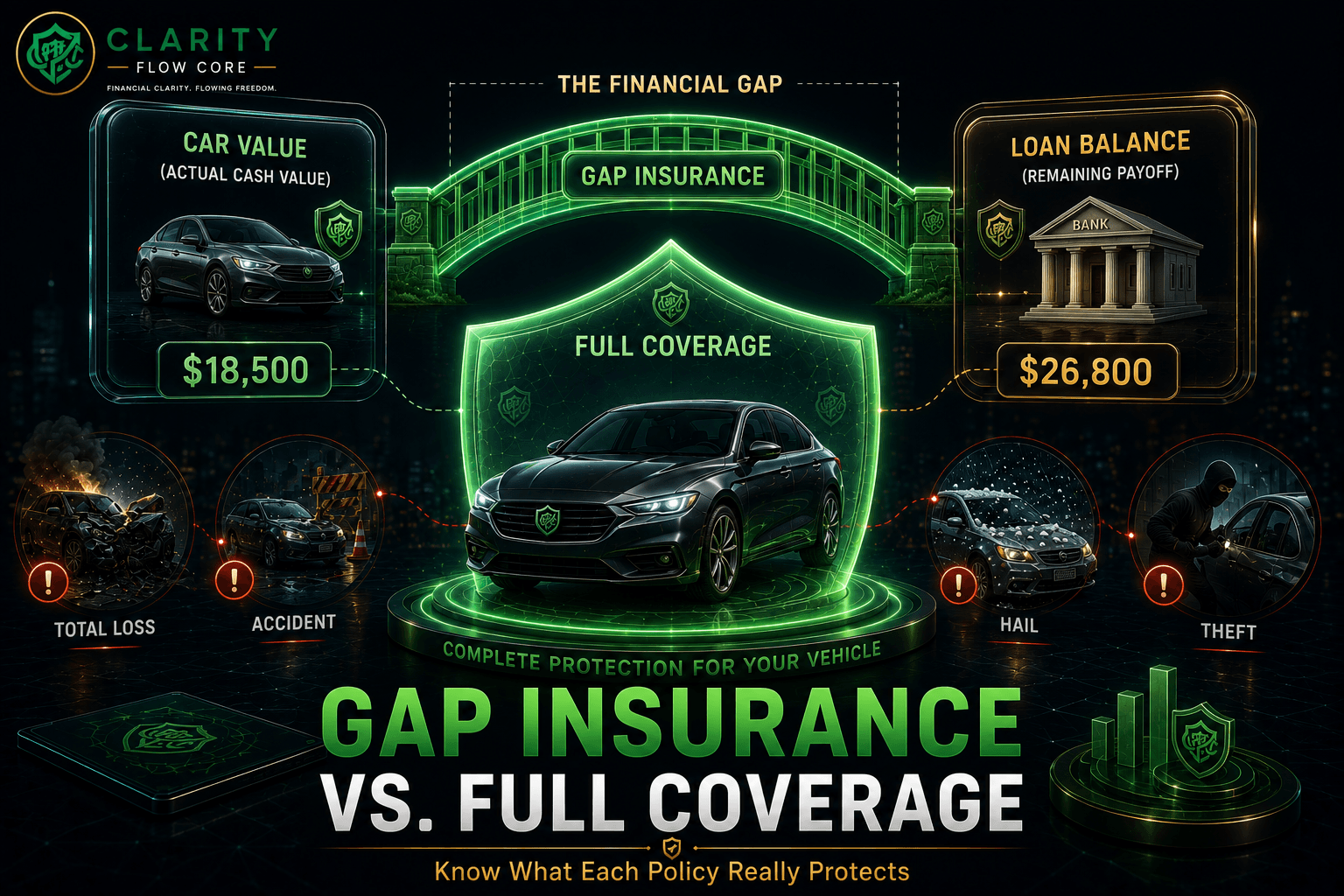
The easiest way to end the confusion around gap insurance vs. full coverage is to look at exactly who is getting paid when the vehicle is destroyed.
Coverage at a Glance
| Feature | Full Coverage | Gap Insurance |
| What it Protects | The physical car & other people | Your auto loan balance |
| How Much it Pays | The Actual Cash Value of the car | The difference between the car’s value and your loan |
| Who Gets the Money? | The repair shop, the victim, or your lender | Strictly your lender (the bank) |
| Is it Mandatory? | Yes, if you have an auto loan | Usually optional (except on leases) |
| When to Drop It | When the car is worth almost nothing | When you owe less than the car is worth |
The Protection Matrix
How the two policies interact during a total loss.
1. Full Coverage (The Foundation)
- The Components: A combination of Liability, Collision, and Comprehensive coverages.
- The Limit: It will never pay out more than the Actual Cash Value (ACV) of your vehicle on the day of the crash.
- The Problem: It does not care how much money you still owe the bank.
2. Gap Insurance (The Bridge)
- The Purpose: Covers the mathematical “gap” between what your car is worth (ACV) and what you still owe on your loan.
- The Trigger: It only activates if your car is declared a total loss (stolen or destroyed) and you are “underwater” on the loan.
Phase 2: Do You Need Gap Insurance If You Have Full Coverage?
When evaluating gap insurance vs. full coverage, the most common question is, “If I have full coverage, why do I need gap insurance?”
Because cars are depreciating assets. The moment you drive a brand-new car off the dealership lot, it immediately loses 10% to 20% of its value. If you put $0 down and financed the car for 72 months, you will owe the bank far more than the car is worth for the first three to four years of ownership.
The Real-World Mathematical Scenario
Imagine you buy a new car for $35,000. You put $0 down, meaning your loan balance is $35,000.
Six months later, you hit a patch of ice and total the car.
- Your Full Coverage policy assesses the vehicle. Because of rapid depreciation, the car’s Actual Cash Value is now only $28,000.
- The insurance company writes a check to your bank for $28,000.
- Your loan balance was $35,000.
Without Gap Insurance, you now legally owe the bank $7,000 for a car that no longer exists. You have to write a check out of your own emergency savings just to clear the debt.
If you had purchased Gap Insurance, the gap policy would step in and pay the remaining $7,000 directly to the lender, wiping your hands clean of the debt.
Phase 3: When to Buy It and When to Drop It
Understanding gap insurance vs. full coverage also means knowing when a policy becomes useless. Gap insurance is a temporary product.
You MUST buy Gap Insurance if:
- You made a down payment of less than 20%.
- Your auto loan term is 60 months or longer (which means you pay down the principal very slowly).
- You leased the vehicle (most leases legally require it, and it is often built into the contract).
- You rolled “negative equity” from an old car loan into your new car loan.
You MUST drop Gap Insurance when:
- You have finally paid down your loan balance so that it is lower than the Kelley Blue Book value of the car. At this point, the “gap” no longer exists. Continuing to pay for gap insurance is literally throwing money away, because the policy mathematically cannot pay out.
Your Ecosystem Tool: Not sure if you can afford the gap insurance premiums or a larger down payment? Use the Smart Budget Planner & Cash Flow Analyzer to run your automotive budget. Alternatively, read How Much Should You Spend on a Car? to avoid being underwater in the first place.
4 Deadliest Mistakes When Buying Gap Insurance
Now that you understand gap insurance vs. full coverage, avoid these four wealth-destroying traps:
❌ Buying Gap Insurance from the Dealership: The finance manager will try to sell you a gap policy for a flat fee of $600 to $1,000, rolled into your loan (meaning you pay interest on it). Do not do this. Call your own auto insurance provider. They will usually add gap insurance to your existing policy for $3 to $5 a month.
❌ Assuming Gap pays your deductible: Some premium gap policies will cover your $500 or $1,000 collision deductible, but most standard policies do not. You are still responsible for paying the deductible before the primary insurance kicks in.
❌ Forgetting to cancel the policy: Your insurance company will not automatically remove gap coverage when your loan balance dips below the car’s value. You must monitor your loan amortization schedule and manually call your agent to cancel the coverage once you have equity in the car.
❌ Confusing it with New Car Replacement: Some insurers offer “New Car Replacement” coverage. This pays to buy a brand-new version of your car if it is totaled in the first year. Gap insurance only pays off your existing loan; it does not give you extra money for a down payment on your next vehicle.
Frequently Asked Questions
If I total my car, will gap insurance give me a check? No. Gap insurance payments go directly to your auto lender (the bank) to satisfy the remainder of your auto loan. It does not put cash in your pocket.
Can I add gap insurance to my policy after I buy the car? Yes, but there is a strict time limit. Most auto insurance companies require you to add gap coverage within 30 days to 12 months of purchasing the vehicle, and you usually have to be the original owner of a new (or very lightly used) car.
Is gap insurance necessary for a used car? It depends on the math. Used cars depreciate much slower than new cars. If you buy a 4-year-old car and put 20% down, you will likely never owe more than the car is worth, making gap insurance completely unnecessary.
Your Action Plan
Do not wait for a catastrophic accident to test your financial perimeter. Take control of your auto insurance today:
- Check Your Loan Value: Log into your auto lender’s portal and write down your exact payoff amount.
- Check Your Car’s Value: Go to Kelley Blue Book or Edmunds and look up the private-party value of your car.
- Make the Call: If your loan balance is higher than the car’s value, call your insurance agent today and add gap insurance. If the loan is lower than the car’s value and you are currently paying for gap insurance, cancel it immediately and pocket the savings.
You can make checking this ratio a standard part of your yearly routine by following our Ultimate Financial Health Checkup (Annual Personal Finance Checklist).
Sources & Further Reading
Official U.S. Guidelines & Consumer Resources
- Consumer Financial Protection Bureau (CFPB): What is Gap Insurance?
- Insurance Information Institute (III): Understanding Auto Insurance
Further Reading from Clarity Flow Core
- Auto Insurance Coverage Levels Explained
- Financial Checklist Before Buying Your First Car
- How Much Should You Spend on a Car?
- Smart Budget Planner & Cash Flow Analyzer
Disclaimer: The information provided in this article is for educational and informational purposes only and does not constitute financial, legal, or insurance advice. Auto insurance policy limits, gap coverage terms, and state regulations vary significantly by provider and jurisdiction. Always consult with a licensed insurance broker to evaluate your specific loan-to-value ratio and coverage needs before adjusting or purchasing a policy.
About Author

Rishabh Nigam
Rishabh Nigam founded Clarity Flow Core to make personal finance easier to understand for everyday readers. He covers credit scores, debt repayment, credit utilization, loan readiness, taxes, and financial planning through practical guides, calculators, and educational resources. His content focuses on turning complex financial concepts into clear, actionable steps that readers can apply in real life.