How Much Can You Safely Withdraw From Retirement? The 2026 Guide
The transition from saving money to actually spending it is often the most terrifying financial leap a person can make. After decades of diligently watching your net worth climb, actively drawing down those balances feels entirely counterintuitive.
If you guess your withdrawal rate and pull out too much, you risk exhausting your savings just as your healthcare costs peak. If you withdraw too little out of fear, you artificially restrict your lifestyle, sacrificing travel and experiences you can actually afford.
If you are asking how much can you safely withdraw from retirement, you need to replace fear with rigid, mathematical strategy. Navigating modern inflation, volatile stock markets, and longer life expectancies requires more than a simple rule of thumb.
Here is exactly how to calculate your personalized Safe Withdrawal Rate (SWR) so you can generate a stress-free, permanent paycheck.
Phase 1: The Three Withdrawal Strategies
To determine how much can you safely withdraw from retirement, you first have to choose the mechanical system you will use to pull the money out.
The SWR Strategy Matrix
How to mathematically construct your retirement paycheck.
1. The Constant Dollar Method
- How it Works: You withdraw a set percentage (like 4%) in Year 1, and then simply increase that exact dollar amount by inflation every subsequent year.
- The Reality: It provides a highly predictable income, but lacks the flexibility needed to survive severe market crashes.
2. The Dynamic Guardrails
- How it Works: You establish a baseline (e.g., 4%), but agree to cut spending if the portfolio drops significantly, and increase spending if the market rallies.
- The Reality: This is the gold standard for modern retirement, protecting your principal while allowing for lifestyle upgrades during bull markets.
3. The Fixed Percentage Method
- How it Works: You withdraw exactly 4% or 5% of whatever the portfolio is worth on January 1st of that specific year.
- The Reality: You will mathematically never run out of money, but your income will fluctuate wildly year-to-year, making budgeting difficult.
Your Ecosystem Tool: Not sure which mechanical strategy fits your risk tolerance? Run your exact portfolio numbers through the Retirement Withdrawal Planner & Safe Withdrawal Strategy Analyzer to map out your long-term income plan.
Phase 2: The 3 Variables That Break the Math
When people ask how much can you safely withdraw from retirement, they often assume they can just pick a percentage and ignore the outside world. To guarantee your portfolio survives, you must account for three external threats:
1. Sequence of Returns Risk
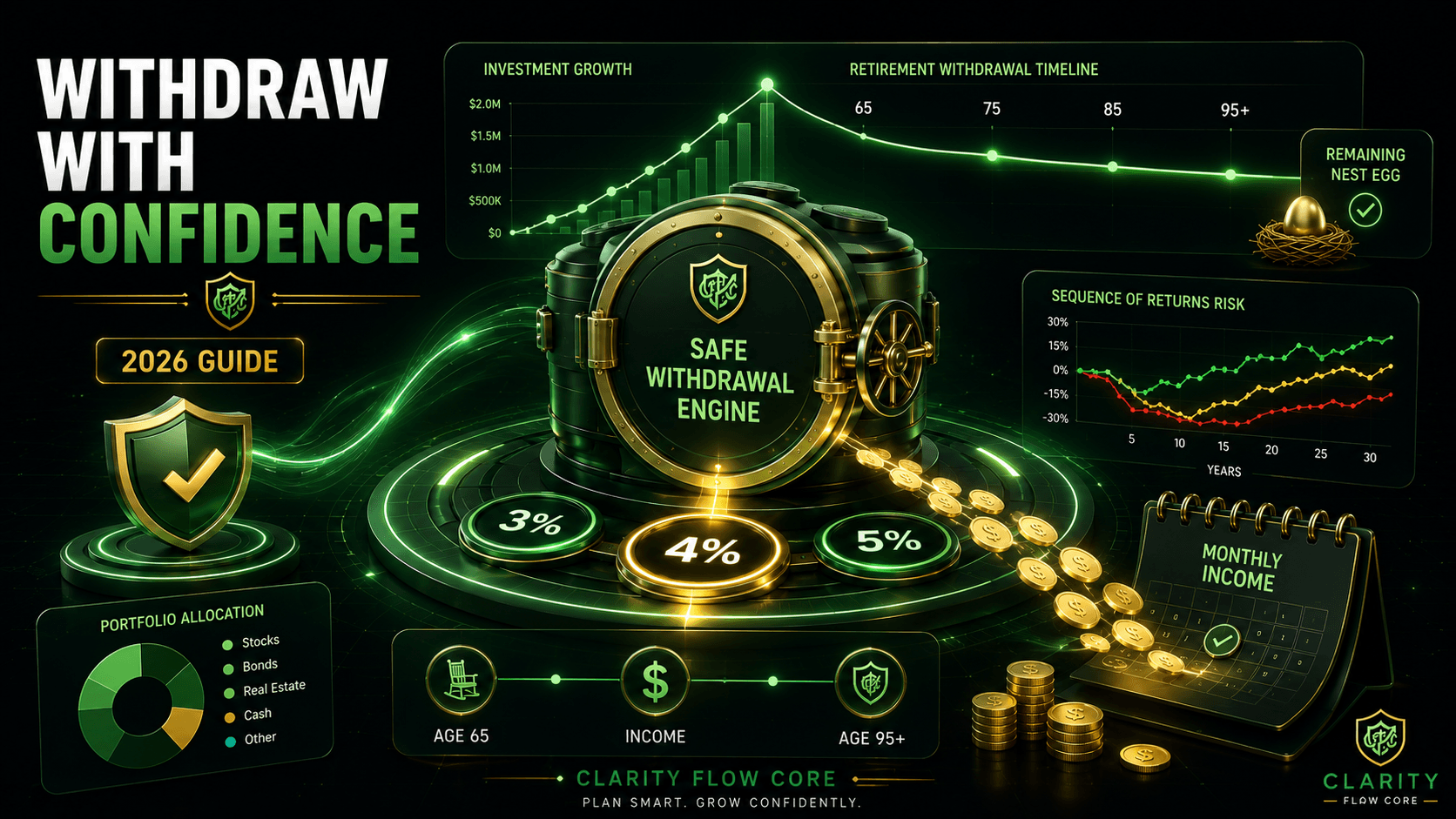
The order in which you experience market crashes is more important than your average return over time. If the stock market crashes by 25% during your very first year of retirement, pulling out your full living expenses forces you to sell assets at rock-bottom prices. This permanently damages your portfolio’s ability to compound. To combat this, you must keep 1 to 3 years of living expenses in cash or a High-Yield Savings Account. When the market dips, you spend your cash buffer and allow your investments time to recover.
2. The Tax Drag
A million dollars in a Traditional 401(k) is not actually a million dollars of spending power. When you withdraw funds from traditional tax-deferred accounts, the IRS taxes every dollar as ordinary income. If you need $50,000 to live on, you might need to withdraw $60,000 to cover the tax bill, drastically inflating your withdrawal rate. Structuring a plan to pull from both taxable and tax-free buckets is essential. Utilize the Tax Strategy Planner & Annual Tax Savings Analyzer to minimize this drag.
3. Early Retirement Horizons
Standard withdrawal rates are built around a traditional 30-year retirement window. If you plan to retire in your 40s or 50s, your money needs to survive for 40 to 50 years. Extending the timeline means you must lower your initial withdrawal percentage. Most financial planners recommend dropping to a 3.25% or 3.5% withdrawal rate for ultra-early retirements.
Real-World Scenario: The Freelancer’s Asset Transition
To truly grasp how much can you safely withdraw from retirement, you have to look at the transition phase.
Consider a freelance video editor who has spent decades scaling a digital content business. For years, they utilized specialized tax-advantaged accounts to shield their high freelance income, maxing out a Solo 401(k) and building a robust taxable brokerage account with their excess business profits.
When they finally decide to step back from daily client work, their income abruptly drops to zero. Because they are self-employed, they don’t have a corporate pension to lean on.
To safely replace their freelance revenue, they implement a dynamic withdrawal strategy. In years when the market is booming, they withdraw a comfortable 4.5%, allowing them to travel and upgrade their personal technology. However, when the market faces a correction, they lean on their dynamic guardrails: they skip their annual inflation raise and briefly pick up one or two short-term video editing contracts to bridge the gap, preventing them from having to sell their investments at a loss.
(Learn more about optimizing self-employed accounts by reading SEP IRA vs Solo 401(k) for Freelancers).
4 Deadliest Mistakes When Withdrawing Retirement Funds
When you finalize your calculations for how much can you safely withdraw from retirement, avoid these four wealth-destroying traps:
❌ Failing to adjust your asset allocation: If you approach retirement with 100% of your money in aggressive growth stocks, a single market crash will destroy your withdrawal plan. As you near your transition date, you must shift a portion of your portfolio into stable bonds and cash equivalents.
❌ Ignoring Required Minimum Distributions (RMDs): If you have money in Traditional IRAs or 401(k)s, the IRS will legally force you to start withdrawing a specific percentage of that money once you hit a certain age (currently 73). If you fail to take the RMD, you will be hit with a massive 25% tax penalty on the amount you were supposed to withdraw.
❌ Underestimating healthcare costs: Before Medicare kicks in at age 65, paying for private health insurance out of pocket can add $10,000 to $20,000 a year to your required budget. You must factor this into your withdrawal rate if you retire early.
❌ Failing to plan for estate transfer: If you pass away with significant assets remaining, poor tax planning can severely penalize your heirs. Learn how to protect your legacy by reading What Happens Financially After Someone Dies?.
Frequently Asked Questions
Does my withdrawal rate include Social Security? No. Your safe withdrawal rate applies strictly to your invested portfolio. You should subtract your guaranteed income (Social Security, pensions, rental income) from your annual expenses first, and then apply your withdrawal rate to the remaining gap.
Is a 5% withdrawal rate ever safe? It is generally only considered safe if your retirement horizon is relatively short (e.g., 15 to 20 years), or if you are extremely flexible and willing to dramatically slash your spending during stock market downturns.
What is the “Bucket Strategy” for retirement withdrawals? The bucket strategy organizes your money by timeline. Bucket 1 holds cash for the next 1–3 years of living expenses. Bucket 2 holds bonds for years 4–10. Bucket 3 holds growth stocks for years 11 and beyond. You live out of Bucket 1 and periodically refill it by selling assets from the other buckets during market highs.
Your Action Plan
Do not let the fear of running out of money keep you from enjoying the wealth you built. Determine exactly how much can you safely withdraw from retirement by executing these three steps this week:
- Define Your True Cash Need: You cannot calculate a percentage until you know your exact baseline. Use the Smart Budget Planner & Cash Flow Analyzer to model your expected post-work expenses.
- Calculate Your Portfolio Gap: Estimate your future Social Security payments. Subtract that number from your baseline expenses. The remaining amount is what your portfolio must generate every year.
- Run the Stress Test: Input your total portfolio balance and your required income into the Retirement Readiness Planner & Retirement Income Analyzer to see if your current trajectory supports a safe withdrawal rate of 4% or less.
Sources & Further Reading
Official U.S. Guidelines & Consumer Resources
- Securities and Exchange Commission (SEC): Retirement Plan Distributions
- Internal Revenue Service (IRS): Retirement Topics — Required Minimum Distributions (RMDs)
Further Reading from Clarity Flow Core
- Retirement Withdrawal Planner & Safe Withdrawal Strategy Analyzer
- Retirement Readiness Planner & Retirement Income Analyzer
- How Much Should You Save for Retirement Each Month?
- Emergency Fund Size After You Retire
- Traditional IRA vs Roth IRA: Which Is Better for Beginners?
- SEP IRA vs Solo 401(k) for Freelancers
- What Happens Financially After Someone Dies?
Disclaimer: The information provided in this article is for educational and informational purposes only and does not constitute financial, legal, or tax advice. Safe withdrawal rates are based on historical market models and do not guarantee future portfolio survival. Investing involves risk, including the possible loss of principal. Always consult with a certified financial planner or registered investment advisor before executing a withdrawal strategy or making permanent retirement decisions.
About Author

Rishabh Nigam
Rishabh Nigam founded Clarity Flow Core to make personal finance easier to understand for everyday readers. He covers credit scores, debt repayment, credit utilization, loan readiness, taxes, and financial planning through practical guides, calculators, and educational resources. His content focuses on turning complex financial concepts into clear, actionable steps that readers can apply in real life.