
Roth Conversion Ladder Explained: The Early Retirement Strategy
Having the Roth conversion ladder explained is the single most important financial step you can take if you plan to retire in your 30s, 40s, or 50s.
When you aggressively save for early retirement, you are heavily encouraged to use tax-advantaged accounts like a 401(k) or a Traditional IRA. These accounts are fantastic for lowering your tax bill during your highest-earning years.
However, they come with a massive catch: the IRS penalty wall. If you try to withdraw money from a traditional retirement account before you reach age 59½, the IRS will hit you with ordinary income taxes plus a devastating 10% early withdrawal penalty.
If you retire at age 45, you have a 14-year gap where you cannot easily touch your own money.
To bridge this gap, the FIRE (Financial Independence, Retire Early) community utilizes a perfectly legal tax loophole. Here is the Roth conversion ladder explained step-by-step, showing you exactly how to access your wealth penalty-free, decades before the government wants you to.
Phase 1: The Loophole and The 5-Year Rule
To understand this early retirement strategy, you must understand a specific rule regarding Roth IRAs.
When you convert pre-tax money (like funds in a Traditional IRA) into a Roth IRA, you have to pay income tax on that money in the year you convert it. However, once that converted money has sat in the Roth IRA for five full tax years, the IRS allows you to withdraw the principal amount completely penalty-free, at any age.
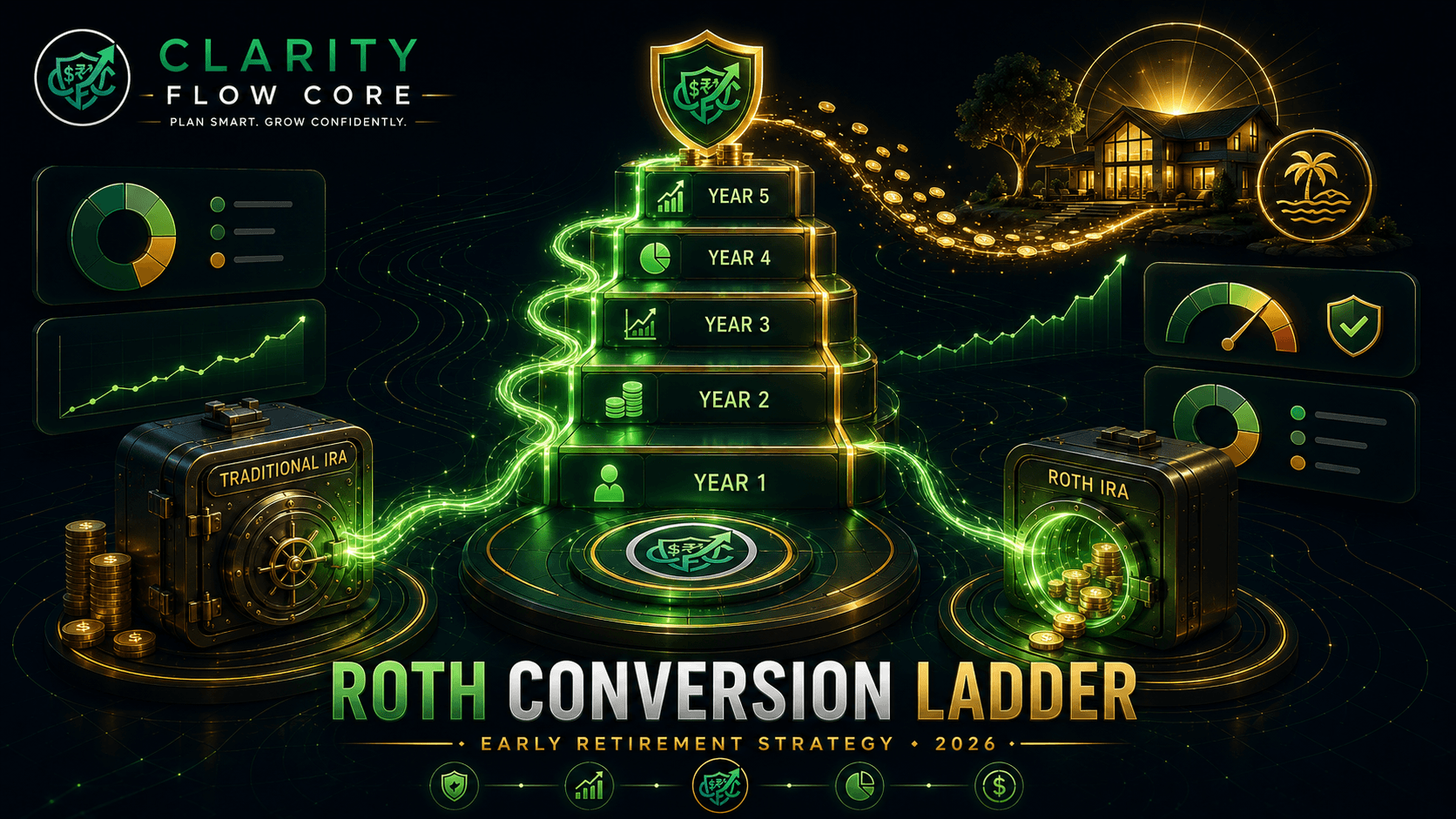
A Roth conversion ladder is simply the process of doing this every single year, creating a rolling, continuous pipeline of accessible cash.
The Ladder Construction Matrix
How the 5-year pipeline actually functions.
1. The Conversion
- The Action: You move $40,000 from your Traditional IRA into your Roth IRA.
- The Tax: You pay standard income tax on that $40,000 for the current year.
2. The Waiting Period
- The Action: You leave that specific $40,000 alone for exactly five tax years.
- The Rule: If you touch it before the 5 years are up, you will be slammed with the 10% early withdrawal penalty.
3. The Paycheck
- The Action: In Year 6, the original $40,000 conversion “matures.”
- The Result: You can withdraw that $40,000 completely tax-free and penalty-free to live on.
(To fully understand the difference in these accounts before starting a ladder, read Traditional IRA vs Roth IRA: Which Is Better for Beginners?).
Phase 2: Building the Pipeline (Step-by-Step)
Because of the mandatory 5-year waiting period, you cannot wake up on your 40th birthday, decide to retire, and immediately use a Roth ladder to pay your rent. The strategy requires a minimum five-year runway.
Here is how you build the continuous pipeline:
The Prerequisite: You must have five years of living expenses saved in a standard, taxable brokerage account or High-Yield Savings Account. This is the cash you will live on while you wait for your first “rung” of the ladder to mature. (Understand your tax exposure here with How Capital Gains Taxes Work for Beginners).
- Year 1 (Age 45): You retire. You live off the cash in your taxable brokerage account. You convert $50,000 from your Traditional IRA to your Roth IRA. You pay the income taxes.
- Year 2 (Age 46): You live off your taxable account. You convert another $50,000 to your Roth.
- Year 3 (Age 47): You live off your taxable account. You convert another $50,000 to your Roth.
- Year 4 (Age 48): You live off your taxable account. You convert another $50,000 to your Roth.
- Year 5 (Age 49): You live off your taxable account. You convert another $50,000 to your Roth.
- Year 6 (Age 50): Your taxable bridge account is now empty. However, the $50,000 you converted back in Year 1 has finished its 5-year waiting period. You withdraw it penalty-free to pay your bills. You then convert another $50,000 at the back of the line to keep the ladder going.
You repeat this process every year until you reach age 59½, at which point the penalty wall disappears and you can access your retirement accounts normally.
Real-World Scenario: The Freelancer’s Exit Strategy
When getting the Roth conversion ladder explained, it is crucial to see how U.S. self-employed individuals leverage this strategy to escape the grind.
Consider a freelance video editor who has spent the last two decades building a highly profitable commercial editing business. Because their income was substantial, they aggressive shielded their profits from the IRS by maxing out a pre-tax Solo 401(k) year after year.
At age 42, they decide they are burned out on client deadlines. They want to shift entirely to passion projects, effectively retiring.
They roll their massive Solo 401(k) into a Traditional IRA. Because their video editing income has suddenly dropped to $0, they are now in the lowest possible tax bracket.
This is the perfect time to build the ladder. They start converting $60,000 a year from the Traditional IRA to the Roth IRA. Because they have no other income, that $60,000 is taxed at incredibly low baseline rates—far lower than what they would have paid while running their active editing business. They live off the cash they hoarded in a standard brokerage account until age 47, when their ladder begins paying out a steady, penalty-free $60,000 a year.
(For an alternative to full early retirement, explore Coast FIRE Explained: Can You Retire Early Without Saving Millions?).
4 Deadliest Mistakes When Building a Roth Ladder
Early retirement leaves zero room for error. If you are executing this strategy, avoid these four wealth-destroying traps:
❌ Using the converted funds to pay the conversion taxes: When you convert $50,000, you will owe income taxes on it. Do not withhold those taxes from the conversion amount. If you are under 59½, the IRS considers tax withholding an “early distribution,” and you will be hit with the 10% penalty on the tax money. You must pay the conversion taxes using outside cash.
❌ Spiking your tax bracket: Do not convert your entire $500,000 IRA in a single year. That will instantly push you into the highest federal tax bracket, destroying the tax efficiency of the strategy. Convert only what you need for a single year’s living expenses. Optimize your amounts using the Tax Strategy Planner & Annual Tax Savings Analyzer.
❌ Confusing the two 5-year rules: The IRS has a 5-year rule for withdrawing earnings, and a separate 5-year rule for withdrawing conversions. A Roth conversion ladder only gives you access to the converted principal. If you try to withdraw the investment growth that occurred inside the Roth account before age 59½, you will be penalized.
❌ Forgetting state income taxes: If you live in a high-tax state like California or New York, your conversion will be subject to state income taxes on top of federal. Factor this into your cash reserves.
Frequently Asked Questions
Does a Roth conversion ladder work with a 401(k)? Yes, but you usually have to add a step. You typically cannot convert money directly from a 401(k) to a Roth IRA while you are still employed with that company. Once you quit, you roll the 401(k) into a Traditional IRA first, and then begin your annual conversions to the Roth IRA.
Is there a limit to how much I can convert each year? No. Unlike standard Roth IRA contribution limits (which are capped annually), there is absolutely no limit on the dollar amount you can convert from a Traditional account to a Roth account. However, you are limited by how much tax you can afford to pay. (Review contribution limits at Roth IRA Contribution Limits and Rules for 2026).
What happens if I make a mistake and break the 5-year rule? If you withdraw a conversion before the five full tax years have passed, you will owe the IRS a 10% penalty on the amount withdrawn.
Your Action Plan
Now that you have the Roth conversion ladder explained, you can mathematically engineer your escape from the mandatory retirement age. Take these three steps this week:
- Calculate Your Runway: Determine exactly how much cash you need to survive the 5-year waiting period. Use the Retirement Withdrawal Planner & Safe Withdrawal Strategy Analyzer to map out your bridging strategy.
- Audit Your Accounts: Log into your portals and calculate your exact ratio of pre-tax money (Traditional 401k/IRA) vs. after-tax money (Roth/Brokerage).
- Project Your Taxes: Before initiating a conversion, consult with a CPA or use a tax planner to ensure the conversion amount will not inadvertently push you into a highly expensive tax bracket.
Sources & Further Reading
Official U.S. Guidelines & Consumer Resources
- Internal Revenue Service (IRS): Retirement Plans FAQs Regarding IRAs – Rollovers and Conversions
- Securities and Exchange Commission (SEC): Traditional vs. Roth IRAs
Essential Tools from Clarity Flow Core
- Retirement Withdrawal Planner & Safe Withdrawal Strategy Analyzer
- Tax Strategy Planner & Annual Tax Savings Analyzer
Further Reading from Clarity Flow Core
- Traditional IRA vs Roth IRA: Which Is Better for Beginners?
- Roth IRA Contribution Limits and Rules for 2026
- What Is a Solo 401(k) and How Does It Work?
- Coast FIRE Explained: Can You Retire Early Without Saving Millions?
- How Capital Gains Taxes Work for Beginners
Disclaimer: The information provided in this article is for educational and informational purposes only and does not constitute financial, legal, or tax advice. The Roth conversion ladder is an advanced tax strategy subject to complex IRS regulations and the 5-year rule. Tax laws and brackets are subject to change. Always consult with a certified public accountant (CPA) or a registered fiduciary financial planner to evaluate your specific tax liability before executing a conversion or making early retirement withdrawal decisions.
About Author

Rishabh Nigam
Rishabh Nigam founded Clarity Flow Core to make personal finance easier to understand for everyday readers. He covers credit scores, debt repayment, credit utilization, loan readiness, taxes, and financial planning through practical guides, calculators, and educational resources. His content focuses on turning complex financial concepts into clear, actionable steps that readers can apply in real life.





One Comment
Comments are closed.