What Is a Solo 401(k) and How Does It Work?
Working for yourself comes with incredible perks. You control your schedule, choose your clients, and make the rules. But there is a catch: you do not have a corporate HR department setting up your retirement plan and automatically deducting contributions from your paycheck. When you are self-employed, securing your financial future falls squarely on your shoulders.
If you work for yourself and have no full-time employees, a Solo 401(k) is one of the most powerful retirement savings tools available for self-employed individuals. It allows you to save massive amounts of money, drastically lower your tax bill, and build long-term wealth faster than almost any other standard retirement account.
This guide will explain exactly what a Solo 401(k) is, how the unique contribution limits work, the rules you absolutely must follow, and how to get one set up. Think of this as your practical roadmap to self-employed retirement planning.
What Exactly is a Solo 401(k)?
A Solo 401(k)—sometimes called an Individual 401(k), an owner-only 401(k), or a one-participant 401(k)—is a traditional 401(k) plan specifically designed for business owners who have no employees.
It works just like the 401(k) you might have had at a previous corporate job, but with one massive advantage: because you are both the employer and the employee of your business, you get to make contributions in both capacities. This dual-role capability is what allows you to shelter tens of thousands of dollars from taxes every single year.
Who Qualifies for a Solo 401(k)?
To open and contribute to a Solo 401(k), you must meet two very strict IRS requirements:
- You must have self-employment income. You need a legitimate business activity that generates earned income. This can be a sole proprietorship, a Limited Liability Company (LLC), a partnership, an S-Corporation, or a C-Corporation. Even freelance side hustles qualify, as long as you are reporting the income to the IRS.
- You must have no full-time W-2 employees. The plan is for you and your spouse alone. If you hire a full-time employee, employees who meet IRS eligibility requirements may require the plan to be converted into a traditional employer-sponsored plan.
The Spouse Exception
There is one important exception to the “no employees” rule. Your spouse can participate in your Solo 401(k) if they earn income from the business. If your spouse works for you and draws a legitimate salary or shares in the business profits, they can make their own employee contributions, and the business can make employer contributions on their behalf. This effectively doubles the household contribution limit, turning the Solo 401(k) into an absolute powerhouse for married couples running a business together.
Before locking all your business capital away into retirement accounts, however, you need to ensure your immediate cash needs are covered. Using our Advanced Emergency Fund Analyzer can help you determine exactly how much cash you need to keep liquid in your business before aggressively funding your retirement.
Is Your Emergency Fund Actually Big Enough?
Stop guessing how much cash you need for a rainy day. Calculate your exact savings target based on your baseline living expenses, income stability, and personal risk factors.
Calculate My Savings TargetThe Two-Part Contribution Powerhouse
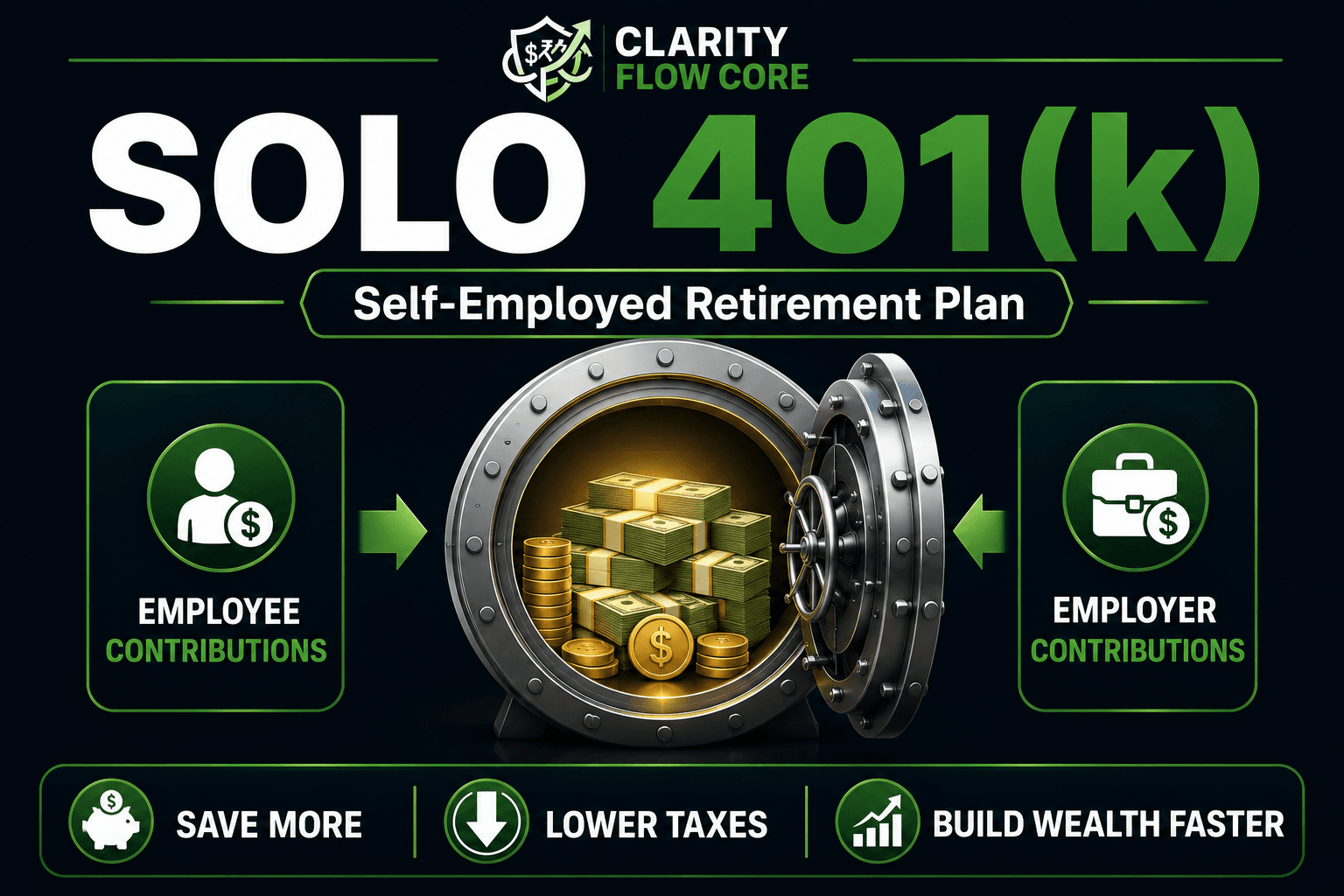
The magic of the Solo 401(k) lies in how it allows you to contribute money. As a self-employed individual, you wear two hats. You are the employee doing the work, and you are the employer paying the wages. The IRS guidelines for One-Participant 401(k) Plans allow you to contribute to the plan in both roles.
Part 1: The Employee Contribution (Elective Deferral)
As the employee, you can defer a portion of your salary or net business income into the plan. For the current tax year, the employee contribution limit is up to $23,000. If you are 50 or older, you get a “catch-up” contribution allowance of $7,500. (Check the IRS website for current limits, as these adjust frequently for inflation).
You can contribute up to 100% of your earned income, up to that limit. If your side hustle only made $15,000 for the year, your maximum employee contribution is $15,000.
Part 2: The Employer Contribution (Nonelective Contribution)
As the employer, your business can also make a profit-sharing contribution to your account. This is where the big numbers happen. The business can contribute up to 25% of your compensation.
Your total combined contributions (employee plus employer) cannot exceed $69,000 for the current tax year, or $76,500 if you are 50 or older. (Again, check the IRS for current overall limits).
How Your Business Structure Changes the Math
Calculating your employer contribution can get tricky because the IRS looks at your income differently depending on how your business is legally structured.
- For S-Corporations and C-Corporations: The math is straightforward. The 25% employer limit is based directly on your W-2 salary. If your S-Corp pays you a $100,000 W-2 salary, the business can contribute $25,000.
- For Sole Proprietors and Single-Member LLCs: The math requires a specific IRS formula. Because you do not pay yourself a W-2 salary, your contribution is based on your net adjusted business profit. After deducting half of your self-employment tax, your maximum employer contribution effectively drops from 25% down to 20% of your net earnings.
If you are trying to map out how these contributions fit into your broader life goals—like buying a house or retiring early—our Financial Freedom Planner is a great tool to help you visualize how aggressive you should be with your retirement funding.
Map Out Your Path to Financial Freedom
Stop winging your financial future. Use our free planner to set concrete goals, optimize your monthly savings rate, and calculate exactly when you will achieve total financial independence.
Build You Freedom Plan For FreeReal-World Scenarios: The Math in Action
To truly understand the power of this account, let us look at two practical examples based on current standard limits.
Scenario A: The Side Hustler
David works a regular 9-to-5 job where he earns $80,000 a year. He also runs a freelance graphic design business as a sole proprietor on the weekends, netting $20,000 a year.
David already contributes $10,000 to his 401(k) at his day job. Because the maximum employee contribution limit applies across all 401(k) plans you have, David can only contribute his remaining allowance as an employee to his Solo 401(k).
However, his freelance business can also make an employer profit-sharing contribution of roughly 20% of his net business income. That is an extra $4,000. David manages to shelter a massive chunk of his freelance income from taxes, wiping out almost all the tax liability on his side hustle.
Scenario B: The High-Earning Consultant
Elena is 40 years old and runs an IT consulting firm structured as an S-Corporation. The business brings in $300,000 in gross revenue. After expenses, the business profit is $200,000. Elena pays herself a reasonable W-2 salary of $120,000.
First, Elena makes her maximum employee contribution.
Second, her S-Corporation makes a 25% employer contribution based on her $120,000 salary, which equals $30,000.
Elena’s total Solo 401(k) contribution for the year clears $50,000. This massive deduction dramatically lowers her taxable income, saving her thousands of dollars at tax time.
Project Your Self-Employed Retirement
Curious how a Solo 401(k) could change your financial timeline? Use our interactive analyzer to project your self-employed contributions, calculate your future compound growth, and see exactly when you can retire.
Plan My RetirementSolo 401(k) vs. SEP IRA
A common dilemma for self-employed individuals is choosing between a Solo 401(k) and a Simplified Employee Pension (SEP) IRA. While both are fantastic tools, they have distinct mechanical differences.
For most solo business owners, the Solo 401(k) is the superior option because it allows for both employee and employer contributions, meaning you can shelter much more money at lower income levels. A SEP IRA only allows employer contributions.
Here is a quick breakdown of how the Solo 401(k) stacks up against other common retirement accounts:
| Feature | Solo 401(k) | SEP IRA | Roth IRA |
| Employee Contributions | Yes | No | Yes |
| Employer Contributions | Yes | Yes | No |
| Roth Option | Usually Yes | No | Yes |
| Loan Feature | Sometimes | No | No |
Note: SEP IRAs do have one major administrative advantage. They have no December 31 setup deadline; they can be opened and funded right up until your tax filing deadline.
Traditional vs. Roth Solo 401(k)
When setting up your plan, you have a choice regarding how you want your money taxed. You can choose a Traditional setup, a Roth setup, or a mix of both.
Traditional Solo 401(k)
Traditional contributions are made on a pre-tax basis. Every dollar you put in reduces your taxable income for the current year. If you make $100,000 and contribute $20,000 to a Traditional Solo 401(k), you only pay income taxes on $80,000. The money grows tax-deferred, meaning you will not owe a dime to the IRS until you withdraw the funds in retirement. When you pull the money out, it is taxed as ordinary income.
This option is generally best if you are currently in a high tax bracket and want immediate relief on your tax bill. If you want a deeper dive into how deductions impact your tax returns, check out our article on Standard Deduction vs. Itemizing Explained.
Roth Solo 401(k)
Roth contributions are made with after-tax dollars. You get no upfront tax deduction. You pay taxes on your full income today, but the money goes into the account and grows completely tax-free. When you withdraw it in retirement, you owe absolutely nothing to the IRS on the contributions or the growth.
This option is fantastic for younger entrepreneurs who expect their business to grow and put them in a higher tax bracket later in life.
Rules and Deadlines You Need to Know
The IRS does not mess around with retirement accounts. Failing to follow the rules and meet deadlines can result in massive penalties, the disqualification of your plan, or surprise tax bills.
The December 31 Setup Deadline
To make contributions for a given tax year, the Solo 401(k) plan must be officially opened and the paperwork signed by December 31 of that year. You cannot decide in February that you want to open a Solo 401(k) for the previous year to lower your tax bill. The plan must exist before the calendar year ends.
The Funding Deadline
While the plan must be opened by December 31, you do not have to deposit the money by then. You have until your tax filing deadline (usually April 15) to actually move the funds into the account.
Form 5500-EZ
When you first open a Solo 401(k), the IRS requires almost no ongoing maintenance or paperwork. However, there is a massive tripwire you need to watch out for. Once the total assets inside your Solo 401(k) exceed $250,000 at the end of the calendar year, you must file Form 5500-EZ with the IRS every single year. Keep a very close eye on your account balance.
Common Mistakes When Managing a Solo 401(k)
Managing your own retirement plan means you are the compliance officer. Here are the most frequent mistakes business owners make that lead to tax headaches.
- Hiring Employees and Keeping the Plan: The second you hire a full-time, non-spouse W-2 employee who meets IRS eligibility requirements, your Solo 401(k) becomes illegal. You must convert it to a standard employer-sponsored plan.
- Overcontributing Across Multiple Jobs: If you have a day job with a 401(k) and a side business with a Solo 401(k), the employee limit is a total combined limit per person, not per plan.
- Mixing Up S-Corp and Sole Prop Math: Sole proprietors often try to contribute 25% of their gross revenue, forgetting they must use net adjusted profit and the 20% formula.
- Failing to Formalize the Loan: Some Solo 401(k) plans allow you to borrow from your own balance. Failing to set up a formal repayment schedule turns the loan into a taxable distribution.
If you are considering taking on debt, even from yourself, it is crucial to understand your overall leverage. Run your numbers through our Debt-to-Income Analyzer & Loan Readiness Planner before borrowing from your retirement.
Calculate Your True Borrowing Power
Find out exactly how lenders view your financial health. Calculate your Debt-to-Income (DTI) ratio instantly to see if you are in the safe zone before applying for a mortgage, auto loan, or new credit card.
Analyze My DTI RatioHow to Open a Solo 401(k) Step-by-Step
Opening the account is not difficult, but it requires a bit more paperwork than opening a basic IRA.
- Obtain an Employer Identification Number (EIN). You cannot open a Solo 401(k) using your Social Security Number. You can apply for an EIN online for free via the IRS.
- Choose a Brokerage Firm. Most major discount brokers offer free, standard Solo 401(k) plans. If you want to invest in real estate or private equity, you will need a “Self-Directed Solo 401(k).”
- Complete the Plan Adoption Agreement. The brokerage will provide you with a plan document that establishes the rules of your specific plan.
- Open the Funding Accounts. Once the plan is established, open the actual bank/brokerage accounts underneath the plan’s umbrella.
- Deposit the Funds. Link your business bank account to the brokerage and transfer your contributions before your tax filing deadline.
Action Plan
Ready to take control of your self-employed retirement? Follow these specific next steps:
- Verify Your Eligibility: Confirm that you have legitimate self-employment income and no full-time, non-spouse employees.
- Project Your Net Income: Estimate what your business profit or W-2 salary will be for the current year.
- Check Your Immediate Cash Needs: Ensure your business has enough working capital and an emergency fund before locking cash away.
- Select a Provider: Decide if you want a free standard brokerage plan or a paid self-directed plan.
- Set a Calendar Reminder: Put a hard reminder in your calendar for mid-December to finalize your account setup paperwork before the December 31 deadline.
Frequently Asked Questions
Can I have a regular 401(k) at my day job and a Solo 401(k) for my side hustle?
Yes, absolutely. However, the employee contribution limit is a per-person limit across all plans. The employer contribution limits, however, are per-employer.
Can I take a loan from my Solo 401(k)?
If your specific plan documents allow for it, yes. The IRS rules allow you to borrow up to 50% of your account balance, or $50,000, whichever is less. You must pay yourself back with interest over a maximum of five years.
What happens if my business loses money this year?
If you have no net profit or W-2 salary from the business, you cannot make any contributions to the Solo 401(k) for that year. The plan can stay open, and your investments will continue to grow.
Can I roll over my old 401(k) or IRA into a Solo 401(k)?
Yes. Most Solo 401(k) plans accept rollovers from other eligible retirement plans like old 401(k)s, 403(b)s, and Traditional IRAs.
What happens if I hire an employee next year?
If you hire a W-2 employee who meets IRS eligibility requirements, they become eligible for your retirement plan. At that point, you can no longer operate a Solo 401(k) and must amend the plan to accommodate them.
Conclusion
The Solo 401(k) is an unmatched tool for self-employed individuals who want to aggressively build wealth while legally reducing their tax burden. By allowing you to contribute as both the employer and the employee, it provides a massive runway to shelter your hard-earned business revenue.
Setting it up requires a little bit of paperwork, and you must stay disciplined with IRS deadlines and compliance rules, especially as your account balance grows. But the payoff is immense. Do not let the lack of a corporate HR department hold you back. Take control, open your plan, and start paying your future self today.
References
- IRS: One-Participant 401(k) Plans
- IRS: Apply for an Employer Identification Number (EIN) Online
- IRS: About Form 5500-EZ
- Consumer Financial Protection Bureau (CFPB): Retirement Planning Resources
- Federal Reserve: Survey of Consumer Finances (SCF)
Disclaimer: The information provided in this guide is for educational purposes only and does not constitute financial, investment, or tax advice. All financial products and offers are subject to individual credit approval and specific lender terms. Please consult with a qualified financial professional to determine if the strategies or products discussed in this guide are the right fit for your personal financial situation.
About Author

Rishabh Nigam
Rishabh Nigam founded Clarity Flow Core to make personal finance easier to understand for everyday readers. He covers credit scores, debt repayment, credit utilization, loan readiness, taxes, and financial planning through practical guides, calculators, and educational resources. His content focuses on turning complex financial concepts into clear, actionable steps that readers can apply in real life.