PMI Explained: When Mortgage Insurance Is Required
Getting PMI explained clearly and early in your home-buying journey can save you thousands of dollars. Buying a house is an incredibly exciting milestone, but the paperwork involved can quickly drain the joy out of the process. When you receive your first official Loan Estimate from a mortgage lender, you will likely see a breakdown of your projected monthly payment. You expect to see charges for your principal, your interest, your property taxes, and your homeowner’s insurance.
But for millions of first-time home buyers, there is a fifth, frustrating line item added to the bill: PMI.
Depending on the size of your loan, this mysterious fee can add anywhere from $50 to $300 to your monthly housing cost. It does not pay down your loan balance. It does not cover your property taxes. (If you want a full breakdown of the other invisible fees driving up your bill, check out The Hidden Costs of Buying a Home: What the Bank Won’t Tell You).
So what exactly is Private Mortgage Insurance (PMI)? Why is the bank forcing you to pay it? And most importantly, how do you get rid of it?
In this comprehensive guide, we are going to break down the exact math behind mortgage insurance. We will explain when it is legally required, how much it typically costs, the critical difference between Conventional PMI and FHA MIP, and the exact steps you can take to drop this fee from your monthly budget forever.
⚡ Quick Answer: What is PMI?
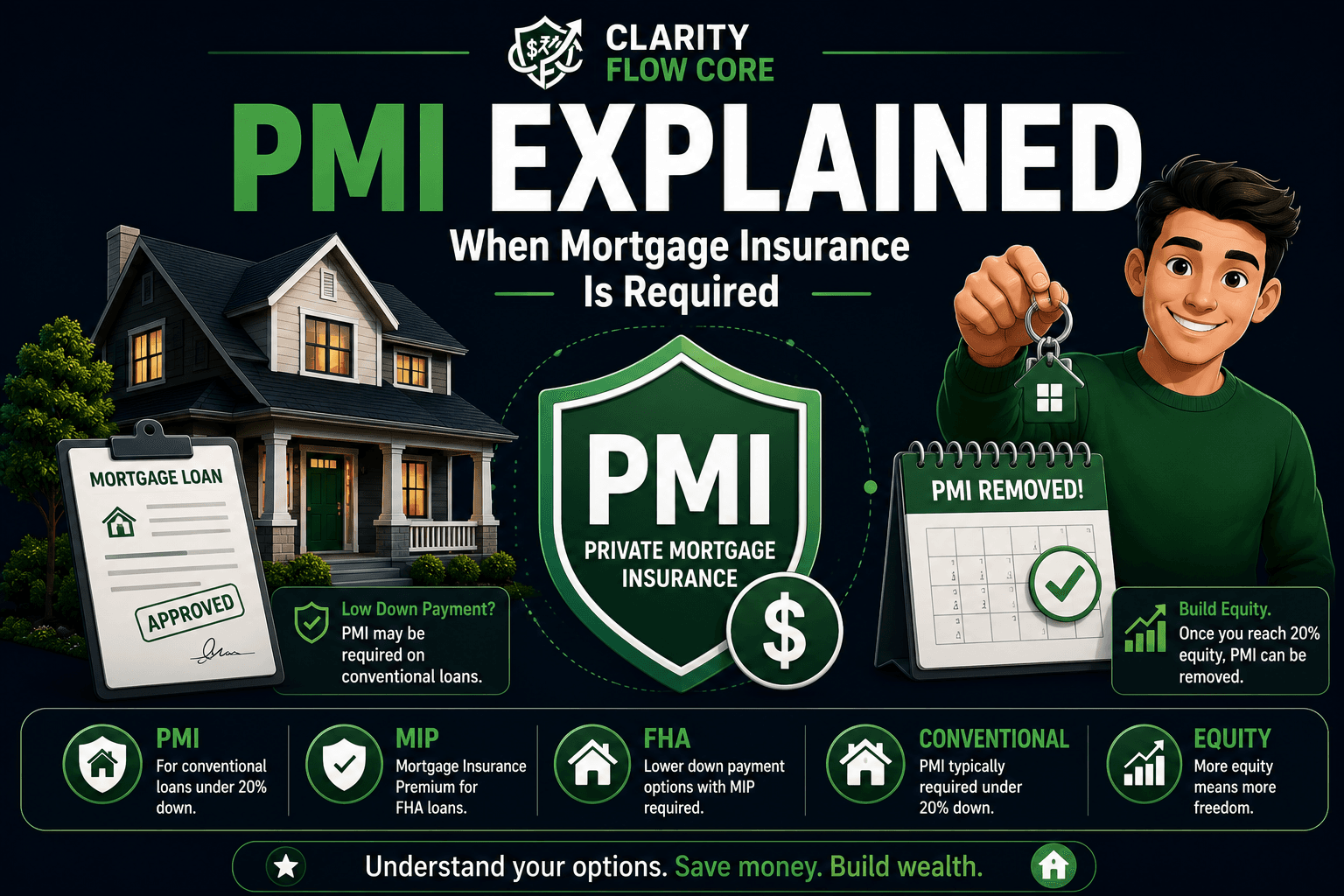
Private Mortgage Insurance (PMI) is a monthly fee added to a Conventional mortgage if you buy a home with a down payment of less than 20%. PMI protects the lender in case you default on the loan; it offers no physical protection to the buyer. Most borrowers pay between 0.5% and 1.5%, though higher-risk borrowers may pay more. Fortunately, PMI is not permanent and can be canceled once you reach 20% equity in your home.
PMI Explained: What Is Private Mortgage Insurance?
To understand why PMI exists, you have to look at the transaction from the bank’s perspective.
When a lender approves a $400,000 mortgage, they are taking on a massive financial risk. If you lose your job and stop making your payments, the bank is forced to go through the lengthy, expensive legal process of foreclosing on the home. They then have to sell the property to recoup their lost money.
Historically, banks learned a simple behavioral truth: if a borrower has a large amount of their own cash invested in the home (known as equity), they are highly unlikely to walk away from the property.
The industry standard for a “safe” amount of equity is 20%.
If you put down 20% of the purchase price, the bank feels secure. If you put down less than 20%, the bank views you as a higher risk. To approve the loan anyway, the bank requires an insurance policy to cover their potential losses if you default.
Here is the harsh reality of PMI: You, the buyer, are required to pay the monthly premium for this insurance policy, but the policy pays out to the lender, not you.
How Much Does PMI Actually Cost?
PMI is not a flat fee. Lenders use a complex matrix to determine your specific premium, but it generally ranges from 0.5% to 1.5% of your total loan amount per year. This annual total is divided by 12 and added to your monthly mortgage payment.
Your specific PMI rate is determined by three main factors:
- Your Down Payment Size: The less money you put down (e.g., 3% vs. 15%), the higher your PMI rate will be because the lender’s risk is higher.
- Your Credit Score: This is the biggest variable. A borrower with a pristine 780 credit score will pay drastically less for PMI than a borrower with a 620 credit score. (Need to boost your score before applying? Use our Credit Score Simulator & Improvement Planner).
- Your Debt-to-Income (DTI) Ratio: If your monthly debts take up a massive chunk of your paycheck, you are viewed as a riskier borrower, which can increase your rate. (See exactly where you stand with our Debt-to-Income (DTI) Analyzer & Loan Readiness Planner).
Test Your Credit Score Before Making Big Moves
Wondering how a new credit card, a missed payment, or paying off a loan will impact your score? Stop guessing. Run real-life financial scenarios instantly through our simulator.
Launch Credit SimulatorCalculate Your True Borrowing Power
Find out exactly how lenders view your financial health. Calculate your Debt-to-Income (DTI) ratio instantly to see if you are in the safe zone before applying for a mortgage, auto loan, or new credit card.
Analyze My DTI RatioReal Dollar Math: The Cost of PMI
Let’s look at how this plays out if you buy a $350,000 home with a Conventional loan, assuming an average PMI rate of roughly 0.75% annually.
| Down Payment % | Down Payment ($) | Loan Amount | Est. Monthly PMI |
| 3% Down | $10,500 | $339,500 | ~$212 / month |
| 5% Down | $17,500 | $332,500 | ~$207 / month |
| 10% Down | $35,000 | $315,000 | ~$196 / month |
| 15% Down | $52,500 | $297,500 | ~$185 / month |
| 20% Down | $70,000 | $280,000 | $0 / month |
PMI vs. MIP: Know Your Loan Type
When people use the term “PMI,” they are specifically referring to Conventional loans. However, if you are using a government-backed loan, the rules for mortgage insurance change drastically. It is critical not to confuse these two.
Conventional Loans (PMI)
As discussed, Private Mortgage Insurance applies to Conventional loans when you put down less than 20%. The massive advantage of Conventional PMI is that it is temporary. Once you reach 20% equity in the home, the PMI goes away.
FHA Loans (MIP)
If you use a Federal Housing Administration (FHA) loan—which is incredibly popular because it allows credit scores as low as 580—you do not pay PMI. You pay MIP (Mortgage Insurance Premium).
FHA MIP is notoriously strict. It requires a large upfront payment at closing (1.75% of the loan) plus an annual premium added to your monthly bill.
The Catch: If you put down the FHA minimum of 3.5%, your MIP is permanent for the life of the loan. It never automatically falls off. The only way to get rid of FHA MIP is to refinance the entire mortgage into a Conventional loan once you reach 20% equity.
VA Loans and USDA Loans
- VA Loans: If you are an eligible active-duty service member or veteran using a VA loan, you do not have to pay any monthly mortgage insurance, even with a 0% down payment. (You do, however, pay a one-time upfront VA Funding Fee).
- USDA Loans: If you are buying in an eligible rural area, USDA loans require a 1% upfront guarantee fee and a 0.35% annual fee, but the terms are generally cheaper than FHA MIP.
4 Ways to Get Rid of PMI
If you buy a home with a 5% down payment, you do not have to pay PMI for the entire 30-year term of your Conventional loan. Here are the four legal ways to eliminate PMI from your monthly bill:
1. Wait for Automatic Cancellation (The 78% Rule)
By federal law (the Homeowners Protection Act), your lender is legally required to automatically cancel your PMI on the exact date your mortgage balance is scheduled to reach 78% of the original purchase price of the home. You do not have to do anything; it simply falls off your bill.
2. Request Manual Cancellation (The 80% Rule)
You do not have to wait for the 78% automatic trigger. The moment your mortgage balance hits 80% of the original purchase price, you have the legal right to write a letter to your lender requesting that they cancel your PMI.
How do you get to 80% faster? You can make extra principal payments every month. By throwing an extra $100 a month strictly at the loan principal, you accelerate your equity growth and can shave years off your PMI timeline.
3. Rely on Home Value Appreciation
The 80% rule is based on the value of the home. If you buy a house for $300,000, 20% equity means you owe $240,000.
But what if you make major renovations, or the housing market explodes, and two years later the house is reappraised at $400,000? If your loan balance is $280,000, you now owe less than 80% of the current market value.
Many lenders will allow you to order a new professional appraisal (which you pay for, usually around $500). If the new appraisal proves you now have 20% equity based on the new home value, the lender will drop the PMI. (Note: Lenders usually require you to have held the loan for at least two years before using this method).
4. Refinance Your Mortgage
If interest rates have dropped significantly since you bought the home, and your home has increased in value, you can completely replace your old loan by refinancing. If the new loan amount is 80% or less of the home’s current appraised value, the new loan will not require PMI.
Is PMI a Scam or a Waste of Money?
Older generations often view PMI as a toxic fee that must be avoided at all costs. “Never buy a house until you have 20% saved!” is standard advice in many financial forums.
However, in a modern, rapidly appreciating housing market, waiting to save 20% is often a massive mathematical mistake.
Let’s assume you want to buy a $400,000 home. You currently have $20,000 saved (5%).
To reach 20%, you need an additional $60,000. If you save $1,000 every single month, it will take you five full years to reach your 20% goal.
If homes in your area appreciate at a modest historical average of 4% per year, that $400,000 home will cost roughly $486,000 in five years. You spent five years saving cash, only to watch the target move entirely out of reach.
For many buyers, paying $150 a month in PMI for a few years is the strategic “price of admission” to enter the housing market early, lock in their purchase price, and start building long-term wealth through real estate appreciation.
Common Mistakes Buyers Make Regarding PMI
Navigating mortgage insurance requires careful financial planning. Avoid these critical beginner traps:
- Mistake 1: Draining Your Savings Just to Avoid PMI. Some buyers get so obsessed with avoiding PMI that they completely empty their bank accounts to scrape together a 20% down payment. This is incredibly dangerous. Houses break. Roofs leak. If you have no cash left after closing day, the first emergency will force you into high-interest credit card debt. Always protect your liquid cash. Use our Advanced Emergency Fund Analyzer to calculate exactly how much cash you must keep in reserve post-purchase.
- Mistake 2: Ignoring Debt Affordability. Even if you can afford the down payment and the PMI, your total monthly debt obligations cannot exceed lender limits. If your credit card minimums and car loans are too high, the bank will deny the mortgage. (Speaking of car loans, if your car payment is ruining your DTI, see if you can lower your overhead by reading Leasing vs. Buying Used Cars: Which Actually Costs Less?).
- Mistake 3: Confusing PMI with Homeowner’s Insurance. These are two completely different policies. Homeowner’s insurance protects you if your house burns down or gets robbed. PMI protects the lender if you stop paying your bills. You will be required to carry both. (And remember, homeowner’s insurance premiums can spike unexpectedly. Learn how this impacts your monthly payment in Why Your Escrow Payment Increased Suddenly).
- Mistake 4: Not Tracking Equity. Lenders are rarely going to call you to excitedly announce you can stop paying them PMI. It is your responsibility to track your loan amortization schedule. The month your principal balance dips to 80% of the original purchase price, it is up to you to initiate the cancellation request.
Is Your Emergency Fund Actually Big Enough?
Stop guessing how much cash you need for a rainy day. Calculate your exact savings target based on your baseline living expenses, income stability, and personal risk factors.
Calculate My Savings TargetYour Action Plan: Managing Your Mortgage Path
If you are preparing to buy a home, you must transition from guessing about fees to running the actual math. Follow these steps this week:
- Calculate Your True Budget: Do not just look at home prices. Run your income through a mortgage calculator that explicitly includes estimated property taxes, homeowner’s insurance, and PMI.
- Optimize Your Credit Profile: Pull your credit reports from all three bureaus. Pay down high credit utilization balances. A jump from a 680 to a 740 credit score will drastically reduce the cost of your PMI.
- Save for Closing Costs: Remember that your down payment is only half the battle. You will also need 2% to 5% of the loan amount in cash to pay for the actual transaction fees.
- Model Your Long-Term Wealth: How does a house fit into your ultimate retirement goals? Ensure your new mortgage payment still leaves you enough free cash flow to invest for the future by running your numbers through our Financial Freedom Planner.
Map Out Your Path to Financial Freedom
Stop winging your financial future. Use our free planner to set concrete goals, optimize your monthly savings rate, and calculate exactly when you will achieve total financial independence.
Build My Freedom PlanFrequently Asked Questions (FAQ)
1. Is PMI tax-deductible?
Historically, the IRS has allowed taxpayers to deduct PMI premiums if their adjusted gross income fell below a certain threshold. However, this deduction is highly subject to annual congressional renewal and frequently expires. Always consult a licensed CPA to verify if the PMI deduction is currently active for the tax year you are filing.
2. Can I pay PMI upfront instead of monthly?
Yes. Some lenders offer “Single-Premium PMI.” Instead of adding a monthly fee to your mortgage, you pay the entire PMI policy in one massive lump sum at closing. This lowers your monthly payment, but the upfront fee is usually non-refundable. If you sell the house or refinance two years later, you lose that money.
3. Does PMI go toward my principal balance?
No. PMI payments do not build equity, pay down your loan, or cover property taxes. It is strictly an insurance premium paid to a third-party company to protect the bank.
4. Are there any Conventional loans that don’t require PMI with less than 20% down?
Occasionally, yes. Some local credit unions or portfolio lenders offer special first-time home buyer programs that waive PMI requirements for 5% or 10% down payments. However, these programs almost always charge a significantly higher interest rate to compensate for the risk, meaning you are still paying for the PMI indirectly.
5. How long does an appraisal take if I want to cancel PMI?
If you believe your home has appreciated enough to reach 20% equity, you must contact your lender first. Do not hire your own appraiser. The lender will require you to use an appraiser from their approved list. The process typically takes two to four weeks and costs between $400 and $600.
6. What is Lender-Paid Mortgage Insurance (LPMI)?
With LPMI, the lender pays the mortgage insurance premium for you, meaning there is no PMI fee on your monthly statement. However, the catch is that the lender will give you a higher interest rate for the entire life of the loan to cover their cost. Unlike traditional PMI, which you can cancel at 20% equity, the higher interest rate of LPMI cannot be removed unless you refinance.
Conclusion
Seeing PMI on your mortgage estimate can feel like a punishment for not being wealthy enough to save a 20% down payment. But when you reframe how you look at it, Private Mortgage Insurance is actually a powerful financial tool.
It is the mechanism that allows average, hard-working people to stop renting and enter the housing market a decade earlier than they otherwise could. Yes, it is an annoying monthly fee, but it is a temporary one. By protecting your credit score, tracking your loan balance, and understanding your cancellation rights, you can use a 5% down payment to secure your family’s future, while aggressively planning the exact date you will drop the PMI forever.
References
- Consumer Financial Protection Bureau (CFPB): What is Private Mortgage Insurance (PMI)?
- Consumer Financial Protection Bureau (CFPB): Understanding Your Loan Estimate
- Fannie Mae: Mortgage Insurance Overview
- FICO: How Credit Scores Affect Mortgage Costs
Disclaimer: The information provided in this article is for educational and informational purposes only and should not be construed as professional financial, legal, or tax advice. Every individual’s financial situation is unique. Before making any major financial decisions, such as applying for new credit lines or taking on debt, consider consulting with a certified financial planner or qualified professional. You can read exactly How We Make Money and review our full site Disclaimer for more details.
About Author

Rishabh Nigam
Rishabh Nigam founded Clarity Flow Core to make personal finance easier to understand for everyday readers. He covers credit scores, debt repayment, credit utilization, loan readiness, taxes, and financial planning through practical guides, calculators, and educational resources. His content focuses on turning complex financial concepts into clear, actionable steps that readers can apply in real life.