
Debt Payoff Calculator & Strategy Planner
Debt Payoff Calculator & Strategy Planner
Are you tired of guessing when you will finally be out of debt? The journey to financial independence does not start with picking the perfect stock—it begins with understanding your current financial foundation and eliminating high-interest liabilities.
Our Debt Payoff Calculator and Strategy Planner is designed to give you a clear, mathematically sound roadmap to debt freedom. Whether you are dealing with credit card balances, auto loans, student loans, or personal loans, having a structured debt payoff strategy is the most effective way to take back control of your cash flow.
Using this advanced debt payoff planner, you can easily compare the Debt Avalanche vs. Debt Snowball strategies, accurately calculate your exact payoff timelines, and estimate total interest costs. More importantly, you will see exactly how making an extra monthly payment accelerates your debt-free date. By uncovering the true opportunity cost of your debt, this tool generates a personalized action plan to help you pay off debt faster and smarter.
Why This Tool Is Different
Most basic online calculators simply ask for a balance, an interest rate, and a monthly payment, then spit out a generic payoff date. They function as simple math equations.
The Clarity Flow Core Debt Freedom Planner is built differently. It operates as a comprehensive financial diagnostic tool that analyzes your entire debt portfolio to provide actionable, coaching-style advice. We built this debt repayment calculator to offer features typically found only in premium financial software:
- Personalized Debt Strategy: Instead of generic advice, the tool tailors a step-by-step payoff plan based on your unique balances, interest rates, and income.
- Multiple Payoff Methods: Instantly toggle between the Debt Avalanche, Debt Snowball, and Current Minimums strategies to see which method works best for your situation.
- Debt Freedom Score: A proprietary metric that grades your payoff speed, interest efficiency, and overall progress toward financial independence.
- Debt Health Score: A secondary metric that evaluates your current debt burden, Debt-to-Income (DTI) ratio, and average APR risk.
- Cash Flow Unlock Timeline: A visual roadmap showing exactly when each specific debt will be eliminated and how much monthly cash flow will be freed up in your budget as a result.
- Opportunity Cost Analysis: A projection of how much wealth you are losing by staying in debt, showing what your debt payments could become if invested in the market.
- Debt Heat Map: A visual breakdown that categorizes each of your debts as Critical, High, Medium, or Low risk based on the annual percentage rate (APR) and balance.
- Strategy Comparison: A side-by-side data table comparing exactly how many months and how much interest you save by switching strategies.
- Personalized Insights: Dynamic, coach-style observations analyzing your specific financial ratios and identifying your biggest financial leaks.
- Professional PDF Report: A beautifully formatted, downloadable summary of your entire debt payoff strategy, perfect for saving to your records or reviewing with a partner.
- Recommended Reading: Dynamically generated educational resources curated specifically for the types of debt you are currently carrying.
How It Works
Building your custom debt payoff strategy takes less than three minutes. We designed this tool to be completely beginner-friendly, requiring no complex financial knowledge to use.
Step 1: Enter your income and expenses Start by entering your monthly salary and essential living expenses. This helps the planner understand your baseline cash flow and calculate your Debt-to-Income ratio.
Step 2: Add your debt details Enter each debt separately into the dynamic debt list. You can add unlimited rows. For each account, select the debt type (credit card, auto loan, student loan, etc.), and input the current balance, interest rate (APR), and minimum monthly payment.
Step 3: Choose your payoff strategy Select how you want to attack your debt. You can choose the Debt Snowball method, the Debt Avalanche method, or simply see what happens if you stick to your current minimum payments.
Step 4: Add an optional extra monthly payment If you have surplus cash flow in your budget, enter an extra monthly payment. The extra payment calculator engine will automatically apply this surplus to your target debt to accelerate your payoff timeline.
Step 5: Generate your personalized roadmap Click the generate button to instantly view your premium dashboard, complete with charts, scores, timelines, and a customized action plan.
Debt Avalanche vs. Debt Snowball: Which Is Better?
When it comes to debt elimination, the two most popular strategies are the Debt Avalanche and the Debt Snowball. Both methods require you to make minimum payments on all of your accounts, but they differ in where you apply your extra monthly payment.
Our Debt Payoff Calculator allows you to seamlessly compare these two methods. Here is how they work:
The Debt Avalanche Calculator Method
The Debt Avalanche method focuses strictly on the math. You organize your debts from the highest interest rate to the lowest interest rate. Every extra dollar you have is applied to the debt with the highest APR. Once that debt is paid off, you take the entire payment you were making and apply it to the debt with the next highest APR.
- Pros: This is the mathematically optimal strategy. Because you are attacking the most expensive debt first, you will pay less total interest over the life of your loans, and you will become debt-free faster.
- Cons: If your highest-interest debt also happens to be your largest balance, it can take months or even years to fully pay it off. This lack of immediate progress can cause some people to lose motivation.
- Best For: Highly disciplined individuals who are motivated by mathematical efficiency and saving the maximum amount of money.
The Debt Snowball Calculator Method
The Debt Snowball method focuses heavily on human psychology. You organize your debts from the smallest balance to the largest balance, completely ignoring the interest rates. Every extra dollar is applied to the smallest debt until it is gone.
- Pros: This method provides rapid psychological wins. Paying off a small $500 medical bill or retail credit card quickly gives you a massive boost of motivation, proving that your strategy is working and encouraging you to stick with the plan.
- Cons: Because you are ignoring interest rates, you will likely leave high-interest debt active for longer. Mathematically, this means you will pay more total interest to the banks compared to the Avalanche method.
- Best For: People who feel overwhelmed by multiple debt accounts and need quick, early victories to build momentum and stay motivated.
Why Extra Payments Matter
If you take nothing else away from this debt payoff planner, understand this: paying only the minimum payment is a trap designed to keep you in debt for as long as possible.
Credit card companies and lenders set minimum payments intentionally low. Usually, a minimum payment only covers the interest generated that month plus a tiny fraction of the principal balance. By adding an extra payment—even a small one—you bypass the interest and directly attack the core balance of the loan.
Here is why extra payments are the key to a successful debt payoff strategy:
- Massive Interest Savings: By reducing the principal balance faster, there is less money for the bank to charge interest on next month. Over the life of a large balance, a $100 extra monthly payment can save you thousands of dollars in interest.
- Faster Debt Payoff: Extra payments drastically shorten your timeline. What might take 15 years paying the minimums could be wiped out in 4 years with consistent extra contributions.
- Improved Cash Flow: The sooner you eliminate a debt, the sooner you permanently recover that monthly payment back into your budget.
- Lower Financial Stress: Watching your balances drop rapidly rather than stagnating provides immense peace of mind and reduces the mental burden of owing money.
- Accelerated Wealth Building: Every month you shave off your debt timeline is another month you can spend investing and building your own net worth.
The Hidden Cost of Debt: Opportunity Cost
One of the most powerful features of our Debt Freedom Planner is the Opportunity Cost Analysis.
When you are carrying consumer debt, the cost is not just the interest you are paying to the bank. The true cost is the wealth you are prevented from building. Every dollar you send to a credit card company is a dollar that cannot be invested in your own future.
In finance, this is called Opportunity Cost.
Imagine you are paying $800 a month toward auto loans, credit cards, and personal loans. If you were to eliminate that debt and instead invest that same $800 every month into a diversified index fund returning an average of 7% annually, the results are staggering due to compound growth. Over 20 or 30 years, that repurposed debt payment could grow into hundreds of thousands, or even millions, of dollars.
Our planner calculates this exact scenario for you. It visually connects the act of paying off debt directly to the act of long-term wealth building, showing you exactly how much your financial future is currently costing you.
Common Debt Mistakes to Avoid
As you build your debt payoff strategy, avoid these frequent stumbling blocks that can derail your progress:
1. Paying Only the Minimums
As mentioned, minimum payments are designed to maximize bank profits, not your financial health. You must find a way to apply extra funds to your target debt to make meaningful progress. If you are struggling to find extra cash, read our guide: I Can Only Afford the Minimum Payments — Now What?
2. Ignoring High-Interest Debt
Not all debt is created equal. A 4% student loan is vastly different from a 26% credit card. Treating them with the same level of urgency is a mistake. High-interest revolving debt is a financial emergency and must be prioritized.
3. Missing Payments
Missing a payment triggers late fees, penalty APRs (which can spike your interest rate to 29% or higher), and damages your credit score. Always set your minimum payments to autopay. If you have recently slipped up, check out our resource on What Happens If You Missed a Credit Card Payment? to mitigate the damage.
4. Closing Old Credit Cards Unnecessarily
When you finally pay off a credit card, your first instinct might be to close the account so you can never use it again. Unless the card has a high annual fee that you cannot afford, closing it can actually harm your credit score by lowering your total available credit and reducing your average age of accounts. Learn more about this in our breakdown of Credit Utilization vs Payment History: Which Matters More?
5. Taking on New Debt While Paying Off Old Debt
You cannot dig your way out of a hole if you keep buying bigger shovels. To make a debt payoff strategy work, you have to temporarily pause the use of credit cards and avoid taking on new auto loans or personal loans until your current consumer debt is eliminated.
6. Not Building an Emergency Fund First
This is the most common reason people fail at paying off debt. If you aggressively throw every spare dollar at your credit cards but have zero cash in the bank, what happens when your car breaks down? You are forced to put the repair right back on the credit card, breaking your momentum. You need a cash buffer. We recommend reading Emergency Fund vs Paying Off Debt: Which Should You Do First? and How Much Emergency Fund Do You Really Need? to find the right balance.
Frequently Asked Questions (FAQs)
Which strategy pays off debt fastest? Mathematically, the Debt Avalanche method pays off debt the fastest. By targeting the balance with the highest interest rate first, you minimize the amount of daily interest accruing across your portfolio, which means more of your money goes directly toward the principal balances.
Should I use the Debt Snowball or Debt Avalanche? Use the Avalanche if you are highly disciplined and want to save the absolute maximum amount of money. Use the Snowball if you get easily overwhelmed by debt and need the psychological motivation of seeing smaller accounts completely zeroed out quickly.
Should I invest or pay off debt first? This depends heavily on the interest rate of your debt compared to the expected return of your investments. Generally, any debt with an interest rate above 7% to 8% (like credit cards or personal loans) should be paid off aggressively before making taxable investments. However, if your employer offers a 401(k) match, you should usually contribute enough to get the full match, as that is an immediate 100% return on your money.
Should I pay the minimums on all my debts? Yes, absolutely. Missing a minimum payment will result in severe credit score damage and financial penalties. Your strategy should be to pay the exact minimum on every single account except for your primary target debt, which receives the minimum plus any extra monthly payment you can afford.
How do extra payments affect my payoff date? Extra payments directly reduce your principal balance. Because interest is calculated based on your principal, lowering the principal faster means less interest generates the following month. This creates a compounding effect in your favor, drastically pulling your payoff date closer.
Can I pay off my debt early? For the vast majority of consumer debts (credit cards, student loans, auto loans, personal loans), yes, you can pay them off as fast as you want. Very rarely, some specific auto loans or mortgages have “prepayment penalties,” but these are uncommon. It is always wise to double-check your loan terms.
Will paying extra reduce my interest rate? Paying extra does not lower your actual interest rate (APR), but it heavily reduces the total dollar amount of interest you will pay over the life of the loan by shrinking the balance that the rate is applied to.
Does paying off debt improve my credit score? Yes. Paying down revolving debt, specifically credit cards, lowers your credit utilization ratio (the amount of credit you are using compared to your total limit). Credit utilization is one of the largest factors in your credit score, so lowering it typically results in a fast and significant score boost.
What is a good Debt-to-Income (DTI) ratio? Generally, lenders prefer a DTI below 36%, with no more than 28% of that debt going toward housing. If your DTI is pushing past 40% or 50%, you are in a high-risk category and need to focus heavily on debt elimination. For a deeper dive, read How Much Debt Is Too Much? A Simple Debt-to-Income Ratio Guide.
Is debt consolidation a good idea? Debt consolidation can be a great tool if it lowers your overall interest rate and simplifies your payments into one monthly bill. However, it does not erase the debt—it just moves it. It only works if you fix the spending habits that caused the debt in the first place. You can read our full analysis in Debt Consolidation vs Debt Settlement: Which Actually Saves More?
How can I find extra money to pay off debt? The most effective way to find extra cash flow is to audit your budget. Categorize your spending into needs and wants, and temporarily trim the wants to accelerate your debt payoff. A great framework to start with is [The 50/30/20 Budget Rule Explained Simply].
What happens after I become debt-free? Once you eliminate your consumer debt, your cash flow is entirely your own. The monthly payments you used to send to lenders can now be redirected toward fully funding your emergency reserve, maximizing your retirement accounts, saving for real estate, or investing in brokerage accounts to build generational wealth.
Is this Debt Payoff Calculator free to use? Yes. The Clarity Flow Core Debt Payoff Calculator & Strategy Planner is completely free to use.
Is my financial data stored or shared? No. Your privacy and security are our top priorities. All calculations performed by this tool happen locally within your own web browser. Your financial data is never stored on our servers, saved to a database, or shared with third parties.
Disclaimer
The Clarity Flow Core Debt Payoff Calculator & Strategy Planner is provided strictly for educational and informational purposes. The charts, scores, timelines, and action plans generated by this tool are estimates based on the user-provided inputs and assumed mathematical constants (such as uninterrupted monthly payments and static interest rates). This tool does not constitute financial, legal, or tax advice. Clarity Flow Core does not guarantee the accuracy of these projections, as individual lender rules, compounding methods, and daily balance calculations may vary. Users are strongly encouraged to verify their specific loan terms and consult with a certified financial planner or qualified professional before making major financial decisions.
Take Control of Your Financial Future
Debt does not have to be a permanent fixture in your life. By moving away from minimum payments and adopting a structured, mathematically sound payoff strategy, you can reclaim your cash flow and redirect your money toward building real wealth.
Don’t wait another month to get organized. Scroll up, enter your balances into the Debt Payoff Calculator & Strategy Planner, and generate your personalized roadmap today. Click the “Export Professional PDF” button to download your customized strategy report, stick it on your fridge, and start your journey toward complete financial freedom.
About Author

Rishabh Nigam
Rishabh Nigam founded Clarity Flow Core to make personal finance easier to understand for everyday readers. He covers credit scores, debt repayment, credit utilization, loan readiness, taxes, and financial planning through practical guides, calculators, and educational resources. His content focuses on turning complex financial concepts into clear, actionable steps that readers can apply in real life.
Debt Payoff Calculator & Strategy Planner [2026]
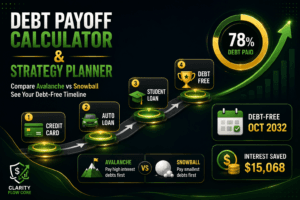
Use our free Debt Payoff Calculator to compare Avalanche vs. Snowball methods. Build a personalized strategy and become debt-free faster.
Price Currency: USD
Operating System: Web Browser
Application Category: WebApplication