
What Happens During a Tax Audit?
What Happens During a Tax Audit? Quick Answer:
A tax audit is a formal operational review by the IRS to verify that the income, expenses, and deductions reported on your tax return are 100% accurate. For over 70% of audited taxpayers, this happens entirely through the mail via a “Correspondence Audit” where you simply mail in missing receipts. If you face an “Office” or “Field” audit, you or your representative will meet with an auditor to walk through your documentation ledger. The audit ends in one of three ways: a “No Change” verdict, an agreement where you pay adjusted back taxes plus interest, or a disagreement that goes to a formal appeals board.

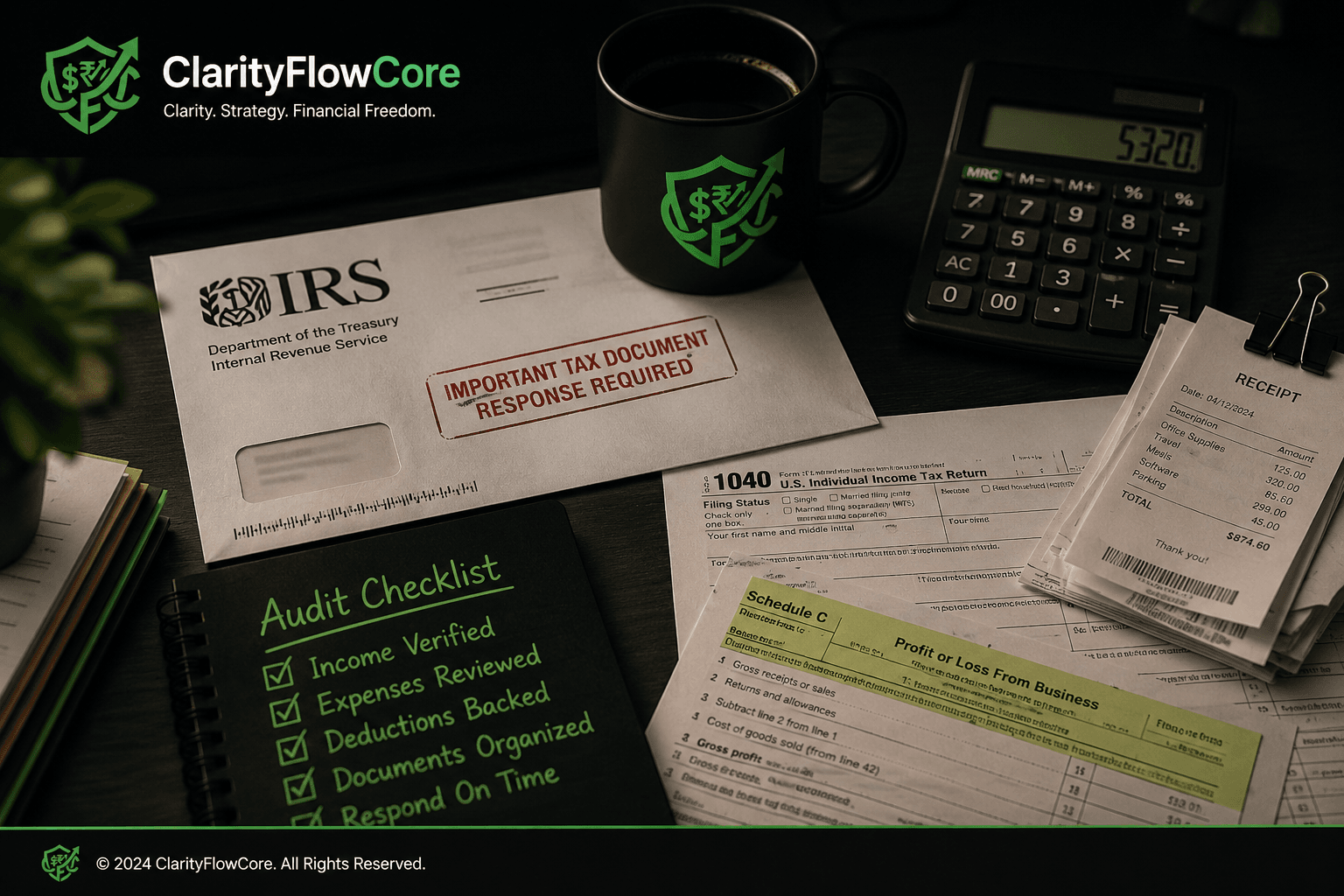
You walk out to your mailbox, flip through a stack of junk mail, and freeze when you see a crisp, white envelope with a distinct return address: Internal Revenue Service.
Your heart rate immediately spikes. You open it up, and right there at the top of the page, the words confirm your absolute worst financial nightmare: your tax return has been selected for an official examination.
The psychological impact of a tax notification is brutal. Your brain immediately paints a vivid picture of flashing lights, armed agents carting off your computer hard drives, and an inescapable prison sentence.
Let’s ground ourselves in operational reality: this isn’t a criminal movie set. A tax audit is not an arrest warrant. It is a routine, highly clinical administrative verification process. The IRS is simply auditing the ledger to ensure the math you reported on your forms perfectly matches the physical reality of your bank statements and receipts.
Early in my business journey, I received an IRS document request questioning a sudden spike in my business deductions. I spent three days pacing my office, convinced a minor bookkeeping error would completely bankrupt me. What actually happened? I sent in a clean stack of digital invoices, an auditor cross-referenced them against my business accounts, and the case was closed via a simple letter.
If you have been flagged or want to proactively insulate your money from a future review, you must understand exactly what happens during a tax audit. Here is the complete editorial framework detailing the tiers of audits, the internal timeline of an examination, and the exact strategic playbook to survive the process intact.
The Trigger: Why Your Return Was Selected
The IRS doesn’t pull names out of a hat based on personal biases. Tax returns are fed into a highly sophisticated, automated pattern-recognition algorithm called the Discriminant Inventory Function (DIF).
The DIF system analyzes every single line item on your return and assigns it a statistical score. If your deductions, income ratios, or business expenses deviate significantly from the national average of individuals within your exact income bracket, your DIF score spikes, and a human agent pulls your file for an operational look.
Real-World Flag Examples:
- The Disproportionate Write-Off: If you earn $60,000 as a sole proprietor and claim $22,000 in “Travel, Meals, and Entertainment” expenses, the algorithm flags you. The math signals that you are likely writing off personal vacations as corporate expenses.
- The Constant Loss Illusion: If your side hustle reports a net loss on Schedule C for four consecutive years, the IRS will audit you to determine if your operation is a legitimate, profit-seeking entity or simply a personal hobby you are using to artificially lower your W-2 tax burden.
- The Cash-Intensive Footprint: If you run an enterprise that handles massive amounts of physical currency—like a laundromat, restaurant, or convenience store—you have a statistically higher chance of an audit because the IRS knows cash transactions are incredibly easy to hide from the books.
The Three Tiers of Tax Audits
Not all audits are created equal. If you are wondering what happens during a tax audit, the answer depends entirely on which of the three administrative tiers your letter dictates.
| Audit Tier | Operational Environment | Scope of Review | Severity & Risk |
| 1. Correspondence Audit | 100% via mail/digital upload | 1–2 specific lines (e.g., missing 1099 or charity receipt) | Low (Resolved in 30 days) |
| 2. Office Audit | Local IRS field office meeting | In-depth review of specific categories (e.g., Schedule C) | Medium (Requires representation) |
| 3. Field Audit | Your home, business, or CPA’s office | Full developmental review of your entire financial life | High (Maximum compliance exposure) |
Tier 1: The Correspondence Audit
This accounts for roughly 70% to 75% of all tax examinations. You will never look an agent in the eye. The IRS simply mails you a letter (such as a Letter 566 or CP2000) stating that a specific data point doesn’t match their records. For instance, if your stock brokerage reported a capital gain that you completely forgot to type onto your return, they will ask for clarification. You mail back the missing paperwork, pay the adjusted difference, and the case is closed.
Tier 2: The Office Audit
This is where the process becomes face-to-face. You receive a letter requesting you to appear at a specific local IRS building at a set date and time. A designated Tax Auditor will sit across a desk from you with your files spread out. They will focus exclusively on a few problematic categories on your return, and you must bring a physical binder of documentation to substantiate every cent you claimed.
Tier 3: The Field Audit
This is the most comprehensive and serious layout. A highly trained Revenue Agent will personally visit your actual place of business or your home. They don’t just want to see receipts; they want to visually inspect your operations, look at your inventory rooms, interview your staff, and verify that the lifestyle you live matches the low income you reported on paper.
Inside the Room: The Operational Timeline
If you are selected for an Office or Field audit, the process follows a strict, highly regulated chronological blueprint. Understanding this timeline is the key to managing your anxiety.
Phase 1: The Initial Contact & Form 4564
The IRS is legally barred from contacting you via phone call, text message, or social media to initiate an audit. Initial contact is always a formal letter delivered via the US Postal Service.
Inside that packet, you will find Form 4564, also known as an Information Document Request (IDR). This form is a highly customized checklist of the exact financial records the auditor demands to see. They will typically grant you 30 days from the date of the letter to compile your data.
Phase 2: The Initial Interview
When the formal meeting begins, the auditor will conduct an initial interview. They will ask open-ended questions about your daily routine, your business structure, and your standard of living.
An Important Insight: Auditors are heavily trained in behavioral psychology. If they ask, “Where do you go on vacation?” or “What kind of car do your kids drive?”, they aren’t making polite small talk. They are fishing for clues to see if your real-world consumption patterns require far more cash than your official tax forms claim.
Phase 3: The Ledger Walkthrough
The auditor will go line-by-line through the items questioned on Form 4564. If your return states you spent $4,250 on “Office Supplies,” they will expect to see an organized spreadsheet that adds up to exactly $4,250, paired with corresponding digital or physical receipts from places like Staples or Amazon. If a receipt simply says “Target” and doesn’t show an itemized breakdown, they will move to disallow the deduction.
Case Study: The Danger of the Unverifiable Write-Off
Let’s look at a raw, real-world scenario to see how an audit turns a paper mistake into a massive financial liability.
Meet David, a self-employed professional who generated $110,000 in gross revenue. When filing his taxes, David wanted to aggressively lower his liability, so he claimed a $12,000 deduction for “Business Vehicle Mileage” on his Schedule C. He calculated that this deduction saved him roughly $3,600 in net federal taxes.
Two years later, David’s return triggers a DIF score anomaly, and he receives an Office Audit letter requesting proof of his vehicle expenses.
What Happens During David’s Audit:
David shows up to the IRS office with a folder full of gas station receipts and a copy of his auto insurance policy. The auditor pushes the folder aside and asks for his contemporaneous mileage log—the daily calendar showing the date of every client trip, the destination, the business purpose, and the exact odometer readings.
David doesn’t have one. He simply guessed his mileage numbers at the end of the year based on intuition.
The Financial Fallout:
Because federal tax law strictly dictates that mileage deductions must be backed by a daily, contemporaneous log, the auditor completely disallows the entire $12,000 deduction.
The auditor updates the system and runs the adjusted math:
| Financial Metric | Before the Audit | Post-Audit Verdict |
| Reported Taxable Business Income | $98,000 | $110,000 (Deduction Denied) |
| Back Taxes Owed on Disallowed $12k | $0.00 | $3,600 |
| Failure-to-Pay Penalty (0.5% per month) | $0.00 | $432 |
| Accuracy-Related Penalty (20% of underpayment) | $0.00 | $720 |
| Accumulated Statutory Interest | $0.00 | $518 |
| Total Cash Required to Clear the IRS | $0.00 | $5,270 |
By failing to keep a clean, operationally compliant mileage ledger, David didn’t just lose his original $3,600 tax savings. The IRS slapped him with a 20% negligence penalty plus compounding interest, turning his unverified deduction into an expensive financial crisis.
WHEN THIS BACKFIRES: The Dangerous Audit Pitfalls
When individuals discover what happens during a tax audit, fear frequently drives them to execute terrible survival strategies. If you make these emotional mistakes, the auditor will escalate your file to higher enforcement tiers:
1. The “Word Vomit” Trap
The single biggest operational error taxpayers make during an face-to-face audit is talking too much. You assume that if you are incredibly friendly and explain your entire life story, the auditor will take pity on you and let you slide.
The opposite happens. Every extra story you tell provides new investigative paths for an auditor. If you say, “Yeah, that was a tough month because my business partner was paying me under the table for a different gig,” you have just confessed to a separate tax crime. Answer the auditor’s questions with absolute, clinical brevity. If they ask for a receipt, hand them the receipt. Do not volunteer an explanation unless explicitly prompted.
2. Creating Fraudulent Documentation After the Fact
You realize you are missing a critical receipt for a $3,000 computer write-off. You open up an online invoice generator, recreate a fake digital receipt from a tech store, change the dates, print it out, and present it to the auditor as an original document.
This is a catastrophic error. IRS agents have highly advanced forensic tools to check metadata, verify corporate transaction logs with vendors, and spot altered paperwork. If you show a missing receipt, you face a minor civil penalty. If you hand an auditor a forged receipt, you cross the line from a civil mistake into willful tax fraud. The auditor will immediately stop the civil audit and refer your entire file to the IRS Criminal Investigation Division.
3. Stonewalling the Auditor
Some people take aggressive internet advice and attempt to assert their rights by refusing to hand over bank statements, ignoring deadlines, or speaking condescendingly to the agent.
This backfires immediately. If you refuse to cooperate, the auditor has the legal authority to issue a Formal Summons, legally forcing your bank or clients to hand over records directly. Furthermore, if you provide zero proof, the auditor will simply close the case, deny 100% of your deductions by default, and hand you the maximum possible bill.
How to Handle an Audit: The Strategic Defense Playbook
If your file has been pulled for a review, execute these three operational steps immediately to insulate your capital:
Step 1: Hire a Qualified Buffer
Never represent yourself in an Office or Field audit. The psychological stress will cause you to make mistakes.
Instead, hire an Enrolled Agent (EA), a Certified Public Accountant (CPA), or a Tax Attorney. You can sign Form 2848 (Power of Attorney), which legally allows your representative to step between you and the IRS. Your CPA can attend the audit meetings without you even being present in the room. They speak the technical language of the tax code, know exactly what the auditor is legally entitled to see, and can shut down invasive questions before they cause damage.
Step 2: Build a Pristine Audit Binder
Do not show up to an audit with a chaotic shoebox full of crumpled papers. This signals to the auditor that your entire bookkeeping structure is a mess, prompting them to expand the scope of the review to your previous tax years.
Organize your documents into a clean, tabbed binder or a perfectly indexed digital folder. Match every single transaction to a specific line item on your tax return. When you hand an auditor a perfectly organized ledger, it sends a psychological signal that you are a disciplined professional, frequently causing them to wrap up the review early.
Frequently Asked Questions (FAQs)
1. How far back can the IRS go to audit my tax returns?
Under the standard statutory limits, the IRS can audit your returns up to three years after the date you filed them. However, if the algorithm uncovers a substantial omission of income (defined as failing to report 25% or more of your true gross revenue), the statutory window automatically doubles to six years. If the IRS can prove that you filed a completely fraudulent return with the intent to evade taxes, the clock stops completely—there is no time limit for tax fraud.
2. What are the chances of getting hit with a tax audit?
For the vast majority of traditional W-2 wage earners, the statistical probability of an audit is incredibly low—typically less than 0.5%. However, the odds scale upwards significantly if you report over $100,000 on a Schedule C sole proprietorship, claim international foreign bank accounts, or report an income exceeding $1 million a year.
3. What happens if I can’t afford to pay the back taxes after an audit?
If the audit ends with a verdict that you owe money but your checking account is dry, the IRS will not throw you in jail. You have access to legal repayment mechanisms. You can instantly sign up for an Installment Agreement to pay the balance down via automatic monthly payments over up to 72 months. If you face severe insolvency, your representative can file an Offer in Compromise (OIC), requesting the IRS to legally settle your entire debt for a fraction of what you owe.
4. Can I appeal the final decision of an IRS auditor?
Yes, absolutely. You are never forced to accept an auditor’s initial assessment. If the review concludes and you completely disagree with their findings, you can refuse to sign the final assessment form (Form 4549). The IRS will then mail you a 30-Day Letter detailing your right to escalate your file to the IRS Appeals Office, an independent internal branch focused entirely on resolving disputes without going to court.
5. How long does a standard tax audit take to finish?
A standard correspondence audit can be fully wrapped up within 30 to 60 days via mail. However, an in-person Office or Field audit is a much slower operational process. Depending on the complexity of your business structure, the availability of your receipts, and the speed of your tax representative, an face-to-face audit can drag on anywhere from three months to over a year.
The Bottom Line
A tax audit is a stressful experience, but it is ultimately a manageable administrative hurdle. It is not an emotional judgment on your character; it is a clinical review of your transactional record-keeping.
Stop treating the IRS like an omnipotent shadow entity, and start treating your taxes like a structured compliance system. Keep your digital receipts pristine, back your deductions with real-time logs, and immediately hire a qualified professional to run your defense if you receive a letter. By approaching an examination with defensive organization and quiet composure, you guarantee that your personal assets remain protected, your records stay secure, and your financial journey stays firmly on track.
IRS Resources & Taxpayer Support
If you ever receive an IRS audit notice, these official resources can help you understand the audit process, verify notices, protect your rights as a taxpayer, and find professional assistance when needed.
- Internal Revenue Service (IRS) – IRS Audits – Learn how audits work, why returns are selected, and what to expect throughout the examination process.
- Internal Revenue Service (IRS) – Taxpayer Bill of Rights – Understand your legal rights before, during, and after an IRS audit.
- Taxpayer Advocate Service (TAS) – An independent organization within the IRS that helps taxpayers resolve audit issues, delays, and other tax-related problems.
- IRS – Publication 1: Your Rights as a Taxpayer – Official guidance explaining taxpayer protections, appeal rights, and IRS responsibilities.
- IRS – Payment Plans & Installment Agreements – Explore options if you owe additional taxes after an audit and cannot pay the balance in full.
- National Association of Enrolled Agents (NAEA) – Find federally licensed Enrolled Agents who can represent taxpayers before the IRS during audits and appeals.
Disclaimer: The information provided in this guide is for educational purposes only and does not constitute financial, investment, or tax advice. All financial products and offers are subject to individual credit approval and specific lender terms. Please consult with a qualified financial professional to determine if the strategies or products discussed in this guide are the right fit for your personal financial situation.
About Author

Rishabh Nigam
Rishabh Nigam founded Clarity Flow Core to make personal finance easier to understand for everyday readers. He covers credit scores, debt repayment, credit utilization, loan readiness, taxes, and financial planning through practical guides, calculators, and educational resources. His content focuses on turning complex financial concepts into clear, actionable steps that readers can apply in real life.