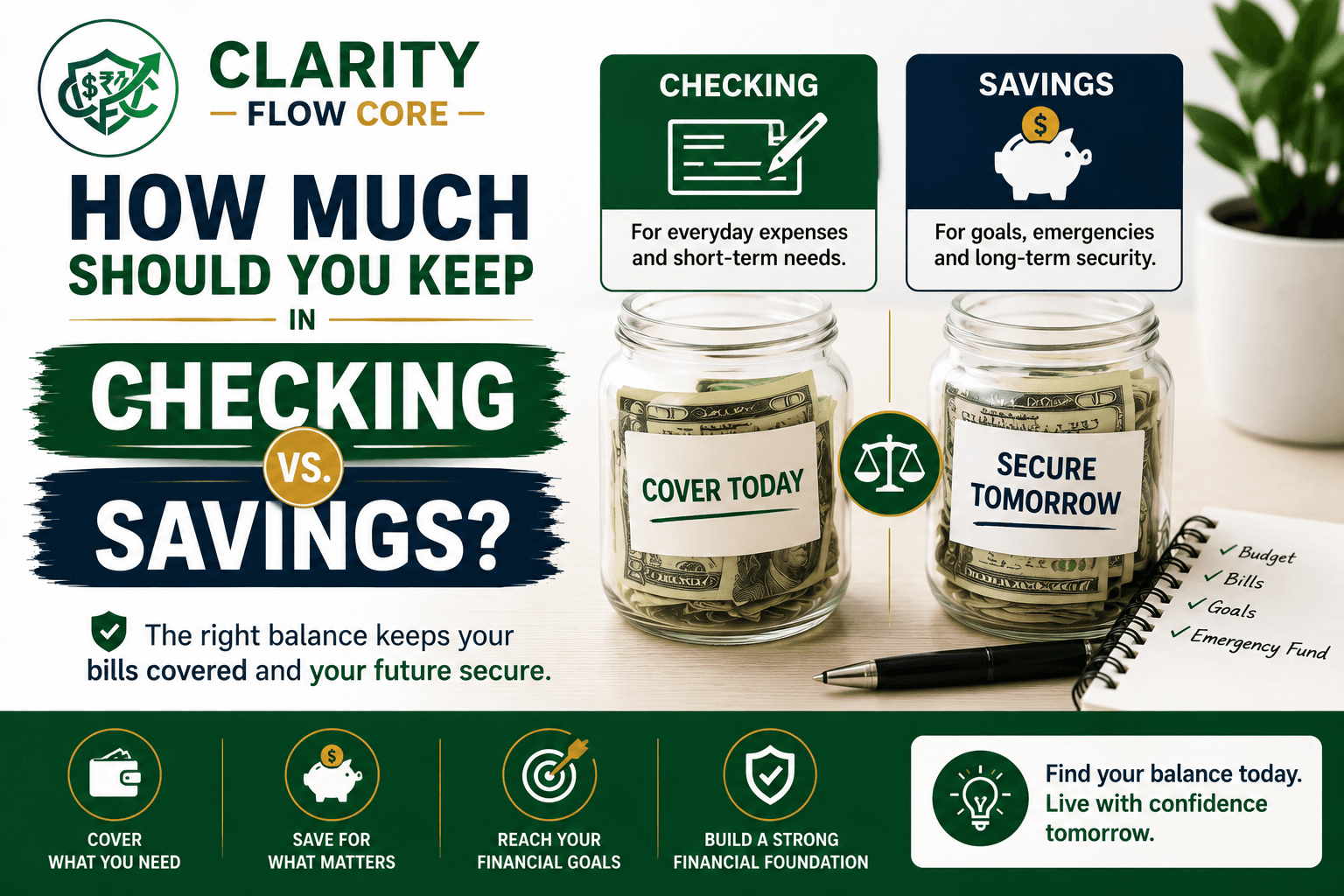
How Much Should You Keep In Checking vs Savings?
If you are wondering exactly how much should you keep in checking vs savings, you are definitely not alone.
Picture this: You are standing in the grocery store checkout line. You open your banking app to make sure you have enough money before you tap your card. Your checking account balance looks a little dangerously low, but your savings account looks great. So, you quickly transfer $50 over just in case.
Or maybe you are on the opposite end of the spectrum. You log in and see a massive pile of cash sitting in your checking account. It feels good to see that big number, but deep down, you know that money isn’t really growing, and it’s painfully easy to accidentally spend it.
If either of these scenarios sounds familiar, you are not alone. Figuring out exactly how much money should live in your checking account versus your savings account is one of those basic adulting skills nobody actually teaches us in high school. We are just expected to figure it out. As a result, most of us just guess. We move money back and forth based on anxiety, upcoming bills, or whatever payday math we can do in our heads.
But money shouldn’t make you feel anxious. Clarity Flow Core is designed to help everyday people understand money and make smarter financial decisions. Let’s break down exactly how to balance your checking and savings accounts so you can stop stressing about overdrafts and start actually building your financial foundation.
The Quick Answer
If you just need the fast, baseline formula to organize your money today, here is the breakdown:
| Account | Purpose | Recommended Amount |
| Checking | Monthly spending & bills | 1 month expenses + 20% buffer |
| Savings | Emergency fund | 3–6 months expenses |
| Sinking Funds | Planned future expenses | Based on goals |
The Real Problem: The Two Banking Extremes
When people don’t have a system for separating their money, they usually fall into one of two traps.
Trap 1: The “Everything in Checking” Method
This happens when you leave almost all of your paycheck in your main checking account. You might tell yourself, “I’ll just spend what I need and whatever is left over at the end of the month will be my savings.”
Let’s be honest: there is rarely anything left over. When all your money is sitting in the account linked directly to your debit card, it feels like you have permission to spend it. That target run that was supposed to be $20 suddenly turns into $150 because, well, the money is there.
Trap 2: The “Starved Checking” Method
This is common among people who are desperately trying to save money or get out of debt quickly. On payday, you aggressively transfer almost everything into your savings account, leaving only pennies in your checking.
The intention is great, but the reality is stressful. A week later, you realize you forgot about your auto insurance draft, or you need gas. Suddenly, you are scrambling to transfer money back to checking to avoid a $35 overdraft fee. You end up treating your savings account like a revolving door, which defeats the purpose of saving in the first place.
Why Do We Struggle With This?
If you feel embarrassed that you haven’t mastered this yet, take a deep breath. You shouldn’t be. The struggle is completely logical.
First, there is the fear of overdrafting. Banks make billions of dollars a year on overdraft fees. If you have ever been hit with one when you were already financially stressed, you know it physically hurts. To protect ourselves, we naturally hoard cash in our checking accounts to create a buffer against those fees.
Second, there is friction. Setting up automatic transfers, opening different accounts, and tracking bills takes time and mental energy. When you are a freelancer dealing with unpredictable income, or a young adult just trying to keep your head above water, finding the time to “optimize” your banking setup feels like a luxury you don’t have.
Lastly, there is the psychology of money. Seeing a high balance in checking gives us a false sense of security. But keeping too much cash in checking actually harms you in the long run.
Common Mistakes Beginners Make
Before we get to the exact formula of how much goes where, let’s look at a few classic mistakes you might be making right now.
- Treating checking like a wealth-building tool: Standard checking accounts earn basically zero interest. If you leave $10,000 sitting in a regular checking account for a year, it will earn pennies. Meanwhile, inflation is making that money less valuable every single day.
- Using the same bank for checking and savings: If your savings account is sitting directly underneath your checking account on your bank’s app, it is way too easy to dip into it. It requires no effort. Out of sight, out of mind is a powerful psychological trick you need to use to your advantage.
- Mixing your emergency money with your vacation money: If your savings account is just one giant bucket of money, you don’t actually know what it’s for. Is that $3,000 meant to fix your car’s transmission, or is it for a trip to Miami? Without clarity, you will probably spend the emergency money on the vacation and then end up in credit card debt when the car breaks down.
The Real Consequences of Getting It Wrong
This isn’t just about making your bank app look organized. There are real, mathematical consequences to getting this mix wrong. If you keep too much in checking, you are losing out on free money. High-Yield Savings Accounts (HYSAs) currently pay decent interest just for holding your cash. By leaving your emergency fund in a checking account, you are literally leaving hundreds of dollars on the table every year.
If you keep too little in checking, you face the wrath of overdraft fees. More importantly, you face chronic financial anxiety. You should never have to log into your bank account while standing at a cash register to make sure your card won’t decline. That stress leaks into your work, your relationships, and your overall happiness.
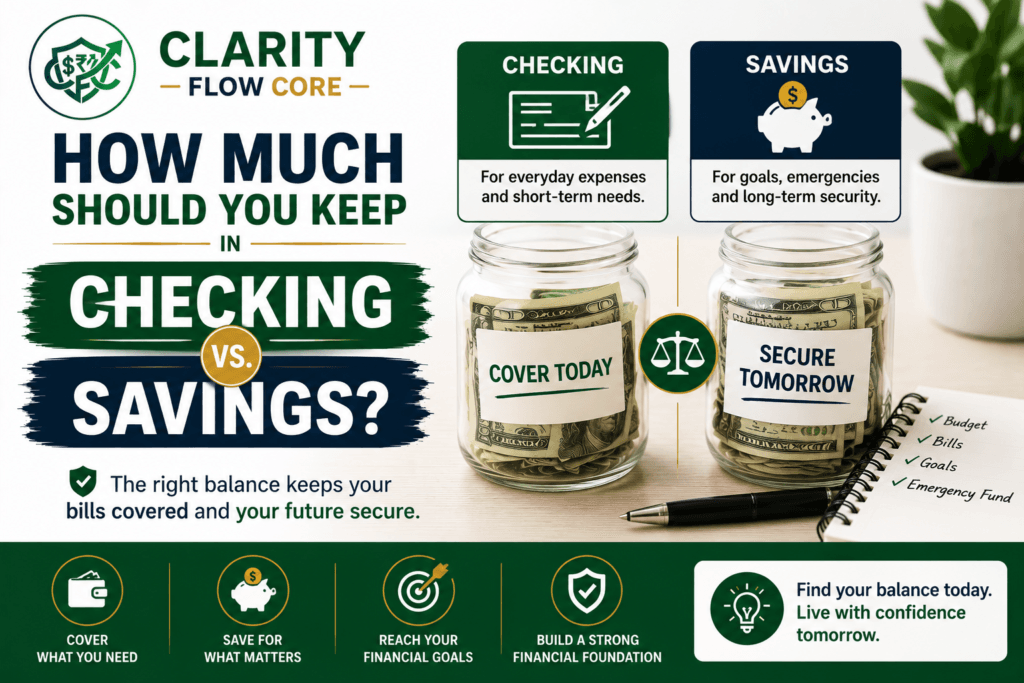
How Much Should You Keep In Checking vs Savings?
Alright, let’s fix this. We are going to establish a clear, realistic boundary between these two accounts. Here is the exact framework to use.
1. How Much to Keep in Checking
Your checking account is your financial grand central station. Money comes in from your job, and money goes out to pay for your life. It is an operations account, not a storage unit.
The Rule: You should keep exactly one month of living expenses, plus a 20% buffer, in your checking account.
Let’s do some simple math. If your rent, utilities, groceries, gas, minimum debt payments, and basic fun money equal about $3,000 a month, then $3,000 is your baseline. Now, add a 20% buffer (which is $600).
Your target checking account balance should hover around $3,600.
Why the 20% buffer? Because life isn’t a perfect spreadsheet. Maybe your utility bill is higher this month because it was incredibly hot and your AC ran non-stop. Maybe a subscription renewed that you forgot about. That buffer protects you from overdraft fees and eliminates the panic of timing your bill payments perfectly with your paychecks.
Once you have one month of expenses plus a 20% buffer in checking, every single extra dollar needs to leave that account.
2. How Much to Keep in Savings
Your savings account is your financial fortress. It is meant for protection, future goals, and growth. Your savings should be broken down into two main categories:
- The Emergency Fund: This is untouchable unless the house is on fire (figuratively speaking). For most people, a solid emergency fund is 3 to 6 months’ worth of necessary living expenses. If you are a freelancer or have an irregular income, lean closer to 6 months. (Tool Suggestion: “Advanced Emergency Fund Analyzer“)
- Sinking Funds: These are targeted savings goals. You know Christmas happens every December. You know your car will eventually need new tires. Instead of putting these on a credit card, you save a little bit each month in a specific “sinking fund” so the cash is waiting for you when the event happens.
Example Scenarios
To make this crystal clear, let’s look at how this cash allocation strategy plays out in real life.
Example 1: The Salaried Employee
Let’s say you have a stable 9-to-5 job, and your monthly living expenses are exactly $3,000.
- Checking Account Target: $3,600 (One month of expenses + a 20% buffer).
- Savings Account Target: $9,000 to $18,000 (3 to 6 months of living expenses in an external High-Yield Savings Account).
Example 2: The Freelancer
Let’s say you are a freelance graphic designer. Your income fluctuates wildly from month to month, but your baseline living expenses are still $3,000. Because your income is less predictable, you need a larger safety net.
- Checking Account Target: $6,000 (In this case, a full extra month of expenses acts as a stronger checking buffer to smooth out months where clients pay late).
- Savings Account Target: $18,000 (A full 6-month emergency fund is highly recommended for self-employed individuals).
(Coming Soon: Clarity Flow Core is currently building a custom Cash Allocation Planner. Soon, you will be able to input your specific monthly expenses, income stability, and goals, and our calculator will build your exact account targets automatically!)
Your Beginner-Friendly Action Plan
Ready to clean up your accounts? Here is your step-by-step action plan to get this done this week.
Step 1: Calculate Your Monthly Burn Rate
Sit down with a cup of coffee and your last 30 days of bank statements. Add up exactly how much it costs to run your life for one month. Include rent, groceries, debt payments, and basic living costs. Do not guess. Actually look at the numbers.
Step 2: Establish Your Checking Floor
Take that monthly burn rate and add 20%. That number is your new “floor.” Your goal is to never let your checking account drop below that buffer amount. If you don’t have enough money to create this buffer right now, that is completely okay! Make it a goal to save $50 a week and leave it in your checking account until the buffer is built.
Step 3: Move Your Savings to a Different Bank
This is the ultimate game-changer. Open a High-Yield Savings Account (HYSA) at a completely different, online-only bank. Why? Because it takes about 2 to 3 business days to transfer money from an external HYSA back to your main checking account. That intentional delay prevents you from impulse-buying a new jacket at 11:00 PM on a Friday. It creates a physical barrier between you and your savings.
Step 4: Automate the Split
Do not rely on your own discipline to manually move money. Human willpower runs out. Talk to your employer’s HR department and ask to split your direct deposit. Have your main paycheck go to checking, and have 10% (or whatever you can afford) routed directly to your external HYSA. You will never even see the money, so you won’t miss it.
Frequently Asked Questions (FAQs)
Should I keep my emergency fund in checking or savings?
Most people should keep emergency funds in a High-Yield Savings Account rather than checking. Savings accounts typically earn more interest while still providing quick access to cash when needed. A small emergency buffer may remain in checking for immediate expenses.
Is it bad to keep $10,000 in a checking account? Unless your basic monthly living expenses are $8,000, yes, it is generally a bad idea. A standard checking account pays almost no interest. By keeping a large amount of cash there, inflation is quietly eating away at its purchasing power. Plus, if your debit card is ever stolen or skimmed, having a massive balance in your checking account puts all that cash at immediate risk. Keep your buffer, and move the rest to a High-Yield Savings Account.
What if my income fluctuates because I’m a freelancer or side hustler? If your income goes up and down, your checking buffer needs to be larger. Instead of a 20% buffer, you might want to keep an extra full month of expenses in your checking account to smooth out the months where clients pay late or sales are slow.
How much is too much in savings? Once you have 3 to 6 months of expenses in your emergency fund and you have fully funded your short-term sinking funds, continuing to pile cash into a savings account can actually hold you back. At that point, you should start looking into investing (like retirement accounts) to make your money truly grow over the long term.
Should I close my savings account at my current local bank? Not necessarily. It can be helpful to keep a small, immediate emergency fund (like $500 to $1,000) in the savings account attached to your main checking for true, immediate emergencies—like needing to pay a tow truck driver at 2:00 AM. But the bulk of your savings should live in an external High-Yield account.
Final Thoughts
Managing your personal finances shouldn’t feel like a punishment, and it shouldn’t require a degree in accounting. Clarity Flow Core believes in practical, hype-free education. The goal of separating your checking and savings isn’t to restrict you; it’s to protect you.
When you know exactly what your checking account is supposed to do—pay for your monthly life—and exactly what your savings account is supposed to do—protect your future—you remove the guesswork. You can swipe your debit card for groceries knowing the math is already handled. You can sleep well at night knowing your emergency fund is safely tucked away, earning interest, and ready if you ever need it.
Start small. Build that checking buffer first. Once you stop stressing about overdraft fees, you’ll have the mental clarity to tackle your next big financial goal. You’ve got this.
Sources & References
- Federal Deposit Insurance Corporation (FDIC) – Deposit Insurance – Learn how FDIC insurance protects eligible bank deposits and understand the coverage limits for checking and savings accounts.
- Consumer Financial Protection Bureau (CFPB) – Bank Accounts – Official guidance on choosing and managing checking and savings accounts, avoiding overdraft fees, and understanding banking services.
- Consumer Financial Protection Bureau (CFPB) – Managing Your Money – Practical resources on budgeting, saving, emergency funds, and building healthy financial habits.
- National Credit Union Administration (NCUA) – Share Insurance – Learn how deposits at federally insured credit unions are protected and how share insurance works.
- Investor.gov (U.S. Securities and Exchange Commission) – Saving and Investing – Educational resources explaining when to keep cash in savings versus investing for long-term financial goals.
- MyMoney.gov – Saving & Investing – U.S. government financial education covering emergency savings, cash management, and financial planning.
Disclaimer: The information provided in this guide is for educational purposes only and does not constitute financial, investment, or tax advice. All financial products and offers are subject to individual credit approval and specific lender terms. Please consult with a qualified financial professional to determine if the strategies or products discussed in this guide are the right fit for your personal financial situation.
About Author

Rishabh Nigam
Rishabh Nigam founded Clarity Flow Core to make personal finance easier to understand for everyday readers. He covers credit scores, debt repayment, credit utilization, loan readiness, taxes, and financial planning through practical guides, calculators, and educational resources. His content focuses on turning complex financial concepts into clear, actionable steps that readers can apply in real life.




One Comment
Comments are closed.