
What Happens After Mortgage Pre-Approval? A Step-by-Step Timeline
If you are currently staring at a letter from a bank and wondering exactly what happens after mortgage pre-approval, take a deep breath and congratulate yourself. You have just crossed the first major hurdle of buying a house.
But if you feel a sudden wave of panic mixed in with that excitement, you are completely normal.
Most people think getting pre-approved is the hard part. The truth is, a pre-approval is just a VIP ticket that gets you into the club. You still have to order, pay your tab, and make sure you don’t get kicked out before the night is over. The time between getting that letter and actually getting the keys to your new front door is known as the “closing process,” and it is filled with a lot of waiting, signing, and sudden financial anxiety.
If you make the wrong financial move during this window, your lender can literally revoke your approval and cancel the purchase.
Let’s remove the mystery from this process. Here is the exact, step-by-step timeline of what happens next, what you need to do, and most importantly, what you absolutely cannot do if you want to keep your loan safe.
The Quick Answer: Your Homebuying Timeline
If you just need a fast visual framework of the road ahead, here is your step-by-step cheat sheet.
| Phase | What Happens | Typical Timeframe | Your Stress Level |
| 1. The Hunt | Shopping for homes within your budget and submitting offers. | 1 to 3+ Months | High (Exciting but exhausting) |
| 2. The Contract | Your offer is accepted, and you submit “Earnest Money.” | 1 to 3 Days | Peaking (It’s happening!) |
| 3. The Freeze (Underwriting) | The bank scrutinizes your finances to finalize the loan. | 30 to 45 Days | High (Lots of waiting) |
| 4. Inspections & Appraisal | Checking if the house is safe and worth the price. | Weeks 2 & 3 of Contract | Medium |
| 5. The Clear to Close | The bank officially says “Yes, we will fund this.” | 3 to 5 Days before Closing | Low (Relief!) |
| 6. Closing Day | You sign a mountain of paperwork and get the keys. | 1 Day | Zero (Celebrate!) |
How Long Does It Take From Pre-Approval to Closing?
Most buyers take 30 to 90 days to go from mortgage pre-approval to closing. The timeline depends on how quickly they find a home, how complex the underwriting process becomes, and whether inspection or appraisal issues arise.
| Step | Typical Time |
| Find a Home | 1–90+ Days |
| Under Contract | 30–45 Days |
| Closing | 1 Day |
Phase 1: The Shopping Phase (And The Budget Trap)
Now that you have your pre-approval letter, you can officially start touring houses with a real estate agent. When you find a house you love, your agent will use that letter to prove to the seller that you have the financial backing to actually buy it.
But there is a massive trap hiding in Phase 1: The Pre-Approval Maximum.
Your lender might pre-approve you for $400,000. That does not mean you should buy a $400,000 house. Lenders calculate your maximum approval based on gross income (before taxes) and ignore things like your groceries, utility bills, daycare costs, and that 20% buffer you keep in your checking account.
If you max out your pre-approval, you will likely become “house poor”—meaning you can pay your mortgage, but you can’t afford to furnish the house, go on vacation, or save for emergencies.
⚖️ Avoid the “House Poor” Trap
Don’t let a bank’s maximum pre-approval dictate your lifestyle. Plug your gross income, current debts, and expected new housing costs into our free Debt-to-Income (DTI) Analyzer to find your true affordability limit before you ever make an offer.
Phase 2: The Accepted Offer and Earnest Money
You found a house that fits your real budget, you made an offer, and the seller accepted it. Congratulations! You are now officially “under contract.”
Within the first 48 to 72 hours, you will have to hand over Earnest Money.
This is a good-faith deposit (usually 1% to 3% of the purchase price) that shows the seller you are serious. If you buy a $300,000 house, expect to wire or write a check for around $3,000.
Don’t panic—this money doesn’t disappear. It is held in a secure escrow account, and on closing day, it will be applied directly toward your down payment and closing costs.
Phase 3: The Danger Zone (Underwriting)
This is the phase that makes everyone sweat. Once you are under contract, your file goes to a person at the bank called an Underwriter.
What is Underwriting? (The Golden Rule)
A pre-approval was just a computer taking a quick glance at your credit and income. Underwriting is a human being taking a microscope to your entire financial life to ensure you aren’t a risk. The Golden Rule of Underwriting: Freeze your finances. From the moment you are under contract until the moment you have the keys in your hand, do not change jobs, do not open new credit, and do not move large amounts of money.
Mortgage Approval Survival Checklist
Until Closing Day:
❌ Don’t open new credit cards
❌ Don’t finance furniture
❌ Don’t buy a car
❌ Don’t quit your job
❌ Don’t move large amounts of money between accounts
❌ Don’t co-sign loans
✅ Keep paying bills on time
✅ Keep balances low
✅ Respond quickly to lender requests
The underwriter’s job is to verify everything you claimed during your pre-approval. They will ask for updated pay stubs, two months of recent bank statements, and they will pull your credit report again right before closing.
If they see anything weird—like a sudden $5,000 cash deposit that you can’t prove the source of, or a brand-new car loan—they will hit the brakes.
Common Mistakes Beginners Make While Under Contract
More mortgages fall apart during underwriting due to self-inflicted wounds than anything else. Do not let these classic beginner mistakes cost you your dream home.
- Buying furniture on credit: You are excited about the new living room, so you go to a furniture store and take advantage of their “0% financing for 12 months” deal. Huge mistake. This adds a new debt obligation to your credit profile, changes your debt-to-income ratio, and can instantly kill your mortgage approval.
- Closing old credit cards: You paid off a card to get ready for the house, and then you closed the account. This drops your total available credit, which causes your credit utilization to spike, tanking your credit score right as the bank is checking it.
📉 Don’t Sabotage Your Loan Approval
During the mortgage underwriting process, your credit score is incredibly sensitive. Before making any major purchases, paying off old collections, or closing an old credit card, run the scenario through our free Credit Score Simulator to ensure you won’t accidentally drop your score and lose your house.
- Quitting your job: Even if you are moving to a better-paying job in the same industry, changing employers right before closing makes underwriters very nervous. If you must change jobs, tell your lender immediately before accepting the offer.
- Moving money between accounts unnecessarily: If you transfer $10,000 from your high-yield savings to your checking, the underwriter will demand a “paper trail” to prove that money wasn’t a secret loan from a friend. Leave your money where it is until the bank explicitly tells you how to pay your down payment.
Phase 4: The Inspection and Appraisal
While the underwriter is doing their paperwork, two very important physical checks happen at the house.
The Home Inspection (For Your Protection)
You will hire an independent home inspector to spend a few hours crawling through the attic, checking the plumbing, and looking for hidden disasters. The bank doesn’t require this, but it is the most important $400 to $600 you will ever spend. If the inspector finds out the roof is caving in, you can use that information to negotiate with the seller to fix it, or you can walk away from the deal and get your earnest money back. This is exactly why you want cash reserves saved up for sudden homeownership surprises and repairs.
The Appraisal (For The Bank’s Protection)
The bank will send a licensed appraiser to the house to confirm its true market value. If you agreed to buy the house for $350,000, but the appraiser says it is only worth $320,000, the bank will only loan you money based on the $320,000 value. You will either have to negotiate the price down with the seller, pay the $30,000 difference out of your own pocket, or walk away.
Phase 5: The “Clear to Close” and Final Walkthrough
If the appraisal is good, the inspection is handled, and the underwriter is happy, you will receive the three most beautiful words in real estate: Clear to Close.
This means the bank has officially finalized the loan.
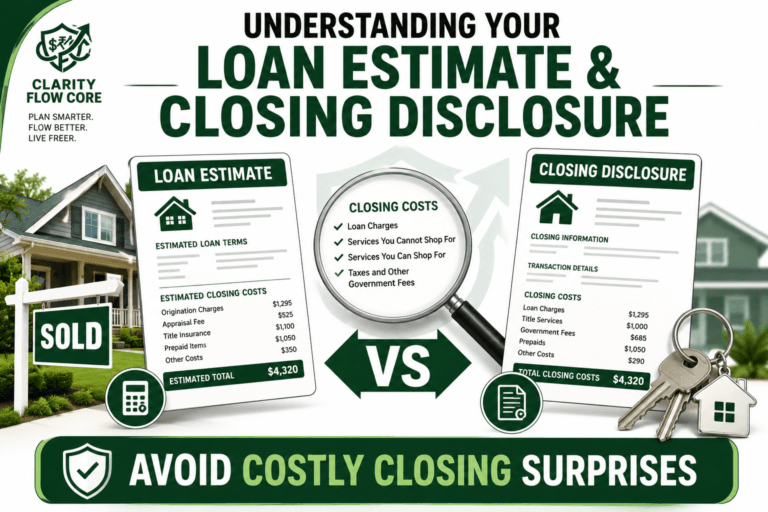
At least three days before your closing date, the lender will send you a document called the Closing Disclosure (CD). This document tells you exactly, down to the penny, how much money you need to bring to closing. This covers your down payment, taxes, and lender fees (minus your earnest money deposit).
Estimate Your Closing Costs
Don’t wait until 3 days before closing to find out what you owe. Use our free Mortgage Affordability Calculator to instantly estimate your hidden cash requirements and total cash to close.
The Final Walkthrough: About 24 hours before you sign the papers, you will walk through the empty house one last time. You are just making sure the seller actually moved out, didn’t punch a hole in the wall while moving the sofa, and left the appliances they agreed to leave.
Phase 6: Closing Day
You made it. Closing day is surprisingly anti-climactic. You will go to a title company’s office, hand over a cashier’s check or a wire transfer receipt for your closing costs, and spend about an hour signing your name until your hand cramps.
Once the funds clear and the title is recorded with the county, the house is legally yours. You get the keys, and you can finally go buy that furniture you’ve been holding off on.

Example Scenarios
To make this feel a bit more concrete, let’s look at two very different ways this timeline can play out.
Example 1: The Smooth Operator (Sarah)
Sarah gets pre-approved for $300,000. She finds a house for $275,000. During underwriting, she continues living her normal financial life. She pays her credit cards in full, leaves her savings sitting quietly in her emergency fund, and ignores the urge to buy a new refrigerator on a store credit card. Her underwriter asks for two recent pay stubs, she emails them within an hour, and she gets her “Clear to Close” a week early. The process is completely stress-free.
Example 2: The Self-Saboteur (Mark)
Mark is also pre-approved for $300,000. He gets an accepted offer and immediately feels like a “homeowner.” To celebrate, he goes out and finances a $40,000 truck so he can haul things for his new yard. Two weeks before closing, the underwriter pulls Mark’s credit report and sees the massive new auto loan. Because Mark now has a huge new monthly truck payment, he no longer qualifies for the mortgage. The loan is denied, the contract falls through, and Mark loses the house.
Frequently Asked Questions (FAQs)
Can I use my credit card while waiting to close?
Yes. You can continue using your credit cards for normal daily expenses. The key is to avoid opening new accounts, taking on new loans, or significantly increasing your balances before closing.
Does a pre-approval guarantee I will get the loan?
No. A pre-approval is highly conditional. It basically means, “Assuming everything you told us is true, and assuming your financial situation does not change one bit over the next 60 days, we will give you a loan.” If your job, credit, or down payment funds change, the deal can be canceled.
How long does a mortgage pre-approval last?
Most pre-approval letters are valid for 60 to 90 days. After that, your lender will need to do a “refresh” by pulling a new credit report and asking for your most recent pay stubs to make sure your financial situation hasn’t changed.
Can I switch lenders after I’m pre-approved?
Yes, absolutely! Just because you got pre-approved with Bank A doesn’t mean you are married to them. Once you have an accepted offer on a house, you can rapidly “shop” your loan with Bank B and Bank C to see who offers you the lowest interest rate and the lowest closing fees. Just make sure you do this within the first few days of your contract so you don’t delay the closing timeline.
What is the difference between Pre-Qualification and Pre-Approval?
A pre-qualification is basically a guess. You tell the bank your income on a website, and they spit out a rough estimate of what you can afford without checking your documents. A pre-approval is serious; the bank actually verifies your W-2s, tax returns, and pulls your hard credit score. Realtors will only take you seriously if you have a pre-approval.
Final Thoughts
Buying a house is easily one of the most stressful, emotionally exhausting financial transactions you will ever make. It is completely normal to feel like you are walking on eggshells from the moment your offer is accepted until closing day.
Clarity Flow Core believes in controlling the controllables. You can’t control if the house appraises slightly low, and you can’t control how fast the seller moves out. But you can control your financial behavior.
Lock your credit cards away, ignore the furniture sales, and respond to your loan officer’s emails as fast as humanly possible. If you protect your payment history, keep your checking and savings accounts stable, and practice a little bit of patience, you will survive the underwriting freeze and get the keys to your new life. You’ve got this.
Sources & References
- Consumer Financial Protection Bureau (CFPB) – Buying a House – Learn about the homebuying process, mortgage shopping, and closing costs.
- Consumer Financial Protection Bureau (CFPB) – Your Home Loan Toolkit – Official guide explaining mortgage pre-approval, loan estimates, closing disclosures, and the home buying process.
- U.S. Department of Housing and Urban Development (HUD) – Homebuying Programs and Resources – Information on purchasing a home, HUD-approved housing counselors, and first-time buyer assistance.
- Federal Housing Administration (FHA) – Buying a Home – Learn about FHA-insured mortgages, borrower requirements, and the mortgage process.
- Fannie Mae – HomeView® Homebuyer Education – Free educational resources covering budgeting, mortgage approval, underwriting, and homeownership responsibilities.
- Freddie Mac – My Home by Freddie Mac – Educational articles explaining mortgage pre-approval, home inspections, appraisals, and closing.
Disclaimer: The information provided in this guide is for educational purposes only and does not constitute financial, investment, or tax advice. All financial products and offers are subject to individual credit approval and specific lender terms. Please consult with a qualified financial professional to determine if the strategies or products discussed in this guide are the right fit for your personal financial situation.
About Author

Rishabh Nigam
Rishabh Nigam founded Clarity Flow Core to make personal finance easier to understand for everyday readers. He covers credit scores, debt repayment, credit utilization, loan readiness, taxes, and financial planning through practical guides, calculators, and educational resources. His content focuses on turning complex financial concepts into clear, actionable steps that readers can apply in real life.