
Roth vs Traditional Withdrawals: How to Optimize Your Retirement Taxes
For decades, the financial industry trains you to focus entirely on saving for retirement. You diligently contribute to your 401(k)s and IRAs, watching your balance grow. But as you transition from saving to spending, you suddenly face a terrifying reality: the IRS owns a massive percentage of your net worth.
If you pull your money out of the wrong account at the wrong time, you can accidentally push yourself into a higher tax bracket, trigger surcharges on your Medicare premiums, and lose thousands of dollars to unnecessary taxes.
To protect your wealth, you must master the mechanics of Roth vs traditional withdrawals. It is not just about how much money you have; it is about where that money lives and when you touch it.
Here is exactly how to structure your retirement paychecks to legally minimize your tax liability and keep your money in your own pocket.
Phase 1: Roth vs Traditional Withdrawals Explained
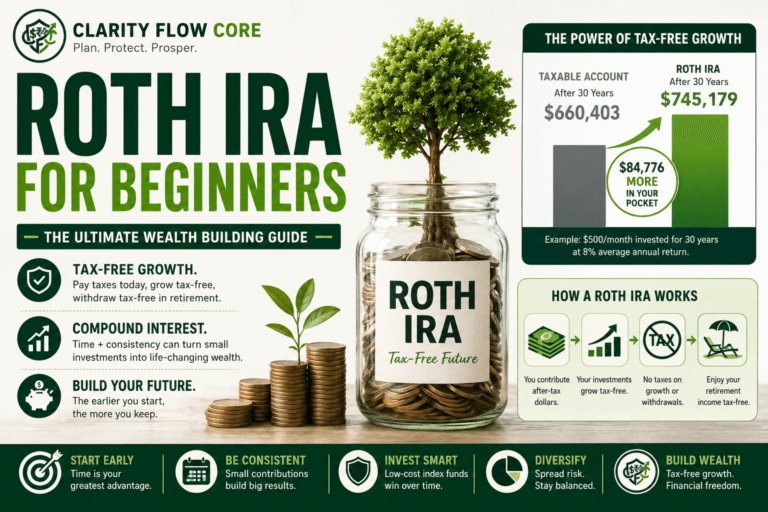
When comparing Roth vs traditional withdrawals, the entire strategy revolves around one question: When did you pay the IRS?
The Retirement Tax Matrix
How the IRS views your retirement income.
1. Traditional Accounts
- The Rule: You got a tax break when you deposited the money. Now, the IRS wants their cut.
- The Impact: Every single dollar you withdraw is taxed as ordinary income, exactly like a paycheck from an employer.
- The Catch: Large withdrawals can push you into a highly expensive tax bracket.
2. Roth Accounts
- The Rule: You already paid taxes on this money before you deposited it.
- The Impact: Withdrawals are 100% tax-free. They do not count toward your taxable income for the year.
- The Catch: The money must have been in the account for at least 5 years, and you must be over 59½.
Your Ecosystem Tool: Not sure how a withdrawal will impact your current tax bracket? Run your numbers through the Tax Strategy Planner & Annual Tax Savings Analyzer to preview your liability before you hit the “sell” button.
Phase 2: The Bracket Optimization Strategy
The biggest mistake retirees make is draining one account completely before touching the other. The secret to mastering Roth vs traditional withdrawals is blending them to manipulate your tax bracket.
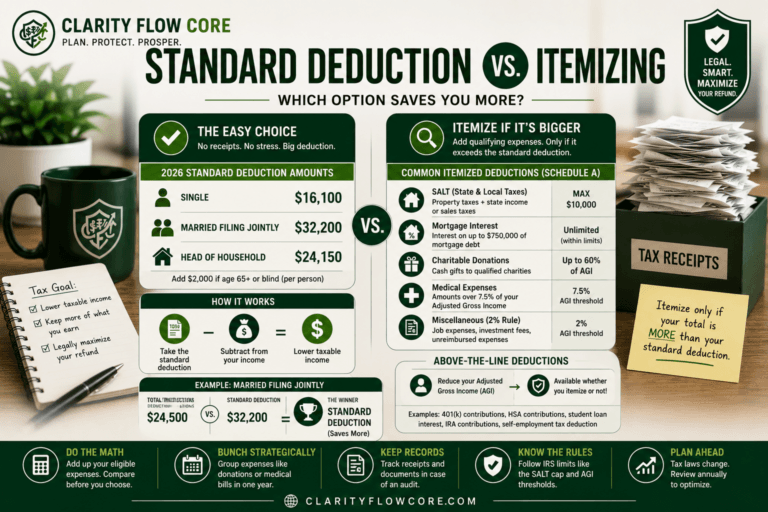
Think of the U.S. tax system as a series of buckets. The first bucket is the Standard Deduction. For a married couple in 2026, the first roughly $30,000 of income goes into this bucket and is taxed at 0%. The next bucket (the 10% bracket) holds the next chunk of money, and so on.
The Golden Strategy:
- Fill the cheap buckets with Traditional money: Withdraw from your Traditional 401(k) or IRA until you max out the Standard Deduction and the lowest tax brackets (e.g., 10% and 12%).
- Top it off with Roth money: If you still need more cash to fund your lifestyle—say you want to buy a new car or take a major vacation—do not pull more from the Traditional account, as it will spill into the expensive 22% or 24% tax buckets. Instead, pull that extra cash from your Roth account. Because Roth money is invisible to the IRS, your tax bill doesn’t go up a single cent.
Real-World Scenario: The Freelancer’s Transition
Consider an independent freelance video editor who has spent years building a digital content and social media brand. Because their income fluctuated wildly during their career, they smartly utilized a mix of tax-advantaged accounts—funding a Solo 401(k) (pre-tax) during highly profitable years to lower their tax bill, and funding a Roth IRA during leaner years.
As they scale back their client work to transition into semi-retirement, they need $70,000 a year to live comfortably.
If they pull the entire $70,000 from their Solo 401(k), the IRS taxes it all. After the standard deduction, they owe thousands in federal income tax.
Instead, they use a blended strategy. They withdraw $30,000 from the Solo 401(k). Because this is completely absorbed by the standard deduction, their tax bill is $0. They then withdraw the remaining $40,000 they need from their Roth IRA. Because Roth withdrawals are tax-free, their tax bill on that money is also $0.
By strategically mixing their accounts, this video editor legally generates a $70,000 income while paying absolutely nothing in federal income taxes. (To understand these account types, read What Is a Solo 401(k) and How Does It Work? and Traditional IRA vs Roth IRA: Which Is Better for Beginners?).
4 Deadliest Mistakes with Retirement Withdrawals
When mapping out your strategy for Roth vs traditional withdrawals, avoid these four wealth-destroying traps:
❌ Ignoring Required Minimum Distributions (RMDs): Once you hit age 73, the IRS legally forces you to withdraw a specific percentage of your Traditional accounts every year, whether you need the money or not. If you fail to take the RMD, you are hit with a massive 25% tax penalty. (Note: Roth IRAs do not have RMDs during your lifetime).
❌ Triggering IRMAA Surcharges: Your Medicare Part B and Part D premiums are based on your taxable income from two years prior. If you pull a massive lump sum out of a Traditional IRA, it acts as a massive spike in income, potentially doubling your Medicare premiums. Use Roth money for large, one-time purchases to avoid this.
❌ Draining Roth accounts too early: Roth accounts are the holy grail of tax-free compounding. If you drain them first, you lose decades of tax-free growth, leaving you entirely dependent on heavily taxed Traditional accounts late in life when healthcare costs are highest.
❌ Forgetting the 5-Year Rule: You cannot withdraw earnings from a Roth account tax-free unless the account has been open and funded for at least five full tax years, even if you are over 59½. (See Roth IRA Contribution Limits and Rules for 2026).
Frequently Asked Questions
Can I withdraw from my Traditional IRA before age 59½? Yes, but you will pay a severe penalty. In addition to ordinary income taxes, the IRS will hit you with a 10% early withdrawal penalty. There are a few exceptions (like first-time home purchases or specific medical expenses), but it should be avoided at all costs.
Can I withdraw my Roth IRA contributions at any time? Yes. Because you already paid taxes on your contributions (the money you personally put in), you can withdraw those exact contributions at any time, at any age, penalty-free. However, if you withdraw the earnings (the growth) before age 59½, you will face taxes and penalties.
Should I convert my Traditional money to a Roth account? A Roth conversion involves taking money from a Traditional account, paying the taxes on it today, and moving it to a Roth account so it grows tax-free forever. This is highly recommended during years when your income (and tax bracket) is unusually low.
Your Action Plan
Do not wait until you are already retired to figure out how your taxes work. Take control of your Roth vs traditional withdrawals strategy today:
- Check Your Balances: Log into your investment portals. Write down exactly how much money you have in the “tax-deferred” bucket versus the “tax-free” bucket.
- Calculate Your Required Income: Use the Retirement Withdrawal Planner & Safe Withdrawal Strategy Analyzer to determine exactly how much cash you need to generate each year.
- Plan the Split: Look up the current IRS tax brackets. Plan to withdraw from your Traditional accounts just enough to fill up the lowest brackets, and cover the rest of your living expenses using your Roth accounts.
Sources & Further Reading
Official U.S. Guidelines & Consumer Resources
- Internal Revenue Service (IRS): IRA FAQs – Distributions (Withdrawals)
- Securities and Exchange Commission (SEC): Traditional vs. Roth IRAs
Further Reading from Clarity Flow Core
- Retirement Withdrawal Planner & Safe Withdrawal Strategy Analyzer
- Tax Strategy Planner & Annual Tax Savings Analyzer
- Traditional IRA vs Roth IRA: Which Is Better for Beginners?
- Roth IRA Contribution Limits and Rules for 2026
- What Is a Solo 401(k) and How Does It Work?
- 401(k) vs IRA: Which Should You Fund First?
Disclaimer: The information provided in this article is for educational and informational purposes only and does not constitute financial, legal, or tax advice. Tax laws, brackets, and IRS regulations are subject to change. Always consult with a certified public accountant (CPA) or a registered fiduciary financial planner to evaluate your specific tax situation before making withdrawal decisions or executing Roth conversions.
About Author

Rishabh Nigam
Rishabh Nigam founded Clarity Flow Core to make personal finance easier to understand for everyday readers. He covers credit scores, debt repayment, credit utilization, loan readiness, taxes, and financial planning through practical guides, calculators, and educational resources. His content focuses on turning complex financial concepts into clear, actionable steps that readers can apply in real life.