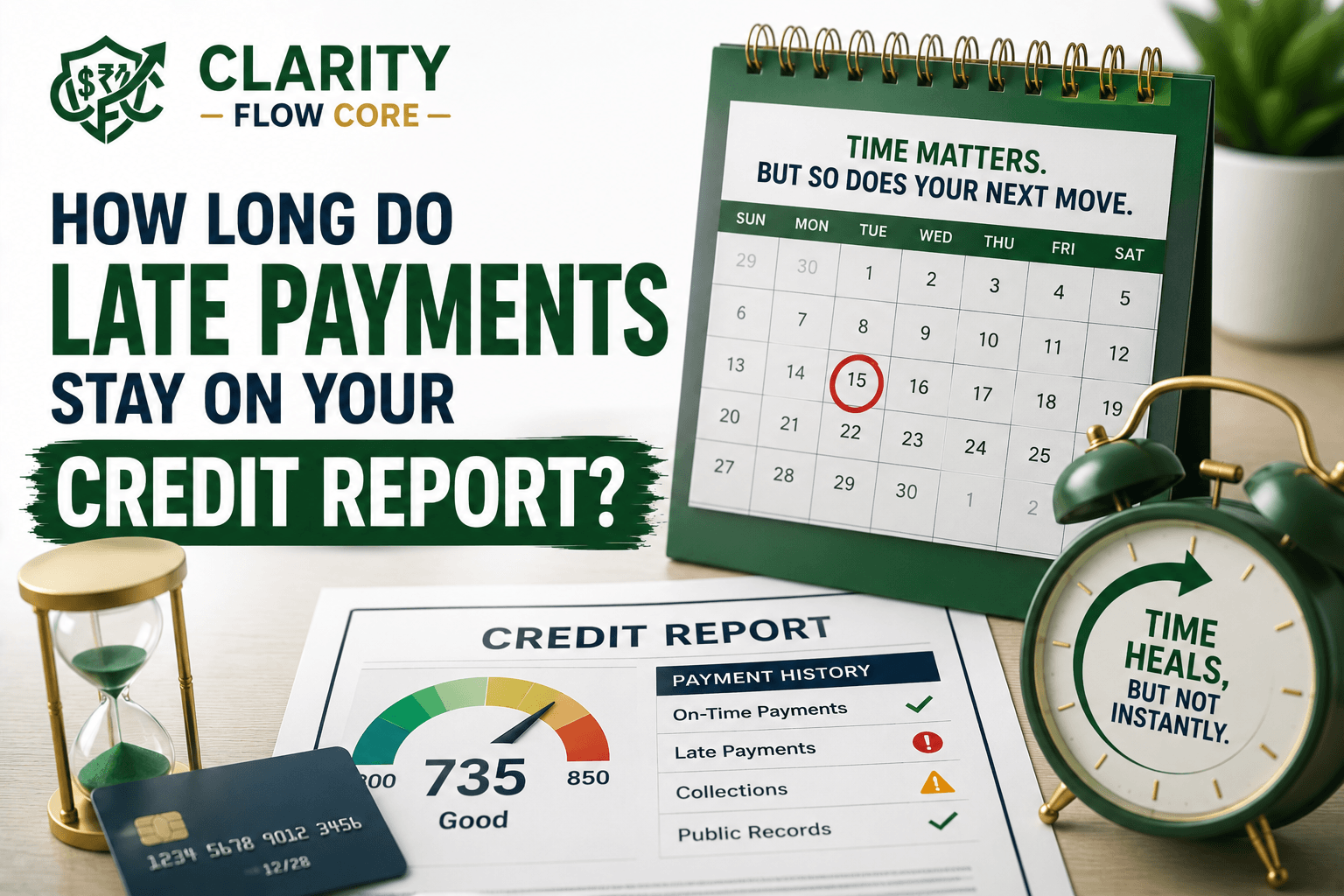
How Long Do Late Payments Stay On Your Credit Report?
If you are frantically searching the internet trying to figure out exactly how long do late payments stay on your credit report, you are probably experiencing that sinking, heavy feeling in your stomach right now.
Picture this: You are checking your emails or sorting through your mail, and you see a bold, red notice from your credit card company. You completely forgot to pay your minimum balance last month. Or maybe you didn’t forget, but you simply didn’t have the cash in your checking account to cover it, so you avoided looking at it.
Now, your credit score has plummeted. You feel embarrassed, anxious, and worried that you have just ruined your financial future for the next decade.
First, take a deep breath. Your credit score is not a reflection of your worth as a person, and you have not ruined your life. Missing a payment is one of the most common financial mistakes people make. However, the credit bureaus take missed payments very seriously, and repairing the damage takes time.
Let’s remove the mystery and the panic. We are going to break down exactly how long that late mark will haunt you, how the damage actually fades over time, and the exact steps you can take today to start repairing your financial foundation.
The Quick Answer
If you are panicking and just need the fast, bottom-line math, here is the exact timeline of how long negative marks stick around:
| Type of Late Payment | How Long It Stays on Your Report | FICO Score Impact |
| 1 to 29 Days Late | 0 Years (Does not show on credit report) | None (Only bank late fees apply) |
| 30 Days Late | 7 Years from the original delinquency date | High |
| 60 Days Late | 7 Years from the original delinquency date | Severe |
| 90+ Days Late | 7 Years from the original delinquency date | Devastating |
| Account sent to Collections | 7 Years from the original delinquency date | Devastating |
If a late payment eventually results in your debt being sent to collections, don’t panic or rush into an agreement. How To Handle Debt Collectors Without Making Things Worse explains how to verify the debt, understand your rights, and negotiate effectively with collection agencies.
How Long Do Late Payments Stay On Your Credit Report?
The short answer is seven years. But to truly understand how that impacts your financial life today, you have to understand exactly what the credit bureaus consider “late” and how that timeline actually works.
The 30-Day Threshold: Are You Actually “Late”?
The biggest source of confusion for beginners is the difference between being “late” to the bank and being “late” to the credit bureaus.
If your credit card bill is due on the 5th of the month, and you finally pay it on the 10th, you are officially late. Your credit card company is going to slap you with a $35 late fee, and they might even raise your interest rate. That is incredibly annoying, but the damage stops there.
The Golden Rule of Late Payments: A lender cannot report a payment to the credit bureaus as “late” until it is a full 30 days past the original due date.
If you are only a few days or weeks behind, pay the bill immediately. You will lose some money to fees, but your credit score will remain completely untouched.
Why Do Late Payments Hurt So Much?
To understand why a single missed payment can drop an excellent credit score by 80 to 100 points overnight, you have to understand how the game is scored.
Your FICO score is simply a math equation designed to predict one thing: Risk. Banks use this score to decide if they should trust you with their money.
In the FICO scoring model, your overall score is divided into different slices of a pie. Payment History makes up 35% of your total score. It is the single largest and most heavily weighted factor in the entire equation.
Why? Because past behavior is the best predictor of future behavior. If you were going to loan $1,000 to a friend, the very first thing you would ask yourself is, “Have they reliably paid me back in the past?” The credit bureaus ask the exact same question. When you cross that 30-day threshold, you signal to the algorithm that you are currently struggling to manage your debts, making you a much higher risk.
The 7-Year Rule (And Why It Isn’t As Bad As It Sounds)
It is true: a 30-day (or worse) late payment will physically remain on your credit report for seven long years.
If you missed a payment in January 2024, that ugly red mark will technically be visible to lenders until January 2031. For a young adult or a financially stressed reader, seven years feels like an eternity. It feels like a financial prison sentence.
But here is the secret the credit bureaus don’t aggressively advertise: The impact of a late payment fades rapidly over time.
The Fading Effect Explained
Your FICO score cares significantly more about what you did last month than what you did three years ago.
- Months 1 to 12: The late payment is fresh. Your score takes a massive hit, and lenders will view you as highly risky. Getting approved for a good mortgage or a premium travel card will be difficult.
- Years 1 to 2: As long as you have made every single payment on time since the mistake, your score will begin to heal. The late payment is still holding you back, but its “weight” is decreasing.
- Years 3 to 7: The late payment is still visible on the report, but its actual mathematical impact on your FICO score is minimal. If the rest of your credit profile is strong, a three-year-old late payment likely won’t stop you from getting approved for a house or a car loan at a great rate.
Visual Recovery Timeline
Here is exactly how the damage from a late payment fades as the years go by:
| Time Since Late Payment | Typical Impact |
| 0–12 Months | Highest impact |
| 1–2 Years | Moderate impact |
| 3–5 Years | Reduced impact |
| 5–7 Years | Minimal impact |
| 7+ Years | Removed from report |
The Rebuilding Truth
You do not have to wait 7 years to have “good” credit again. If you bury that one late mark under a mountain of consistent, on-time payments, your score will recover long before the negative mark officially falls off your report.
Example Scenarios: How Timeline Impacts Recovery
Let’s look at how this plays out in the real world with two very different borrowers.
Example 1: The Honest Mistake (Sarah)
Sarah has a great credit score of 750. She goes on a two-week vacation, completely unplugs from her email, and forgets to pay her $40 minimum credit card payment. By the time she realizes it, she is 33 days late.
- The Result: Her score drops to 660 overnight.
- The Recovery: Sarah immediately pays the past-due balance and sets up auto-pay. Because she only hit the 30-day mark, and she immediately resumed perfect payment behavior, her score may recover significantly within 9 to 18 months if she maintains perfect payment behavior, even though the 30-day late mark remains on her report.
Example 2: The Job Loss Struggle (Mark)
Mark gets laid off and drains his checking account to pay rent. He simply cannot afford to pay his auto loan for three consecutive months. He hits the 30-day, 60-day, and 90-day late marks.
- The Result: Mark’s score plummets from 700 to 550. Hitting the 90-day mark signals severe financial distress to the bureaus.
- The Recovery: Mark finds a new job and gets current on his loan. Because a 90-day late payment is viewed as a major derogatory mark (dangerously close to a default or repossession), it will take Mark a solid 2 to 3 years of perfect payment history to see his score truly recover.
Common Mistakes Beginners Make When They Are Late
When people see their credit score drop, panic sets in. Panic leads to bad decisions. Avoid these classic mistakes:
- Closing the credit card out of anger: You are mad at the bank for ruining your score, so you pay the card off and close the account. Do not do this. Closing the card lowers your total available credit, which causes your credit utilization to spike. This will drop your score even further. Keep the card open, put a small recurring subscription on it, and pay it automatically.
- Ignoring the lender: If you know you can’t make the payment, ignoring the bank’s phone calls is the worst thing you can do. Banks do not want you to default; it costs them money. If you call them before you are 30 days late, they often have hardship programs that can defer your payment and protect your credit score.
- Thinking paying it off deletes the mark: If you are 60 days late, and you finally pay the full balance, your credit report will update to show the account is “Current.” This is great! But paying the balance does not erase the historical fact that you were 60 days late. The late mark stays for 7 years.
Acting early can often prevent your account from reaching collections. But if it already has, check our guide on How To Handle Debt Collectors Without Making Things Worse and go walks through the safest way to communicate with collection agencies.
Your Beginner-Friendly Action Plan
You made a mistake. Now it’s time to fix it. Here is your step-by-step survival guide to stopping the bleeding and rebuilding your score.
Step 1: Pay the Past-Due Amount Immediately
If you are currently 32 days late, you need to pay the minimum balance right this second. Do whatever it takes to prevent the account from reaching the 60-day mark. The difference between a 30-day late and a 60-day late is massive in the eyes of the credit bureaus. Stop the clock.
Step 2: Try a “Goodwill Letter”
If this is your very first late payment, you have a secret weapon. You can write a “Goodwill Letter” to your lender. This is a polite, humble letter explaining why you missed the payment (e.g., a medical emergency, a confusing bank transfer, lost a job) and highlighting your history of being a great customer. You explicitly ask them to grant you a “goodwill adjustment” and remove the late mark from your credit report. It does not always work, but when it does, your score may improve quickly if the lender agrees to remove the late mark.
Step 3: Automate Your Future Minimums
You can never rely on human memory for your financial foundation. Log into every single loan and credit card account you have today and turn on Autopay for the “Minimum Payment Due.” You can always log in later to pay the full statement balance, but having the minimum on autopilot acts as a safety net. You will never accidentally cross the 30-day threshold again.
When Will You Finally Be Debt-Free?
Stop wasting money on high interest rates. Compare the Debt Avalanche and Debt Snowball methods to build a custom payoff plan and find your fastest path to zero debt.
Build My Payoff StrategyFrequently Asked Questions (FAQs)
Can a single late payment ruin my credit forever?
No. A late payment can significantly hurt your score in the short term, but its impact fades over time. Consistent on-time payments and responsible credit use can help your score recover long before the late mark falls off your credit report.
Can I pay a company to remove a late payment from my credit report?
No. Be incredibly careful with “Credit Repair” companies that promise to wipe accurate late payments from your report for a fee. If the late payment is accurate, it is legally allowed to be there for 7 years. Credit repair companies usually just spam the credit bureaus with dispute letters, which you can do yourself for free.
What if the late payment on my report is a mistake?
If a bank reported you late, but you have bank statements proving the money left your account on time, you are in luck. You can file a formal dispute directly with the three major credit bureaus (Experian, Equifax, TransUnion). Provide your proof, and they are legally required to investigate and remove the false mark within 30 days.
Will paying off a collection agency remove it from my report?
Usually, no. If your late payment went so long that it was sold to a collection agency, paying the collection agency just changes the status to “Paid Collection.” However, some newer FICO scoring models ignore paid collections. If you are about to pay a collection agency, always ask for a “Pay-for-Delete” agreement in writing, where they agree to remove the account from your report entirely in exchange for your payment.
Final Thoughts
Watching your credit score drop because of a late payment feels terrible, but you cannot let it paralyze you. Clarity Flow Core is all about moving forward with facts, not fear.
The seven-year rule sounds terrifying on paper, but the reality is much more forgiving. Time is the ultimate healer in the world of credit. By getting current today, setting up your automatic payments, and managing your credit utilization wisely, you will start burying that negative mark immediately.
Forgive yourself for the mistake, lock down your financial systems so it doesn’t happen again, and let time do the rest. Your credit score will recover. You’ve got this.
Official Resources & Consumer Guidance
Understanding how late payments affect your credit is easier when you rely on trusted information from consumer protection agencies, credit bureaus, and credit scoring organizations. The resources below provide additional guidance on payment history, credit reporting, and your rights as a consumer.
- FICO® — What’s in Your FICO® Score?
Learn why payment history is the single most influential factor in FICO® credit scoring models. - Consumer Financial Protection Bureau (CFPB) — Credit Reports and Scores
Official guidance on how credit reports work, how negative information is reported, and how consumers can monitor their credit. - AnnualCreditReport.com — Request Your Free Credit Reports
The federally authorized website where U.S. consumers can obtain free credit reports from Equifax, Experian, and TransUnion to review payment history and identify reporting errors. - Federal Trade Commission (FTC) — Disputing Errors on Your Credit Reports
Learn how to dispute inaccurate late payments and understand your rights under federal law. - Experian — How Long Do Late Payments Stay on Your Credit Report?
Explains how late payments affect your credit profile and how their impact changes over time. - Equifax — Understanding Late Payments and Credit Reports
Educational resources explaining how payment history influences your credit standing and future borrowing.
Disclaimer: The information provided in this guide is for educational purposes only and does not constitute financial, investment, or tax advice. All financial products and offers are subject to individual credit approval and specific lender terms. Please consult with a qualified financial professional to determine if the strategies or products discussed in this guide are the right fit for your personal financial situation.
About Author

Rishabh Nigam
Rishabh Nigam founded Clarity Flow Core to make personal finance easier to understand for everyday readers. He covers credit scores, debt repayment, credit utilization, loan readiness, taxes, and financial planning through practical guides, calculators, and educational resources. His content focuses on turning complex financial concepts into clear, actionable steps that readers can apply in real life.