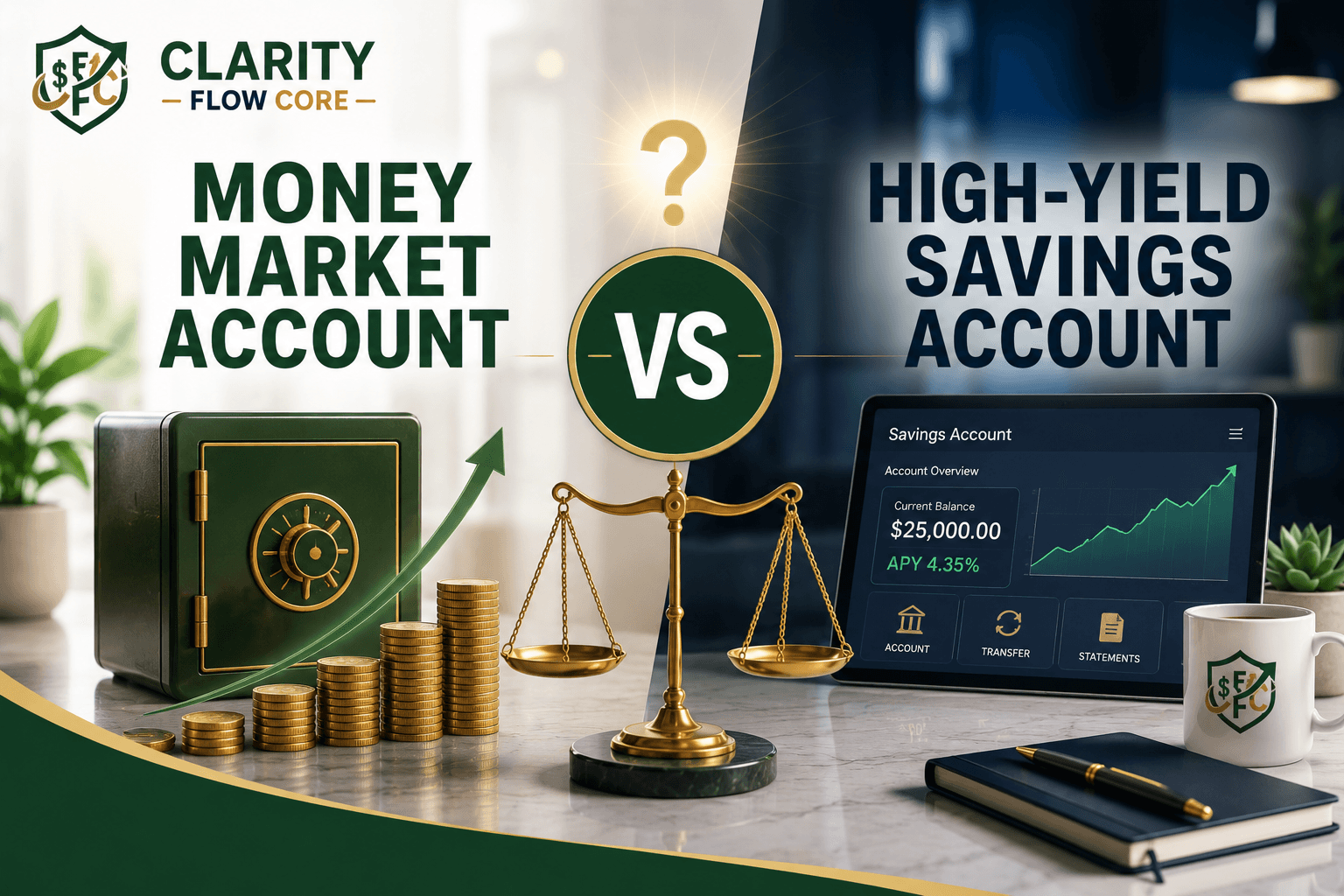
Money Market Account vs High-Yield Savings Account: Which Is Better?
If you are trying to understand the difference between a money market account vs high yield savings account, you are definitely not alone.
Picture this: You have finally managed to scrape together some extra cash. Maybe it’s your tax refund, a bonus from work, or money you meticulously saved by cutting back on eating out. It’s currently sitting in your everyday checking account earning a depressing 0.01% interest. You know it needs to move somewhere better, so you log into your banking app to fix it.
Suddenly, you are confronted with a choice: Do you open a High-Yield Savings Account (HYSA), or do you open a Money Market Account (MMA)?
Both options claim to offer great interest rates. Both accounts promise to keep your money safe. But because they have different names and slightly different rules, you freeze up. Analysis paralysis kicks in, your banking app times out, and you close your phone. Your money stays in your checking account, losing value to inflation, simply because the financial world can’t explain things simply.
But keeping your savings optimized shouldn’t cause a headache. Clarity Flow Core is all about cutting through the banking noise to help normal people make smart moves. Let’s break down exactly how these two options compare, where the hidden traps are, and how to decide exactly where your cash belongs.
The Quick Answer
If you are just looking for the fast, bottom-line differences to help you move your money today, here is the visual breakdown of how these two accounts compare:
| Feature | High-Yield Savings Account (HYSA) | Money Market Account (MMA) |
| Typical Interest Rate | High | High (Often tiered based on balance) |
| Debit Card Access | ❌ Extremely Rare | ✅ Yes (Usually included) |
| Check-Writing Privileges | ❌ No | ✅ Yes (Limited number per month) |
| Minimum Balance Required | Very Low (Often $0 to $1) | Medium to High (Often $1,000+) |
| Best Use Case | Emergency Fund | Planned Spending |
| Safety (FDIC/NCUA insured) | ✅ Yes | ✅ Yes |
The Real Problem: Why Parking Your Cash Feels Confusing
When people try to save money, they often treat every banking product like it’s a completely different language. Lenders use complex terms to make simple things sound prestigious, and it makes everyday savers feel like they are missing some secret inside information.
We look at our savings through an emotional lens. We want our money to grow as fast as possible, but we also want to know we can grab it instantly if the car breaks down or a bill comes due unexpectedly.
The banking industry exploits this tension by designing different buckets for your money. They don’t design these accounts to confuse you on purpose; they design them to serve different types of liquidity needs.
The real struggle isn’t finding a good interest rate—it’s matching your specific lifestyle to the rules of the account so you don’t get hit with unexpected balance penalties or access restrictions.
Money Market Account vs High-Yield Savings Account: The Deep Dive
To understand which account wins for your specific goals, we need to lift the hood on both vehicles and see how they actually run.
1. High-Yield Savings Account (HYSA)
A High-Yield Savings Account is exactly what it sounds like: a regular savings account on steroids. These are typically offered by online-only banks that don’t have to pay for physical brick-and-mortar branches. Because their overhead costs are so low, they pass those savings onto you in the form of a much higher interest rate.
The Mechanics: You link an HYSA to your existing checking account. When you want to move money, you initiate an electronic transfer. It usually takes 1 to 3 business days for the money to land back in your checking account where you can spend it.
The Benefits: HYSAs are incredibly simple. Most of them have no monthly maintenance fees and require almost zero money to open. It is a pure, hands-off storage unit for your cash.
If you’re ready to open your first HYSA but aren’t sure how to compare different banks, How to Choose Your First High-Yield Savings Account explains exactly what to look for, including FDIC insurance, fees, APYs, and transfer features.
The Limitations: You cannot walk up to an ATM and swipe a debit card linked to your HYSA. You can’t write a check from it. It has a single door for entry and exit: electronic bank transfers. For a lot of savers, this limitation is actually a hidden blessing because it stops them from impulse spending.
2. Money Market Account (MMA)
A Money Market Account is a hybrid banking product. It is essentially what happens when a checking account and a savings account fall in love and have a baby. It gives you the high interest rate of a savings account, but bundles it with the convenient access features of a checking account.
The Mechanics: When you open an MMA, the bank will typically mail you a book of checks and a debit card. You earn a competitive interest rate on your balance, but if you need to pay a contractor or handle an emergency, you can write a check or use an ATM directly from that account.
The Benefits: Unparalleled flexibility. If your car breaks down at a mechanic shop, you don’t have to wait 48 hours for an electronic transfer to clear into your checking account. You can just swipe your MMA debit card right there at the register.
The Limitations: That convenience comes at a price. Banks usually require a much higher minimum deposit to open a Money Market Account, and they will slap you with heavy monthly fees if your balance drops below a specific threshold. Furthermore, their interest rates are often “tiered,” meaning you only get the highest advertised rate if you maintain a large amount of cash in the account.

Common Mistakes Beginners Make
Before we look at which account makes the most sense for your goals, let’s identify a few classic mistakes savers make when navigating these accounts.
- Confusing Money Market Accounts with Money Market Funds: This is a massive, incredibly common mistake. A Money Market Account is a bank account insured by the federal government. A Money Market Fund is an investment product offered by brokerage firms. While funds are generally safe, they are technically investments and are not FDIC-insured against bank failures.
- Chasing tiny interest rate differences: Spending three hours closing an account and opening a new one just to get an extra 0.05% interest rate is a waste of mental energy. On a $5,000 balance, a 0.05% difference amounts to a whopping $2.50 for the entire year. Focus on user experience, low fees, and stability over minor rate chasing.
- Ignoring the monthly transaction limits: Historically, federal rules restricted savings and money market accounts to six convenient withdrawals per month. While the government relaxed this rule, many banks still enforce it. If you treat either of these accounts like an everyday checking account and make dozens of transactions a month, the bank will fine you or force you to close the account.
The Real Consequences of Getting It Wrong
Choosing the wrong account won’t ruin your life, but it can quietly drain your hard-earned progress.
If you put your money into a Money Market Account but fail to read the fine print about the $2,500 minimum balance, the bank might charge you a $15 monthly fee. That fee will completely wipe out any interest you earned that month, meaning you are literally paying the bank to hold your money.
On the flip side, if you place your immediate emergency fund into an HYSA at an entirely separate bank, and your water heater bursts on a Friday night, you might not be able to access that cash until Tuesday morning when the bank transfer clears. If a contractor demands payment on the spot, you might be forced to put that emergency on a high-interest credit card, completely defeating the purpose of having a cash reserve.
The Showdown: Which Wins?
Which Matters More?
For the vast majority of beginners and everyday savers, a High-Yield Savings Account (HYSA) is the winner. It offers a simpler fee structure, lower barriers to entry, and the lack of a debit card keeps your money safe from impulsive spending habits. Choose a Money Market Account (MMA) only if you have a large chunk of cash and absolutely require direct check-writing access for upcoming milestones.
Think of it this way: Your checking account is your financial kitchen counter—everything passes through it daily. An HYSA is your backyard shed—it’s out of sight, meant for long-term storage, and takes a little bit of physical effort to access. An MMA is an attached garage—it keeps things separate from the main house but gives you a direct door to drive right out when needed.
Example Scenarios
Let’s look at how this plays out in the real world with three different types of savers.
Example 1: The Emergency Stasher (Salaried Employee)
David has a stable job and wants to build a $10,000 emergency fund. He knows he has a habit of spending money if it’s too easy to access.
- The Best Choice: High-Yield Savings Account. By putting the money in an online HYSA without a debit card, David creates a healthy barrier between himself and his money. The cash grows safely, earns great interest, and stays protected from weekend target runs.
Example 2: The Tax Planner (The Freelancer)
Maya is a freelance video editor with unpredictable income. She needs to save 30% of every paycheck to pay her quarterly estimated taxes to the IRS. When tax day arrives, she needs to write a massive check directly to the United States Treasury.
- The Best Choice: Money Market Account. Maya can park her tax money in an MMA where it earns high interest all quarter long. When tax day hits, she can write a check directly out of that account to the IRS, bypassing the need to transfer huge sums back and forth through an intermediate checking account.
Example 3: The Big Project Manager
Carlos is planning a major home renovation project over the next six months. He has $25,000 saved up to pay various contractors, plumbers, and material suppliers as the work gets completed.
- The Best Choice: Money Market Account. Because Carlos needs to pay different people at random intervals over a short period, an HYSA would be too slow and clunky. The MMA gives him high interest on his remaining balance while letting him hand physical checks to contractors on the spot.
(Coming Soon: Clarity Flow Core is currently developing a custom Savings Yield Optimization Planner. This tool will let you input your current balances, your monthly transaction needs, and your liquidity goals to instantly tell you exactly how to split your cash between checking, HYSAs, and MMAs for maximum growth and safety!)
Your Beginner-Friendly Action Plan
Ready to optimize your banking setup this weekend? Follow this simple, stress-free blueprint.
Step 1: Define the Purpose of the Money
Before opening an account, give your cash a specific job. Is this money for a rainy-day fund that you hope you never touch? Or is it for a vacation you are taking in four months? If it’s a long-term safety net, lean toward an HYSA. If it’s a short-term pot of money that requires flexible spending, check out an MMA.
If you’re saving to move into your own apartment or house, that goal deserves its own dedicated savings plan as well. Read How Much Should You Save Before Moving Out on Your Own? to estimate the amount you’ll need before signing a lease.
Step 2: Audit Your Balance Power
Look at your current savings. If you have less than $1,000 to start with, stick entirely to an HYSA. Most top-tier online HYSAs have no minimum balance requirements. If you have over $5,000 and want debit card functionality, look for a highly-rated Money Market Account, but read the disclosure statement carefully to ensure you clear their fee-waiver threshold.
Step 3: Verify the Insurance Sandbox
Never place your money in an institution that isn’t backed by the federal government. Look at the footer of the bank’s website. If it’s a bank, ensure it clearly displays the FDIC logo. If it’s a credit union, look for the NCUA logo. This ensures that even if the bank goes completely bankrupt tomorrow, the US government guarantees you will get every single penny back up to $250,000.
Step 4: Set Up a Small Automation
Don’t wait until you have a massive lump sum to start earning high interest. Open the account today, even with just $20. Set up a recurring weekly transfer of $10 or $25 from your everyday checking account. Automating the process builds the habit without draining your willpower.
Frequently Asked Questions (FAQs)
Which account is better for an emergency fund?
For most people, a High-Yield Savings Account is the better emergency fund option because it offers competitive interest rates while creating a small barrier between your savings and everyday spending. A Money Market Account may be useful if you want direct check-writing or debit card access to emergency funds.
Can the interest rate change on these accounts?
Yes. Both HYSAs and MMAs have variable interest rates. This means the bank can raise or lower the rate at any time based on macroeconomic conditions and the Federal Reserve’s benchmark interest rates. If the economy shifts, your rate will shift with it.
Is my money safer in an MMA or an HYSA?
They are completely identical in terms of safety. As long as your bank is FDIC-insured (or your credit union is NCUA-insured), your money is 100% protected by the federal government up to $250,000 per depositor, per institution.
Can I open both accounts at the same time?
Absolutely! Many people use an online HYSA for their untouchable emergency fund and keep a separate Money Market Account at a local credit union for irregular but planned expenses, like annual insurance premiums or holiday shopping.
Why do traditional banks offer such low rates compared to these accounts?
Traditional neighborhood banks have massive expenses. They have to pay rent on physical storefronts, pay electricity bills for hundreds of branches, and employ local tellers. Online banks drop those physical expenses entirely, allowing them to pay you significantly more interest just to win your business.
Final Thoughts
Organizing your finances shouldn’t feel like navigating an obstacle course. Whether you choose a High-Yield Savings Account or a Money Market Account, the absolute most important step is simply getting your money out of a standard, low-interest checking account.
Clarity Flow Core believes that financial confidence comes from clarity, not complexity. If you want simplicity and safety from your own spending triggers, open an HYSA. If you want a flexible cash reservoir that can handle physical checks and ATM swipes, pick an MMA. Make your choice, set up your automatic transfer, and let compounding interest do the heavy lifting behind the scenes. You’ve got this.
Banking Resources
Choosing between a Money Market Account (MMA) and a High-Yield Savings Account (HYSA) is easier when you understand how deposit insurance, account features, and banking regulations work. These trusted resources can help you make an informed decision.
- Federal Deposit Insurance Corporation (FDIC) – Learn how FDIC insurance protects bank deposits, understand coverage limits, and verify whether a bank is federally insured.
- National Credit Union Administration (NCUA) – Explore how federal share insurance protects deposits held at federally insured credit unions.
- Consumer Financial Protection Bureau (CFPB) – Bank Accounts – Official guidance on choosing checking and savings accounts, understanding account fees, and managing your money safely.
- Federal Reserve – Consumer resources explaining interest rates, inflation, and how changes in monetary policy affect savings products.
- MyMoney.gov – U.S. government financial education covering saving strategies, emergency funds, budgeting, and building healthy financial habits.
- BankFind Suite (FDIC) – Search and verify FDIC-insured financial institutions before opening a new account.
Disclaimer: The information provided in this guide is for educational purposes only and does not constitute financial, investment, or tax advice. All financial products and offers are subject to individual credit approval and specific lender terms. Please consult with a qualified financial professional to determine if the strategies or products discussed in this guide are the right fit for your personal financial situation.
About Author

Rishabh Nigam
Rishabh Nigam founded Clarity Flow Core to make personal finance easier to understand for everyday readers. He covers credit scores, debt repayment, credit utilization, loan readiness, taxes, and financial planning through practical guides, calculators, and educational resources. His content focuses on turning complex financial concepts into clear, actionable steps that readers can apply in real life.