
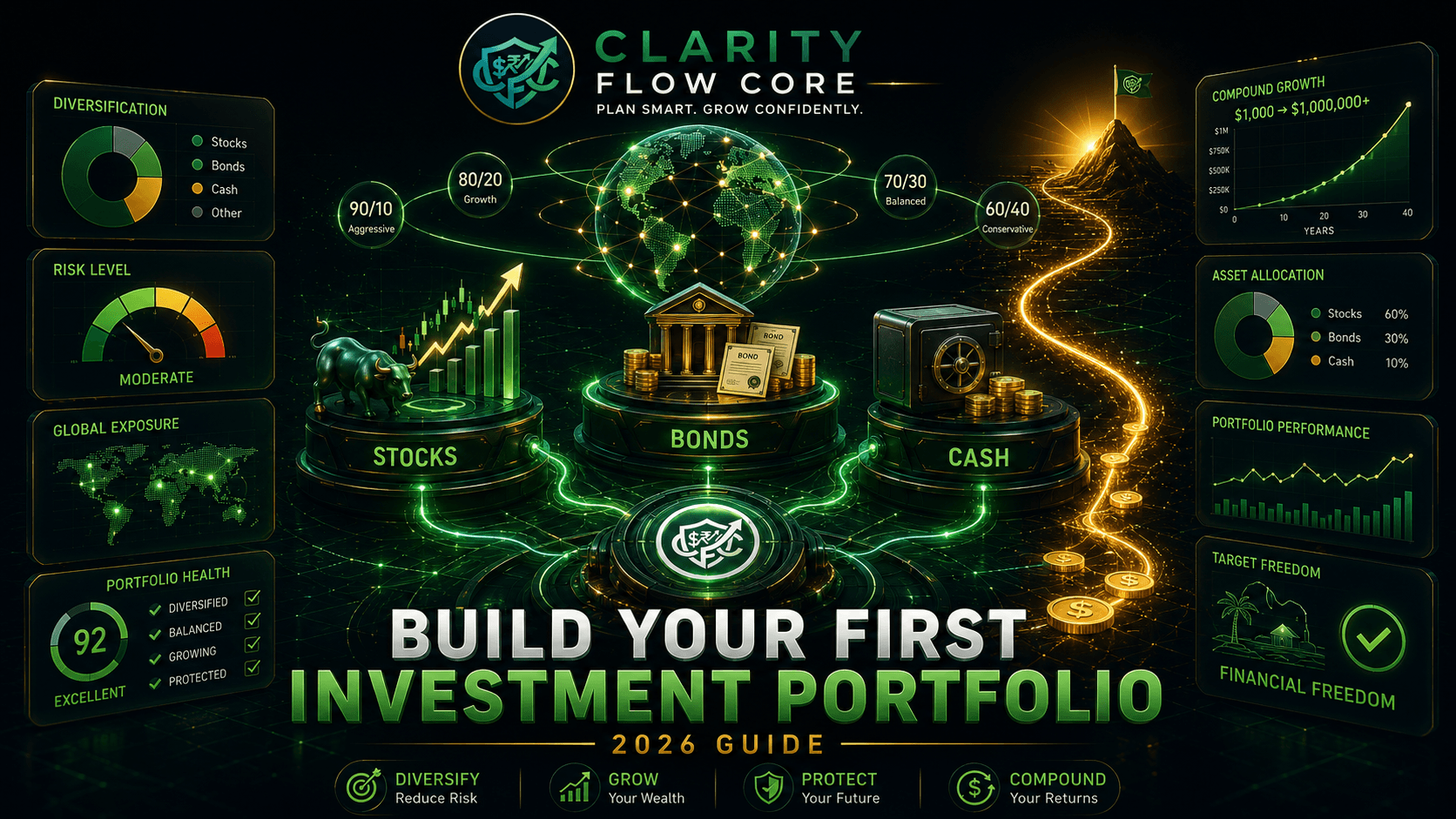
How to Build an Investment Portfolio From Scratch: The 2026 Guide
The biggest barrier to building wealth is not a lack of income; it is the overwhelming complexity of the financial industry. When new investors open a U.S. brokerage account, they are immediately bombarded with thousands of ticker symbols, cryptocurrency charts, and contradictory advice on social media.
This complexity is a trap designed to make you pay for expensive professional management. In reality, the most effective wealth-building strategies are incredibly simple and strictly systematic.
Research repeatedly shows that long-term financial success does not come from picking the next trending tech stock. It comes from owning a broadly diversified slice of the entire global economy and holding it for decades.
If you are tired of leaving your cash in a basic savings account to lose value to inflation, here is exactly how to build investment portfolio from scratch using a proven, low-cost framework.
Phase 1: The Building Blocks of Wealth
Before you buy a single investment, you must understand the three core ingredients of a modern portfolio. Every asset class serves a distinct mathematical purpose.
The Portfolio Construction Matrix
The three fundamental asset classes for your foundation.
1. Equities (Stocks)
- The Engine: Stocks represent ownership in real companies. They are the primary driver of long-term compound growth.
- The Reality: They are highly volatile in the short term, but consistently outpace inflation over decades.
2. Fixed Income (Bonds)
- The Shock Absorber: Bonds are loans you make to corporations or the U.S. government in exchange for regular interest payments.
- The Reality: They offer lower returns than stocks but provide critical stability during violent stock market crashes.
3. Cash Equivalents
- The Safety Net: This includes High-Yield Savings Accounts (HYSAs), Certificates of Deposit (CDs), and Money Market Funds.
- The Reality: Zero market risk, but guaranteed to lose purchasing power to inflation if held too long.
(To dive deeper into the mechanics of these assets, review ETF vs. Mutual Fund vs. Index Fund: Which Should Beginners Choose?).
Phase 2: The “3-Fund Portfolio” Strategy
You do not need to own 50 different stocks to be diversified. The simplest way to execute how to build investment portfolio from scratch is by utilizing the famous “3-Fund Portfolio” popularized by the Bogleheads investing community. By purchasing just three broad-market index funds, you instantly own a microscopic fraction of over 15,000 securities worldwide.
To execute this, you simply need to select one broad-market fund for each of the three categories. While we list a few popular examples below, you can use equivalent low-cost index funds or ETFs from Vanguard, Fidelity, Charles Schwab, or any other major U.S. brokerage. The goal is to focus entirely on the strategy, not a specific fund family.
- Total U.S. Stock Market Index Fund: This fund captures the largest, most dominant companies in the United States. (Examples: Vanguard’s VTI, Fidelity’s FSKAX, or Schwab’s SWTSX).
- Total International Stock Market Index Fund: This fund protects you if the U.S. economy struggles, giving you exposure to developed and emerging global markets outside the U.S. (Examples: Vanguard’s VXUS or Fidelity’s FTIHX).
- Total U.S. Bond Market Index Fund: This provides stabilizing interest payments to smooth out the ride during market recessions. (Examples: Vanguard’s BND or Schwab’s SWAGX).
You simply buy these three funds in the percentages dictated by your age and risk tolerance, and automate your monthly contributions.
Phase 3: Setting Your Target Asset Allocation
When learning how to build investment portfolio from scratch, the most critical decision is your asset allocation (the exact percentage of your money placed into each bucket).
According to the updated 2026 Bogleheads portfolio benchmarks, your exposure to bonds should steadily increase as you get older to protect the wealth you have built.
Age-Based Allocation Targets for 2026
- 20s to 30s (Aggressive Growth): 90% Stocks (54% U.S. / 36% International) and 10% Bonds. At this stage, you have decades to recover from a market crash, so you should prioritize heavy equity growth.
- 40s (Balanced Growth): 80% Stocks (48% U.S. / 32% International) and 20% Bonds. You begin adding more stability as your portfolio size increases.
- 50s (Conservative Growth): 70% Stocks (42% U.S. / 28% International) and 30% Bonds. With retirement approaching, capital preservation becomes highly important.
- 60s+ (Capital Preservation): 60% Stocks (36% U.S. / 24% International) and 40% Bonds.
Your Ecosystem Tool: Not sure if your current allocations match your long-term goals? Plug your exact balances into the Investment Portfolio Planner & Goal Allocation Analyzer to visualize your risk exposure.
Real-World Scenario: The Freelancer’s Split Strategy
Applying these timelines is crucial when your income is unpredictable.
Consider an independent freelance video editor based in California. They frequently drive heavily congested routes between client shoots in Los Angeles and Orange County, dealing with high overhead costs for new camera equipment and delayed invoice payments from U.S. corporate clients.
If this freelancer puts 100% of their net worth into the stock market, a sudden U.S. market crash combined with a dry spell of client work could force them to sell their investments at a massive loss just to cover their rent.
Instead, they build a two-part portfolio. They keep a strict 6-month runway of business and personal expenses entirely in a High-Yield Savings Account (Cash Equivalents). Because this short-term safety net is fully secured, they can confidently invest all remaining excess profits into a highly aggressive 90% Equity / 10% Bond portfolio for their retirement that is 25 years away.
(If you manage irregular income, structure your cash flow using the Best Beginner Budgeting Method for Irregular Income).
4 Deadliest Mistakes When Building a Portfolio
As you execute your plan, protect your wealth by avoiding these four common beginner traps:
❌ Waiting until you have “enough” money: Compounding interest relies on time, not starting capital. Waiting five years to save a massive lump sum will mathematically cost you more than simply investing $50 a month starting today.
❌ Ignoring U.S. tax-advantaged accounts: Before investing in a standard taxable brokerage account, you must maximize your tax-sheltered options like Roth IRAs and 401(k)s. Understand your limits by reading Traditional IRA vs Roth IRA: Which Is Better for Beginners? and What Is a Solo 401(k) and How Does It Work?.
❌ Paying high expense ratios: If a mutual fund charges a 1% annual management fee, they are confiscating a massive portion of your overall growth. Only purchase index funds or ETFs with “Expense Ratios” below 0.20%. (See Index Funds vs. Mutual Funds: What Beginners Should Know).
❌ Investing money you need next year: Never put your emergency fund or upcoming U.S. tax payments into the stock market. Keep immediate obligations liquid.
Frequently Asked Questions
Can I lose more money than I invest? No. When buying standard index funds, mutual funds, or ETFs in a standard cash account, the maximum amount you can lose is the initial cash you put in. You cannot go into debt from buying a standard stock. (This only changes if you engage in advanced, high-risk tactics like “trading on margin,” which beginners should avoid).
How often should I check my portfolio? Ideally, no more than two to four times a year. Checking a long-term portfolio daily induces emotional panic during routine market dips, leading to catastrophic panic-selling.
What is portfolio rebalancing? Over time, market growth will skew your target percentages. If your goal was 80% stocks and 20% bonds, a massive stock market rally might push your portfolio to 90% stocks. Once a year, you must “rebalance” by selling some of the winning stocks and buying more bonds to force the portfolio back to your 80/20 risk target.
Your Action Plan
Now that you know how to build investment portfolio from scratch, it is time to move from theory to execution. Take these three steps this week:
- Clear the Runway: You should not invest heavily if you have high-interest credit card debt. Map out your elimination strategy using the Debt Payoff Calculator & Strategy Planner.
- Secure Your Base: Calculate exactly how much cash you need to hold in absolute safety (your 3-to-6-month buffer) using the Financial Safety & Emergency Fund Planner.
- Automate the Process: Open an account with a low-cost U.S. brokerage, set your 3-fund asset allocation, and set up an automatic monthly transfer from your checking account. Monitor your progress macroscopically with the Net Worth Tracker & Wealth Growth Planner.
Sources & Further Reading
Official U.S. Guidelines & Consumer Resources
- Securities and Exchange Commission (SEC): Beginners’ Guide to Asset Allocation, Diversification, and Rebalancing
- Morningstar: The Best Index Funds for 2026
Essential Tools from Clarity Flow Core
- Investment Portfolio Planner & Goal Allocation Analyzer
- Financial Safety & Emergency Fund Planner
- Net Worth Tracker & Wealth Growth Planner
- Debt Payoff Calculator & Strategy Planner
Further Reading from Clarity Flow Core
- Asset Allocation Strategies for Beginners: The 2026 Guide
- ETF vs. Mutual Fund vs. Index Fund: Which Should Beginners Choose?
- Index Funds vs. Mutual Funds: What Beginners Should Know
- Traditional IRA vs Roth IRA: Which Is Better for Beginners?
- What Is a Solo 401(k) and How Does It Work?
- Best Beginner Budgeting Method for Irregular Income
Disclaimer: The information provided in this article is for educational and informational purposes only and does not constitute financial, legal, or tax advice. Investing in the stock market involves risk, including the possible loss of principal. Asset allocation, diversification, and the 3-fund portfolio strategy do not guarantee a profit or protect against loss in a declining market. Past performance of any specific index fund or ETF is not indicative of future results. Always consult with a certified financial planner (CFP®) or a registered investment advisor before making investment decisions or adjusting your portfolio.
About Author

Rishabh Nigam
Rishabh Nigam founded Clarity Flow Core to make personal finance easier to understand for everyday readers. He covers credit scores, debt repayment, credit utilization, loan readiness, taxes, and financial planning through practical guides, calculators, and educational resources. His content focuses on turning complex financial concepts into clear, actionable steps that readers can apply in real life.



2 Comments
Comments are closed.