Should You Save, Invest, or Pay Off Debt First?
It is the ultimate financial tug-of-war. You finally have a little bit of extra cash at the end of the month, but you are immediately faced with three conflicting voices.
One expert says you need a massive emergency fund. Another says you are losing thousands of dollars in compound interest if you do not invest immediately. A third says that keeping any debt is a financial emergency.
When you try to do all three at the same time, your money gets stretched so thin that you make zero noticeable progress on any front.
If you are wondering, should you save, invest, or pay off debt first, you need to stop guessing. There is a definitive, mathematically proven “Order of Operations” for your money. By following this exact sequence, you eliminate risk while maximizing your long-term wealth in the U.S. economy.
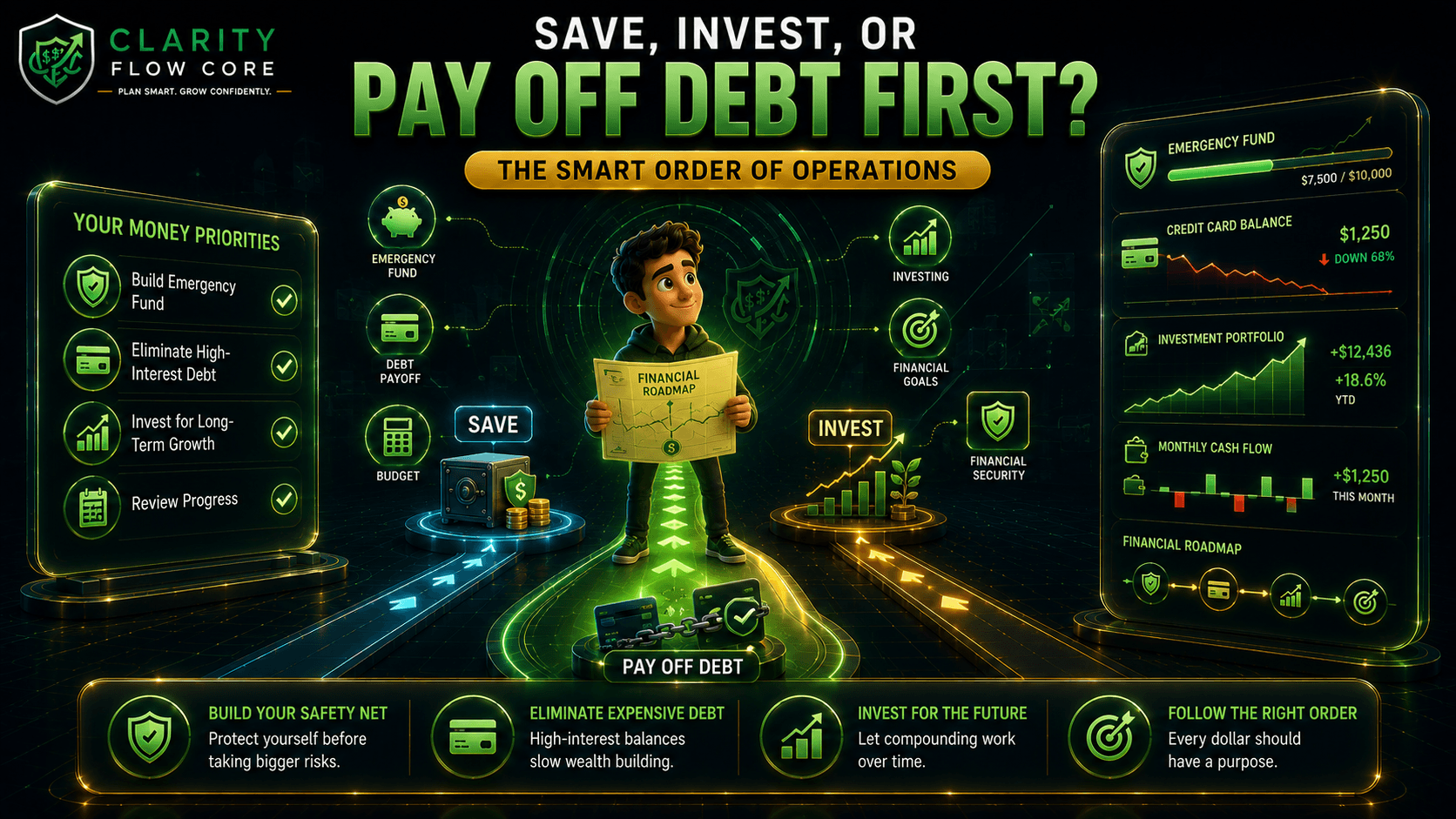
Phase 1: The Order of Operations
You cannot build a house on a sinking foundation. Your financial life requires you to secure your basic survival before you attempt to build long-term wealth.
The Priority Matrix
The step-by-step roadmap for your next dollar.
Step 1: The Safety Net
- The Action: Save a $1,000 to $2,000 starter emergency fund in a High-Yield Savings Account.
- The “Why”: If you aggressively pay down debt but have zero cash, the next flat tire will just go straight back onto a 25% APR credit card.
Step 2: Toxic Debt
- The Action: Pause all investing (except an employer 401k match) and ruthlessly attack high-interest debt (anything over 7% APR).
- The “Why”: The stock market averages a 10% return. If your credit card charges 24%, you are mathematically losing 14% every year you carry a balance.
Step 3: Wealth Building
- The Action: Once toxic debt is gone, expand your savings to a full 3-6 months of expenses, then invest aggressively.
- The “Why”: You now have no high-interest leaks. Your money can finally compound uninterrupted. Low-interest debt (like a 3% mortgage) can be paid slowly.
(For a deeper dive into establishing your initial buffer, read Building Your First $10,000 Emergency Fund: Step-by-Step Plan).
Phase 2: The Math Behind the Strategy
Personal finance is highly emotional, but the numbers never lie. When deciding between investing in a U.S. brokerage account or paying off a loan, you must compare the interest rate of the debt against the expected return of the investment.
- The High-Interest Trap (Anything over 7% APR): Credit cards, personal loans, and many auto loans fall here. There is no legal investment on earth that guarantees a 25% return. Therefore, paying off a 25% APR credit card is the equivalent of earning a guaranteed 25% return on your money, tax-free. Debt wins.
- The Low-Interest Leverage (Anything under 5% APR): If you locked in a 3% mortgage or a 4% student loan, the math flips. Over decades, a U.S. S&P 500 index fund averages roughly 10% annually. If you pay extra on a 3% loan instead of investing for a 10% return, you are sacrificing 7% of compound growth. Investing wins.
(Calculate your exact debt payoff strategy using the Debt Avalanche vs. Debt Snowball: Which Debt Payoff Method Works Better? guide).
Real-World Scenario: The Freelancer’s Dilemma
This priority matrix shifts slightly if your income is not guaranteed by a bi-weekly corporate paycheck.
Consider an independent U.S. freelance video editor who produces digital financial content. Their income is notoriously unpredictable—they might land a massive editing contract one month, and spend the next two months waiting on delayed corporate invoices while writing scripts for their own brand.
If this freelancer limits their Step 1 safety net to just $1,000 before attacking their $8,000 high-interest camera equipment loan, they are in extreme danger. A single delayed invoice will wipe out that $1,000 instantly, forcing them to take on even more high-interest debt just to cover rent and software subscriptions.
Because their cash flow is irregular, they must modify the rules. Their Step 1 “starter” fund needs to equal at least one full month of baseline business and personal expenses. Only after that larger safety buffer is secured in cash should they redirect all excess project profits toward eliminating the toxic equipment debt.
(If you manage variable income, structure your cash flow using the Best Beginner Budgeting Method for Irregular Income).
4 Deadliest Mistakes When Prioritizing Your Money
When deciding should you save, invest, or pay off debt first, avoid these four common traps:
❌ Turning down the employer match: If your company offers a 401(k) match, it is a 100% guaranteed return on your money. Even if you have credit card debt, you must contribute exactly enough to get the full match. Never leave free compensation on the table.
❌ Trying to multi-task: Sending an extra $50 to a savings account, $50 to an index fund, and $50 to a credit card feels productive, but it is highly inefficient. Financial velocity requires laser focus. Attack one step of the matrix at a time with everything you have.
❌ Waiting to be 100% debt-free to invest: You do not need to pay off your mortgage or your low-interest student loans before you start investing. If you wait until you are 45 to be entirely debt-free before buying your first stock, you will miss out on decades of compound interest.
❌ Confusing a limit increase with wealth: Paying off a credit card does not mean you now have extra spending money; it means you have extra cash flow to redirect immediately into your Phase 3 wealth-building goals.
Frequently Asked Questions
Should I drain my savings to pay off my credit card? Never drain it completely to zero. You must retain a minimum starter emergency fund (at least $1,000 to $2,000). If you drain everything to pay off a card, the very next unexpected expense will force you right back into high-interest debt, destroying your psychological momentum.
What if I have an interest-free promotional balance transfer? If you have a 0% APR period on a credit card, you must still treat it as a high-priority debt. If you do not pay the balance in full before the promotional period ends, many banks will retroactively charge you all the deferred interest. Treat it as a strict deadline.
Do I prioritize a Roth IRA or an Emergency Fund? The Emergency Fund always comes first. The stock market is highly volatile. If you tie your cash up in a Roth IRA and the market crashes right when your car breaks down, you will be forced to sell your investments at a loss just to pay the mechanic.
Your Action Plan
Stop spinning your wheels and dividing your extra cash into a dozen different buckets. Apply the order of operations today with these three steps:
- Audit Your Interest Rates: Log into every loan and credit card account you own. Write down the exact APR for each one. Anything above 7% is an immediate financial emergency. Map your debt using the Debt Payoff Calculator & Strategy Planner.
- Cap the Checking Account: If you have high-interest debt but are hoarding $15,000 in a checking account “just in case,” you are losing the math battle. Leave a 1-month buffer and use the rest to slaughter the toxic debt today.
- Automate the Sequence: Use the Smart Budget Planner & Cash Flow Analyzer to calculate exactly how much free cash you have each month and automate that exact amount toward your current priority step.
Sources & Further Reading
Official U.S. Guidelines & Consumer Resources
- Securities and Exchange Commission (SEC): Paying Off Credit Card Debt vs. Investing
- Financial Industry Regulatory Authority (FINRA): Managing Debt
Essential Tools from Clarity Flow Core
- Debt Payoff Calculator & Strategy Planner
- Smart Budget Planner & Cash Flow Analyzer
- Financial Safety & Emergency Fund Planner
- Investment Portfolio Planner & Goal Allocation Analyzer
Further Reading from Clarity Flow Core
- Emergency Fund vs. Paying Off Debt: Which Should You Do First?
- Debt Avalanche vs. Debt Snowball: Which Debt Payoff Method Works Better?
- Building Your First $10,000 Emergency Fund: Step-by-Step Plan
- Best Beginner Budgeting Method for Irregular Income
- 0% APR Balance Transfers: How They Actually Work
Disclaimer: The information provided in this article is for educational and informational purposes only and does not constitute financial, legal, or tax advice. Personal financial circumstances vary significantly. Always consult with a certified financial planner (CFP®) or a registered fiduciary before withdrawing investments, heavily altering your savings rate, or restructuring your debt.
About Author

Rishabh Nigam
Rishabh Nigam founded Clarity Flow Core to make personal finance easier to understand for everyday readers. He covers credit scores, debt repayment, credit utilization, loan readiness, taxes, and financial planning through practical guides, calculators, and educational resources. His content focuses on turning complex financial concepts into clear, actionable steps that readers can apply in real life.