
Credit Score Simulator: Explore How Credit Changes May Affect Your Score
Use the simulator below to explore how changes to balances, credit limits, payment history, and new credit may affect your credit profile.
What Does a Credit Score Tell You?
A credit score is a number generated by a credit-scoring model using information from a credit report.
It is designed to help lenders assess credit risk, but there isn’t one universal credit score.
Different scoring models can produce different numbers from the same underlying credit-report information. The score shown by a consumer credit-monitoring service may therefore differ from the score a lender uses.
FICO explains that its scores are calculated using information grouped into five major categories: payment history, amounts owed, length of credit history, new credit, and credit mix. The relative importance of these categories can vary depending on the individual’s credit profile. (myfico.com)
How This Credit Score Simulator Works
This credit score simulator lets you explore hypothetical changes to your credit profile before making a financial decision.
Depending on the scenarios supported by the tool, you may be able to model changes such as:
- reducing revolving balances
- changing credit limits
- adding or removing potential inquiries
- paying down debt
- maintaining positive payment history
- other changes supported by the simulator
The result is a scenario estimate, not a guaranteed score change.
Actual results can differ because scoring models consider the information on the entire credit report, and different models may react differently to the same change.
What Is a Good Credit Score?
There isn’t one score that guarantees approval or the best interest rate for every financial product.
FICO commonly uses the following ranges for its base scoring models:
| FICO Score Range | General Rating |
|---|---|
| 300–579 | Poor |
| 580–669 | Fair |
| 670–739 | Good |
| 740–799 | Very Good |
| 800–850 | Exceptional |
These ranges are useful for understanding a FICO score, but they aren’t universal approval categories for every lender or scoring model.
A lender can also consider your credit history, income, debt obligations, loan type, and other information when making a decision.
For additional context, read FICO vs. VantageScore: Why Credit Scores Differ Between Apps.
What Actually Goes Into a FICO Score?
FICO currently groups credit-report information into five major categories:
| Factor | Approximate Weight | What It Includes |
|---|---|---|
| Payment History | 35% | Whether you’ve paid credit obligations as agreed |
| Amounts Owed | 30% | Balances, utilization, and other debt-related information |
| Length of Credit History | 15% | Age of accounts and related history |
| Credit Mix | 10% | Different types of credit accounts |
| New Credit | 10% | Recent applications and newly opened accounts |
These percentages are commonly cited for base FICO scoring models. FICO also notes that the importance of the categories can vary by individual profile and that the calculation uses many pieces of information within each category. (myfico.com)
Don’t treat the percentages as a simple point formula.
For example, a 10-point change in utilization does not automatically produce a predictable number of score points because FICO scores are calculated from the overall information in the credit report.
Payment History: The Most Important FICO Category
Payment history is the largest category in the commonly published FICO weighting.
It considers information such as whether accounts have been paid on time and the severity, recency, and frequency of negative payment information. (myfico.com)
For that reason, consistently making payments on time is one of the most important long-term credit habits.
A late payment should also be understood in context.
A payment that is a few days late can result in a late fee under the card agreement, but negative payment information generally isn’t reported to the credit bureaus as a 30-day late payment until it reaches that threshold.
The consequences of a reported late payment can vary according to the rest of the credit profile.
Amounts Owed and Credit Utilization
The FICO Amounts Owed category accounts for 30% of the commonly published weighting for base FICO models. Credit utilization is one component of this category. (myfico.com)
Credit utilization generally refers to the amount of revolving credit you’re using compared with your available revolving limits.
For example:
$2,000 balance ÷ $10,000 total limit = 20% utilization
A lower utilization ratio can generally be favorable for credit scores.
However, there is no universal utilization percentage that guarantees a specific score.
You can explore utilization scenarios with our Credit Utilization Planner & Recovery System.
For more detail, read The 30% Credit Utilization Myth: What Actually Matters?.
Can Paying Down a Credit Card Raise Your Score?
It can, particularly when a reduction in revolving balances lowers the utilization information being reported.
But there is no universal formula such as:
“Pay $1,000 and gain 25 points.”
The effect depends on your complete credit profile, the balances being reported, the credit limits involved, the scoring model, and other information in your credit report.
FICO notes that the balance shown on your credit report can reflect information reported by the lender, which may not always equal your current real-time balance. (myfico.com)
That is why the simulator should be used to explore a scenario, not to expect an exact point increase.
Individual Card Utilization Can Matter Too
Your overall utilization isn’t necessarily the only information considered.
For example, suppose you have:
- $20,000 total available revolving credit
- $2,000 total revolving balances
Your overall utilization is:
10%
But suppose the entire $2,000 balance is on one card with a $2,200 limit.
That individual account has utilization of roughly:
91%
Credit-scoring models can consider information at both the overall and individual-account level. FICO specifically notes that the number of accounts with balances and utilization on revolving accounts are among the factors considered within its amounts-owed category. (myfico.com)
The exact effect on a score depends on the model and the rest of the profile.
Why Your Credit Score Can Change After Paying Off Debt
Paying off a loan or reducing a balance does not guarantee an immediate score increase.
A score can sometimes move unexpectedly after a debt is paid because the information on your credit report has changed.
For example, paying off an installment loan can change the mix or status of accounts reflected in the credit report. A score can therefore move in either direction depending on the individual’s overall profile and scoring model.
This doesn’t necessarily mean paying off debt was financially wrong.
Credit-score optimization and debt management are not always the same decision.
Use the simulator to explore the credit-score side of a decision, but also consider interest costs, cash flow, emergency savings, and your broader financial goals.
How Quickly Does a Credit Score Change?
There is no universal update schedule.
Your score can change after lenders or creditors report updated information to a credit bureau and that information is incorporated into a scoring model.
Different creditors may report at different times, and the three major credit bureaus may not always receive identical information at exactly the same time.
That means paying down a balance does not guarantee that your score will change on a specific day.
Instead of promising a particular number of days, use the simulator to understand the potential direction of a scenario and monitor your actual credit reports and scores afterward.
Three Practical Ways to Improve Your Credit Profile
1. Pay Your Credit Obligations on Time
Payment history is a major component of FICO scoring.
Set up reminders or automatic payments so that required payments are made by their due dates.
If you’ve already missed a payment, bringing the account current and continuing to pay on time can help establish a stronger payment history over time. FICO notes that recent and severe late-payment information can have greater impact than older or less severe negative information. (myfico.com)
2. Manage Revolving Balances
High revolving utilization can negatively affect credit scores.
Consider paying down balances when doing so fits your overall financial situation.
Don’t drain your emergency savings simply to chase a small potential score improvement.
Use the Credit Utilization Planner to model your revolving balances.
3. Apply for New Credit Selectively
Applying for new credit can create hard inquiries and can also change the age and composition of your credit accounts.
FICO says its new-credit category considers recent inquiries and newly opened accounts, and that several new accounts in a short period can represent greater risk, especially for people with limited credit histories. (myfico.com)
That doesn’t mean you should never apply for credit.
It means you should apply when the account serves a real financial purpose.
Should You Request a Higher Credit Limit?
A higher credit limit can reduce your utilization ratio if your balances remain unchanged.
For example:
$1,500 balance ÷ $3,000 limit = 50% utilization
If the limit increases to $6,000 while the balance remains $1,500:
$1,500 ÷ $6,000 = 25% utilization
That mathematical change can be helpful for the credit-utilization portion of your profile.
However, a credit-limit increase isn’t automatically beneficial.
The issuer may conduct a hard inquiry depending on its policies, and a higher limit could encourage additional spending that increases your balance.
Before requesting an increase, check the issuer’s disclosure to determine how the request may be handled.
For a detailed guide, read How to Increase Your Credit Limit Without Hurting Your Credit Score.
What About Becoming an Authorized User?
An authorized-user arrangement can sometimes affect the authorized user’s credit profile because information about the account may be reported to the credit bureaus.
However, the effect isn’t guaranteed, and the treatment can depend on the scoring model, the issuer, and what information is reported.
If you are considering this strategy, choose someone you trust and understand that the account’s reported history can affect the authorized user’s credit profile.
Don’t describe authorized-user status as a way to guarantee a score increase or to “copy and paste” another person’s credit history.
When Credit-Score Strategies Can Backfire
Credit optimization only makes sense when it supports your broader financial health.
A Higher Credit Limit Can Backfire
A higher limit can lower utilization if spending stays constant.
But if the higher limit leads to additional debt, the strategy can work against you financially.
Paying Down a Balance Can Compete With Your Emergency Fund
Reducing a credit-card balance can help utilization, but using every available dollar to pay debt can leave you without cash for an unexpected expense.
Consider both goals.
Use our Emergency Fund Calculator to estimate an emergency savings target.
Closing a Credit Card Can Change Your Profile
Closing an account can reduce available revolving credit and may affect your utilization.
It can also affect your credit history over time.
That doesn’t mean every old card should remain open forever. Annual fees, inactivity, security concerns, and other factors can make closing an account reasonable.
Make the decision based on the full financial picture rather than score optimization alone.
Should You Carry a Credit-Card Balance to Build Credit?
No.
You don’t need to pay interest to build credit.
Carrying a balance from month to month can create unnecessary interest costs. Paying your statement balance in full when you can afford to do so can help you avoid purchase interest when the card’s grace-period terms apply.
The goal is responsible account management—not paying the lender interest simply to generate a credit score.
For more on this topic, see How to Build a Strong Credit Profile Without Paying a Dime in Interest.
Does Checking Your Own Credit Score Hurt It?
Generally, checking your own credit report or credit score is a soft inquiry and does not lower your credit score.
A hard inquiry occurs when a lender or creditor accesses your credit report in connection with a credit application. FICO explains that inquiries associated with new credit can be considered within the new-credit category. (myfico.com)
Using this simulator also does not create a hard inquiry because the tool isn’t submitting a credit application or pulling your credit report.
Why Is My Credit Score Different on Different Apps?
There are several reasons your displayed score can differ.
Different Scoring Models
FICO and VantageScore use different scoring methodologies.
Different Model Versions
Even within FICO, lenders can use different model versions depending on the product and industry.
Different Credit Reports
The three major credit bureaus may receive information from creditors at different times, and not every report necessarily contains identical information.
Different Update Dates
A score may be calculated using information that was updated at a different time from the information used for another score.
For more explanation, read FICO vs. VantageScore: Why Credit Scores Differ Between Apps.
Credit Score Simulator vs. Your Actual Credit Score
The simulator is designed to answer a question like:
“What might happen if I change this part of my credit profile?”
It does not answer:
“What exact score will I have next month?”
Your actual score depends on the scoring model and the information in your credit report when that model calculates the score.
Think of the simulator as a scenario-planning tool, not a replacement for your actual credit report or lender-provided score.
How to Use the Credit Score Simulator
For the most useful result:
Start With Your Current Information
Use your current balances, limits, payment history, and other relevant information supported by the tool.
Change One Major Variable at a Time
For example, compare:
Current utilization
versus
Lower utilization
This makes it easier to understand what the scenario is changing.
Compare Multiple Scenarios
You might compare:
- paying down one card
- paying down multiple cards
- requesting a higher limit
- avoiding a new application
- maintaining the current profile
Compare Score Impact With Financial Impact
A scenario that potentially helps your score isn’t automatically the best financial decision.
For example, paying down a card with a 25% APR may have a very different financial benefit from paying down a card with a 0% promotional APR.
Building Credit From Scratch
If you don’t have an established credit history, the priorities are different from someone who already has several accounts.
Focus on:
- opening appropriate credit accounts
- making payments on time
- avoiding unnecessary applications
- keeping revolving balances manageable
- giving your accounts time to establish history
FICO states that a valid FICO score generally requires at least one account that has been open for six months or more and at least one account reported to a credit bureau within the past six months. (myfico.com)
For a step-by-step guide, read How to Build Credit From Scratch in 2026.
If Your Credit Score Has Fallen
Don’t assume one bad month means your credit profile is permanently damaged.
Start by identifying the underlying issue.
High Revolving Utilization
Review your balances and limits.
Use our Credit Utilization Planner.
Missed Payment
Get the account current and continue making payments on time.
See How Long Do Late Payments Stay on Your Credit Report?
Too Many Recent Applications
Pause unnecessary applications and allow your profile to stabilize.
See 10 Credit Score Mistakes That Can Cost You 100+ Points.
Errors on Your Credit Report
Review your credit reports for inaccurate information and dispute information that you believe is incorrect.
For a practical guide, see How to Read and Fix Errors on Your Credit Report.
Credit Score vs. Financial Health
A credit score is useful, but it isn’t a complete measure of financial health.
Someone can have an excellent credit score while carrying expensive debt and having little emergency savings.
Someone else can have a developing credit profile while maintaining strong cash reserves and a healthy budget.
That’s why Clarity Flow Core treats credit scoring as one part of broader financial planning.
You can review your wider financial position with our Financial Health Score & Annual Checkup Planner.
Related Financial Planning Tools
Credit Utilization Planner & Recovery System
Explore your revolving utilization and potential payoff scenarios.
Open the Credit Utilization Planner
Debt-to-Income Ratio Calculator
Compare your monthly debt obligations with your gross income.
Debt Payoff Calculator
Compare potential debt-repayment strategies and see how different payments affect your balances.
Open the Debt Payoff Calculator
Emergency Fund Calculator
Estimate a cash reserve based on your essential expenses and circumstances.
Open the Emergency Fund Calculator
Financial Health Score
Review broader aspects of your financial position beyond your credit score.
Open the Financial Health Planner
Recommended Reading
Credit Scores & Credit Reports
- FICO vs. VantageScore: Why Credit Scores Differ Between Apps
- 10 Credit Score Mistakes That Can Cost You 100+ Points
- How Long Do Late Payments Stay on Your Credit Report?
- How to Read and Fix Errors on Your Credit Report
- How Many Credit Cards Should You Have for the Best Credit Score?
Credit Utilization & Debt
- The 30% Credit Utilization Myth: What Actually Matters?
- How Much Does Credit Utilization Affect Your Credit Score?
- Credit Utilization vs Payment History: Which Matters More?
- How to Increase Your Credit Limit Without Hurting Your Credit Score
- Debt Avalanche vs. Debt Snowball: Which Debt Payoff Method Works Better?
Building Credit
- How to Build Credit From Scratch in 2026
- How to Build a Strong Credit Profile Without Paying a Dime in Interest
- Best Credit Cards for Beginners
- Best Secured Credit Cards for Beginners in 2026
Those URLs are taken from the Clarity Flow Core article inventory you supplied earlier.
Frequently Asked Questions
How much can my credit score increase by paying down debt?
There is no universal number of points.
Paying down revolving debt can reduce reported utilization and may improve a credit score, but the effect depends on the rest of your credit profile and the scoring model being used.
The simulator can help you explore a scenario, but it cannot guarantee an exact point increase.
How quickly will my credit score change after paying down a card?
The timing depends on when the creditor reports updated information, when the credit bureau receives and processes it, and which scoring model is used.
There is therefore no guaranteed number of days or a universal 30-day or 45-day update period.
Does checking my own credit score lower it?
Generally, no.
Checking your own score is treated as a soft inquiry and does not lower your credit score. A credit application that results in a hard inquiry can have a temporary effect.
Why is my Credit Karma score different from my lender’s score?
Consumer apps and lenders may use different scoring models, model versions, credit reports, and update dates.
FICO and VantageScore also use different scoring methodologies.
A difference between two scores does not automatically mean one of them is wrong.
Should I pay off my credit card before the statement closes?
Reducing a balance before it is reported can potentially lower the balance appearing on your credit report, but the exact reporting date varies by creditor.
Don’t move money out of an emergency fund simply to optimize a reported balance unless doing so makes sense for your overall finances.
Should I request a higher credit limit?
A higher limit can reduce utilization if your spending and balance remain unchanged.
However, the issuer may evaluate the request using a hard inquiry depending on its policies, and a higher limit can create additional temptation to spend.
Review the issuer’s terms before requesting an increase.
Does becoming an authorized user improve my credit?
It can affect your credit profile when the account is reported, but the impact isn’t guaranteed and can vary by scoring model and account information.
The primary cardholder’s payment behavior and reported balances can also affect the account’s information appearing on your credit report.
Should I close a credit card after paying it off?
Not necessarily.
Closing an account can reduce your total available revolving credit and may change your utilization. Over time, it can also affect your credit-history profile.
But keeping an account open isn’t always the right choice if it has an expensive annual fee, security concerns, or other disadvantages.
Make the decision based on the complete financial picture.
Do I need to carry a balance to build credit?
No.
You don’t need to pay interest to build credit. Responsible use and on-time payments matter more than carrying a balance from month to month.
How long does it take to build a credit score from scratch?
FICO states that a valid FICO score generally requires at least one account to have been open for six months or more and at least one account reported within the past six months. (myfico.com)
Building a strong credit profile can take longer.
Consistency matters more than trying to force a particular score by a particular date.
Does paying off a loan hurt your credit?
Paying off debt is generally a positive financial step, but the resulting change in your credit score can vary.
Closing or paying off an installment account can change the information used by a scoring model.
A temporary score change doesn’t necessarily mean that paying off the loan was a bad financial decision.
How This Credit Score Simulator Works
This simulator models potential credit scenarios using the information and assumptions built into the tool.
It is designed to help you compare possible outcomes before making a financial decision.
The simulation does not access or change your credit report and does not submit credit applications.
Because actual credit scores depend on the scoring model and the information contained in a credit report, simulated results can differ from the score you eventually see.
Use the simulator as a scenario-planning tool, not as a prediction of your future lender score.
Sources & Verification
Our credit-scoring guidance draws primarily from:
FICO
FICO explains the major categories used in its scoring models, including payment history, amounts owed, length of credit history, new credit, and credit mix. (myfico.com)
FICO — What’s in my FICO Scores?
FICO — How New Credit Impacts Your Credit Score
FICO — How Payment History Impacts Your Credit Score
FICO — How Owing Money Can Impact Your Credit Score
FICO — How to Build and Improve Your Credit Score
Consumer Financial Protection Bureau
The CFPB provides consumer information about credit reports, credit scores, and inquiries.
CFPB — Credit Reports and Scores
How We Update This Tool
We review the educational content and material assumptions used by the simulator when updating this page.
Credit-scoring models, scoring versions, lender practices, and reporting information can change.
Important Limitations
This simulator provides hypothetical estimates, not guaranteed score changes.
It cannot determine:
- your exact future credit score
- the exact score a lender will use
- whether you will be approved for credit
- the interest rate you will receive
- how every scoring model will react to a particular action
Actual results can vary based on your complete credit profile, the information reported by creditors, the scoring model used, and when the information is reported.
Disclaimer
The information provided by Clarity Flow Core and this Credit Score Simulator is for educational and informational purposes only and does not constitute financial, investment, credit, legal, or lending advice. Simulator results are hypothetical estimates based on user-provided information and the assumptions built into the tool. They do not guarantee a future credit score, lender decision, loan approval, interest rate, or other financial outcome. Individual circumstances and credit-scoring models vary, and readers should consider their own financial situation and consult a qualified professional when appropriate.
About Author

Rishabh Nigam
Rishabh Nigam founded Clarity Flow Core to make personal finance easier to understand for everyday readers. He covers credit scores, debt repayment, credit utilization, loan readiness, taxes, and financial planning through practical guides, calculators, and educational resources. His content focuses on turning complex financial concepts into clear, actionable steps that readers can apply in real life.
Free Credit Score Simulator & Improvement Planner
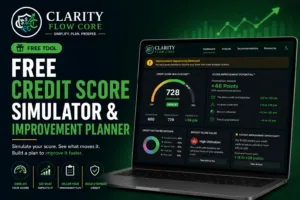
Use our free credit score simulator to see exactly how paying off debt, increasing limits, or new inquiries will impact your FICO score.
Price Currency: USD
Operating System: Web Browser
Application Category: WebApplication